The Hexacoto

Listening to the sound of one hand clapping

On copyrights and conlangs

One would imagine that if someone invented a language for use in a creative work, that someone could retain copyrights to the use of the language, would he or she not? According to U.S. case law, that might not be so, in the opinions of the Language Creation Society (LCS), a nonprofit organisation created for the promotion and discussion of constructed languages (conlangs). LCS submitted an amicus curiae — unsolicited advice to the courts for pending cases — to the Paramount v. Axanar case, where Paramount Pictures sued Axanar Productions for infringing various parts of its intellectual property over a fan-produced film Prelude to Axanar. These include: Vulcans, likeness of Vulcans, Romulans, uniforms with gold shirts, triangular medals, etc etc., and The Hollywood Reporter has more information on how Axanar is planning to respond to each claim.

What caught my interest was that Paramount laid claim to the Klingon language, which got me thinking: “Can conlangs created for the purpose of creative works be copyrighted?” Paramount has claimed the copyright to the Klingon language, its vocabulary and its graphemes but LCS believes that its claims will not hold in the court of law — indeed, anyone can claim copyright to anything but it is only when copyrights are challenged in courts that they are found to be valid or otherwise.

Citing an 1879 case Baker v. Selden, LCS said that while reproductions of creative works are protected by copyright laws, no laws exist to prevent individuals from using systems and creating their own derivative works with it. Baker v. Selden was a case where Selden created a system for bookkeeping and wrote books about it, hoping to sell the ideas to counties and the government. However, he was unsuccessful. Later on, Baker produced a book on bookkeeping that had systems very similar to Selden’s. Selden’s estate sued Baker, but the courts ruled that:

“[W]hilst no one has a right to print or publish his book, or any material part thereof, as a book intended to convey instruction in the art, any person may practice and use the art itself which he has described and illustrated therein… The copyright of a book on book-keeping cannot secure the exclusive right to make, sell, and use account books prepared upon the plan set forth in such a book.”

Thus Klingon as a language cannot be copyrighted, especially given its status where not only its creator Marc Okrand but also various scholars have contributed to the development and expansion of Klingon. Upon the establishment of linguistic rules of Klingon — syntax, phonology, morphology, etc — the language takes a life of its own and it would be unthinkable that a copyright holder could lay ownership to all and any subsequent derivative works from using that language. LCS cites the translated works of Shakespeare’s Hamlet and the Epic of Gilgamesh into Klingon, not to mention the technically somewhat-valid native speaker of Klingon, Alec d’Armond Speers, as proof that Klingon is a robust-enough language and trying to enforce copyrights to it would be unreasonable. It would be akin to enforcing a copyright on Esperanto today.

Moreover, the movie Prelude to Axanar isn’t ripping Klingon dialogue verbatim in their fan film, but devising dialogue based on using the Klingon language system. Indeed, besides Baker v. Selden, LCS is citing many other case laws to their effect that Klingon is a free language that cannot be copyrighted, and if anyone’s interested should check out the amicus brief (linked at the top of this post and also embedded below). The brief is also replete with lots of Klingon phrases written in Klingon script and accompanying footnotes, which I think is hilarious but probably not very amusing to the presiding judge.

So what does this mean? Feel free to write your fan-fiction in Quenya, Sindarin, Klingon, Na’vi or even that Atlantean language that Marc Okrand also created for the Disney movie Atlantis: The Lost Empire. As long as one isn’t merely ripping off dialogue (reproduction) but can prove that the utilised language is a product of using the language systems to derive original work, copyrights to the language are unenforceable. Granted, this is merely my opinion, but other folks have voiced similar sentiments (I liked this and this from LCS member Sai), and they’re worth checking out if you’re interested in copyrights and conlangs. We’ll see May 9th how the courts rule, and hopefully it’ll be in the favour of language hobbyists and enthusiasts.
“That’s something we write for white people”

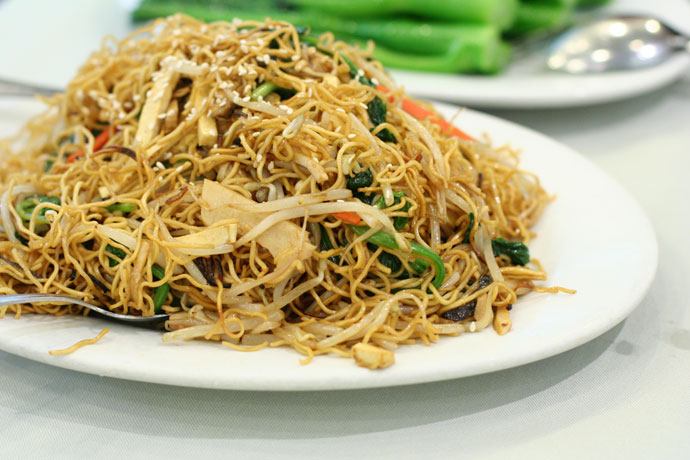
chowmein

I know, I am super late to the game. Everyone worth his or her salt and MSG has already written about Calvin Trillin’s piece about Chinese food “Have They Run Out of Provinces Yet?” in the New Yorker.

I was quite nonplussed at his poem; it was a fairly tasteless poem, at best skirting around blandly with race while trying to give the impression that it was edgy and exciting. However, I was rather intrigued by the second stanza.

Now, as each brand-new province appears,
It brings tension, increasing our fears:
Could a place we extolled as a find
Be revealed as one province behind?
So we sometimes do miss, I confess,
Simple days of chow mein but no stress,
When we never were faced with the threat
Of more provinces we hadn’t met.
Is there one tucked away near Tibet?
Have they run out of provinces yet?

I’ll explain why that stanza piqued my interest after this fun story:

Near where I live, there’re a couple of Chinese takeout places. One claimed to be Hunan, but was probably about as Hunan as Trillin’s piece was insightful. Maybe the owners were indeed from Hunan, and that Hunan takeout restaurant merely meant “Hunan people making Chinese American food for people”. In fact, my neighbourhood being primarily Caribbean, Haitian and African American, their best seller, aside from General Tso Chicken Special, was actually fried chicken wings with french fries. Every time I go in there and wait for my order, most of the clientele would order “Fried Chicken Wing w FF”. I was probably the only one who bothers to look at the menu.

One night, after work, I was feeling kinda lazy and I just wanted Chinese takeout. As anyone in the U.S. knows, on Chinese takeout menus, under the noodles section there are usually “chow mein” dishes. I had no idea what chow mein was exactly, but since I speak Mandarin, I assumed it was simply fried noodles, because it sounds like “chao mian” (炒面). In my experience of ordering fried noodles, they’re usually fried wheat or egg noodles. So I went up to the acrylic-shielded counter and ordered in Mandarin, “I’ll have an order of barbecue pork fried noodles (叉烧炒面), number 18.”

She responded back in Mandarin, “Number 18? Oh you want fried rice vermicelli (炒米粉, chao mi fen)?”

I was confused. I asked, “Hang on, doesn’t number 18 say ‘chow mein’? That’s fried (wheat/egg) noodles, right?”

“Ohh. no,” she said. “That ‘chow mein’ is simply something we write for white people. While ‘chow mein’ does sound like fried noodles, it actually refers to rice vermicelli here. White people order ‘chow mein’ and get rice vermicelli and they don’t know the difference anyway.”

“Ah, I see. Uh, ok, so can I get the barbecue pork fried vermicelli then?”

“Sure thing.”

“So who orders the chow mein if most of the people here order fried chicken wings and french fries?”

“White people.”

“Oh, I see.”

“Simple days of chow mein but no stress,/When we never were faced with the threat/Of more provinces we hadn’t met.”? Trillin, I was pretty stressed out ordering that chow mein. I went into that Hunan takeout place expecting to go home with an order of fried egg noodles and left with an order of fried rice vermicelli instead. I’m not sure if universally in New York chow mein is always rice vermicelli, because some of my friends attest to them actually getting egg noodles, but they always order in English. In another Chinese eatery (cha chan teng) in Chinatown, I saw a sign for chow mein, but it was thankfully accompanied by the Chinese characters for rice vermicelli. I confidently ordered the chow mein this time expecting rice vermicelli.

It’s hard enough to be an expert on Chinese food, even as a Chinese person. But Trillin, when you claim that life might have been better in the simple chow mein days, I’m afraid you’ve simply been eating rice vermicelli all along, and it’s hard for me to take you seriously.

Notes on how to pronounce Malay words in ‘Semoga Bahagia’

Singaporean musical group The TENG Ensemble did a cover of one of my favourite childhood songs, “Semoga Bahagia,” which translates loosely from Malay into “wishing you happiness” or according to Wikipedia, “May you achieve happiness.” Their use of traditional Chinese instruments for the song makes for a wonderful arrangement, led by local indie singer Inch Chua, who sounds great.

However, and some have noticed and commented on the ensemble’s Facebook post about the video, Chua does not quite get the pronunciations of the words right. Chua’s pronunciation is a highly Anglicised/Americanised vowel/consonant map, informed by her Chinese background. If the TENG Ensemble ever wishes to redo their video — and I think they’ve indicated their interest in doing so — here’s my notes on how to get the Malay words right. An understanding of IPA transcription will help in understanding this post better but even if not, I’ll try to transcribe it in an easily understandable format.

Note 1: The Malay language uses flapped/tapped r’s (/r/), which is similar to the r’s in Spanish, Japanese, and many other languages in the world. It does not use the rhotic r (/ɹ/) English uses.

Note 2: Vowels in spoken Malay tend to be preserved in their lengths and rarely shortened unless spoken very fast. Therefore words like “jiwa” should sound like “jee-wah” (/dʒiwa/) rather than “juh-wah” (/dʒɪwa/). When singing, it’s especially important to preserve the vowels since they become very apparent when shortened.

Note 3: Malay does not usually do aspirated consonants. There is strong aspiration in Chua’s d’s in “pemudi-pemuda,” which is how we usually pronounce d’s in English. Thus the Malay “d” sounds different from the way one would pronounce “dog” in English, which has an audible breathy release in the initial consonant. (Contrast the d consonant in “dog” vs. “dandan 淡淡”)

Note 4: In Malay orthography, “ng” is the velar nasal (/ŋ/), even if it’s between two vowel. Thus “dengan” is “duh-ng-an” and not “deng-gan.” (/dəŋan/) Same with “c” it’s a postalveolar affricate (/tʃ/) as in “ch-urch” and never an “s” sound.

And now for the second-by-second analysis! My comments will be in the form of (observation); followed by suggestion if applicable.

  • Pandai cari [0:35] — rolled r; do flapped r instead.
  • pelajaran [0:39] — rolled r; do flapped r instead.
  • jaga diri [0:46] — rolled r; do flapped r instead.
  • kesihatan [0:49] — Chua said kAH-see-ha-tan; kuh-see-haa-tan, preserve e vowel, don’t aspirate t.
  • Serta sopan santun [0:53] — mispronounced, rolled r; SER-TA sopan santun.
  • dengan [0:58] — good job on de-NG-an!
  • bersih serta suci [1:23] — rolled r; do flapped r instead, preserve all r’s.
  • hormat dan berbudi [1:27] — rolled r; do flapped r instead.
  • jaga tingkah [1:29] — k consonant dropped; preserve the k sound in tingkah, but lightly released.
  • Capailah [1:38] — diphtong aɪ changed to vowel a; don’t drop the i in ca-pAI-lah.
  • pemudi-pemuda [1:42] — aspirated d’s; don’t aspirate d, especially audible in pemuDA.
  • kita ada harga [1:48] — rolled r; do flapped r instead.
  • di mata dunia [1:50] — good job on the d! This is the example of the unaspirated d.
  • kalau kita [2:10] — a vowel changed to e (/a/ to /ə/); preserve A vowel, kAH-lau instead of kUH-lau.
  • lengah [2:12] — added a g consonant; there is no g consonant, it’s pronounced le-ng-ah, not len-gah.
  • serta [2:13] — rolled r; do flapped r instead.
  • hidup [2:15] — Chua said he-daap (/hidap/); it’s pronounced he-doop (/hidup/)
  • sia-sia [2:16] — Chua said saya-saya (/saɪya-saɪya/); it’s see-ah see-ah (/sia-sia/)
  • jiwa [2:19] — Chua said juh-wah (/jəwa/); preserve all vowels, it’s pronounced jee-wah
  • besar sihat serta segar [2:19] — rolled r; do flapped r instead.
  • dengan (2:23) — good example of dengan.
  • perangai pemudi [2:28] — rolled r, aspirated d; do flapped r instead, don’t aspirate d.
  • cergas [2:31] – Chua said sergas, rolled r; it’s pronounced CHeRgas, ch consonant, do flapped r instead
  • suka rela [2:35] — rolled r; do flapped r instead.
  • berbakti [2:37] — rolled r; do flapped r instead. This word is also an example of unreleased ‘k’
  • sikap yang pembela [2:38] — vowel was changed to p-uhm-bUH-la (/pəmbəla/); preserve vowel, it’s p-uhm-bAY-la (/pəmbela/).
  • berjasa [2:41] — rolled r; do flapped r instead.
  • capailah [2:44] — see before
  • pemudi-pemuda [2:47] — see before
  • rajinlah supaya berjasa [2:52] — rolled r; do flapped r instead.
  • semoga bahagia [2:56] — bahagia was pronounced as bUH-ha-g-i-a (/bəhagia/); preserve the A vowel in “ba,” making it bAH-ha-gi-a (//bahagia/). It’s ok to break “gia” into “gi-a” for stylistic purposes but “ba” should remain “ba.” In Malay, “be” (/bə/) and “ba” (/ba/) are contrastive.

Hey, no one ever said Malay was easy, right?

Here’s an example of the song sung by a Malay person (I’m assuming) with all the right consonant sounds, although I think it’s interesting when he overdoes some of his r’s and turns it into a trill [0:33].

It’s a lovely touch that gives it a very folksy flavour, that I’ve heard sometimes older Malay Singaporeans do than younger ones. It’s not quite dissimilar in Japanese, where the flapped r can become a trilled r, called makijita (巻き舌 or rolled tongue), and it is sometimes associated with rural communities, and — interestingly — with the Yakuza and in war cries (“uorrrrrrryaa!”). Pay attention to how he pronounces his d’s, r’s, t’s, and k’s.

Hopefully this will help the TENG Ensemble and Inch Chua make a better second version of the song hitting all the right sounds of the wonderful Bahasa Melayu. After all, nobody wants to hear an ang-mor-cised version of our Chinese songs, do we?


(Woe…. da…. zheeeah.. gay woe! Eee shwaang zheeaan ding zhhh paaang….!!!)

Listening Comprehension: Fill in the empty spaces. (27 marks)

Lines

I cast a line, and I waited, not expecting a response.
But, lo! A bite!
You called me by a familiar name, a name from a time thought foregone.
I reeled; could it be?
That no matter the time lapsed, distance spanned, silences met,
that things were as they should have been?
But I knew better: time ravages, distance cools, silence forgets
And pulled in to meet with trembling hands and a clamoring heart.

Captain

You spoke of how you thrashed, how you were lashed
by forces that had you trundled, trussed, and tried.
Blinded beyond belief, beyond benefaction — barking madness.
Bye,” you said, as I remembered, back then,
back when you cast yourself afloat.
And I cried as I heard your tale,
sorrowed that I could not sail with you
during your stormy seas.

Colours

“Have you heard about colours?” you asked.
“They can be quite therapeutic,” you said
through a new veil of age and wisdom.
And so I sat in silence for hours,
drawing out lines and figures
dashing out spaces
despite my cramping hand
(whilst you worked),
so that I could give you something to fill in with colours
to repair the missing gaps in our lives.

20150909_145534

Aftermath of a Singapore Election

The sun rose, as it always did, but one would not have noticed it. It hid behind a haze, some say the courtesy of Indonesia, but I know better. Hanging thick in the air was a calm that belied people’s true feelings from the frenzy of live tweets, climbing numbers, excitement and disappoint and clamour the night before.

An elderly Chinese man, pushing his bicycle along the foot of a HDB flat, walks up to an elderly Indian man. “Ehhh! PAP ar?” the Chinese man said, shaking the Indian man’s hand. “Ya,” replied the Indian man as they both shared a laughter, and then they parted ways.

The kopitiam was divided. Laughter and merriment rang from some tables, while nearby sullen tables glanced angry sidelong glares, with some shaking their heads.

Wa lau eh, why like that?” piped one.

Bo pian, what can we do?” said another, showing characteristic Singaporean spirit.

“Well, at least Lee Kuan Yew got what he wanted before the ghost gates closed. I guess his spirit can now return in peace.”

“Eh, I ask you ar, do you think his spirit went to heaven or to hell ah?”

Aiyoh, you think leh?”

“…aiyah my GRC no fight one lah! But then hor, I still voted opposition anyway just to show them what for!”

“I know it’s not going to make a difference, but I don’t want the PAP to become too complacent mah. They cannot keep on doing what they’re doing without answering to anyone right?”

“But even if you did that, got change anything meh?”

“So you stay up until how late last night?”

“I stay until 12 midnight, then I buay tahan liao. Anyway next day wake up see the results, see on the spot, also the same what.”

“So what you think? Who did you vote for?”

Aiyoh I tell you then still call elections for what?”

Nearby, an incense paper shop owner gave instructions on how to burn the offerings as the Hungry Ghost Festival drew to a close.

And Singapore lived through another General Elections.

Corporeal Property

The coldness of your touch
makes me think that rigor mortis must follow
and indeed,
stiffness at a touch;
the flinch, the recoil,
like from a pistol,
shots fired, and a
blank
silence hits the floor.
And so many words, so many words
rapid-fire
ejected
to change the topic
so that you won’t have to deal with the issue
that you no longer love me.

Seaworthy, But A Worth Not Seen

A ship arrived in the city
No one is aboard
A massive liner that could carry thousands
Not a soul to be seen
The finest luxuries afforded
No silverware even touched
A ship arrived in the city
No one knows why it was there

“Where did it come from?”
“When did it come?”
“How did it get here?”
“Who brought it here?”
“Why did it come here?”
“What will we do with it?”

Perhaps we could scuttle it, said one, use its wood as kindling
Perhaps we could make a playground out of it, said another
Perhaps as a homeless shelter?
No one thought to use it as a ship

And so the city folk took their axes
And hacked the ship apart
They pried plank from frame, steel from heart
The ship wept salty tears
For the ship crossed leagues and leagues of sea
To see a city it has heard of
Of shining ports and great big lights
Where ships could be ships

How not to write your headlines

ibtuk

From the International Business Times UK site. Apparently IBT UK is a franchise of IBT Media, and that there are multiple IBT’s all around with no editorial links with each other. There’s IBT Australia, India, UK, and the vanilla IBTimes.com, based in New York. As someone who just wrote about this topic, I can tell you what is wrong with this headline.

Argentine President Fernandez did make a tweet that played on racist Chinese stereotypes while she was in Beijing, but she did not say that the “country’s stupidity is toxic.” What she did say was that her tweet, that so many Western media had jumped on and gotten outraged about, was so highly ridiculous and absurd that it could only have been construed as “humour,” or else it would have been a very toxic tweet — which was definitely not her intention.

I mean, she’s in Beijing trying to get the country to invest money in her ailing economy! While her tweet was ill-advised, it was definitely not ill-intentioned, and that IBT UK’s headline is the statement that is truly “toxic.”

The interview that never got published

bmission

As some of you may know, I am currently writing for the International Business Times. On the day the snowstorm was supposed to hit, I pitched a story wondering how various cities in the United States Northeast were going to help the homeless. I got to go to the historic Bowery Mission in Manhattan, and the operations director Matt Krivich was kind enough to show me around. Beyond that, he helped with my request to talk to one of the homeless who was seeking shelter from the storm.

I got to interview Gerald Hudson, an African-American Vietnam War veteran. As much as I wished I could have written the interview as it was spoken to me, I had to quote Hudson as I would in an article; that is in the third person. Here is how the interview went as Hudson and I spoke.


Me: Are you keeping warm from this storm?

Gerald Hudson: I’m just trying my best, man.

Me: Do you mind if I ask you a couple of questions?

GH: Sure thing! I just want to let you know, thanks to this Mission, I have the warmest equipment around.

Me: What do you mean by “warmest equipment?”

GH: A jacket, man. This Mission gave me a jacket.

Me: Is that the one you’re wearing right now?

GH: No way. I only wear that specially when I go out. I ain’t gonna wear that in here. Do you want me to show you?

Me: Is that alright with you?

GH: Sure! Come, follow me!

(We walk to the chapel)

GH: I’m a grateful man, and I’m always grateful for what this Mission has done for me.

(We walk to the pews where Hudson has his stuff. He lifts his bag off the pews, and hidden underneath is a nice brown jacket)

Me: That’s a very nice jacket.

GH: Yeah, it keeps me warm when I go out.

Me: So how did you know to come in here for the storm? Did someone tell you?

GH: No, I’ve been here for two weeks.

Me: Oh, so you didn’t just come in for the storm?

GH: Nah, I’ve been here for two weeks. But trust me I’m trying to get a place to live. The last time before that was six months ago.

Me: I’m sorry?

GH: I don’t want to be here too much. I’ve been here for two weeks, and the last time I had to be here was six months ago.

Me: Oh, Where were you during the time you were not here. Did you have a place to stay?

GH: Yea, kind of.

Me: What happened, if you don’t mind me asking?

GH: Bad things happened, violence and stuff. I’m just trying to get a permanent place to stay, you know that? But I’m just waiting for the right time for that to happen.

Me: I’m sure that will work out for you one day.

GH: I’m a vet, you know that? Vietnam War.

Me: I’m grateful for what you’ve done for the country, as I’m sure many others are.

GH: I came back, and I had a hard time. I’m at the epitome of… of… (can’t remember what he said here)

Me: Are you a religious man?

GH: I’m a believer, I’m a believer in God, in the Father, and that he will take care of me.

Me: Well I hope things work out for you.

GH: I hope so too. Hey man you know I gotta try, but would you by any chance…? (hand gestures) But I don’t think you can right?

Me: I’m sorry, I’m not supposed to give anything. I wish you all the best.

GH: Alright you take care too, God bless.

The TRUE reason why this blizzard is scary

stonest

#noescape