I just recovered from being bedridden for what was probably five days. I think I am ready to resume writing.
On a plus side, I am no longer unemployed! Granted, my job’s only a fellowship, and it’s only for six months currently, but I’ll take what I can get at this point.
I made shakshouka, but this post isn’t about the shakshouka. In fact, it’s about the pita in the background, which I made.
Did you know how cheap it is to make your own pita? Had I known how cheap it was, I’d never have bought those commercial pita. Plus, home-made ones are so much fluffier! Seriously, the initial crunch and then the yield of the white, soft fluffy interior is so luxurious, I could sleep in it.
Let me break down the cost it takes to make pita:
1 lb all-purpose flour costs maybe $1 – 1.50. A 1lb bag yields about 7 cups of flour. The recipe I used to make the pita uses 3.5 cups of flour to make 12 pita, so 24 pitas for $1 – 1.50.
3 packets of active dry yeast for $1, and it’s 1 packet for 12 pita, so 60 cents for 24 pita.
Salt, sugar, and olive oil, which are hard to calculate.
So it’s approximately $1.60 – $2.10 to make 24 pita, when most commercial pita sells for, I don’t know, $1 – 2 for 8? This makes it a cost of $3 – 6 for 24, nearly triple the price. Plus most commercial pita are quite tough and flat.
Sprinkle yeast over warm water in a mixing bowl and allow to stand until the yeast forms a creamy foam, about 5 minutes. Mix in 2 cups of flour, salt, and shortening; beat for 2 minutes with a fork. Stir in as much of the remaining 1 1/2 cup flour as needed.
Turn dough out onto a floured surface and knead until smooth and elastic, kneading in more flour if dough is sticky. Form into a ball, cover with a kitchen towel, and let rest in a warm area for 15 minutes.
Preheat oven to 500 degrees F (260 degrees C).
Divide dough into 12 equal portions; flour your hands and roll each piece into a ball. Cover dough balls with a kitchen towel and let rest for 10 minutes. Flatten the balls into rounds on a floured surface, cover with kitchen towel, and let rest 10 more minutes. Gently roll each dough ball into a circle about 6 inches in diameter on a floured surface. Place pita breads in a single layer on ungreased baking sheets.
Bake in preheated oven until the pita breads puff up, 3 to 4 minutes. Flip breads over with a spatula, return to oven, and bake 2 more minutes. Let cool on wire racks before cutting pita breads in half and gently separating tops and bottoms to form pockets for filling.
I didn’t have shortening, so I altered the recipe and used somewhere between 1/8 and 1/4 cup of olive oil instead. I ended up using all 3.5 cups of flour. The trick to fluffy pita is to really just give them time to rise. Total time taken is about 1 hour 20 – 30 minutes.
Of course I understand that not everybody has the luxury of time to splurge on making pita, when the convenience of just buying them from the store appeals so much more to the time-pressed. But I assure, that oh-so-soft fluffiness of home-made pita is worth it, the lack of preservatives in it makes it healthier too.
So I made a batch of 12, I’m not going to be able to finish all of it in one sitting. I figure it’ll keep fairly well in the fridge in a ziploc bag until when I need it. Now if you’ll excuse me, I’ve got some fluffy pitas to roll around in.
It was a geek overload over the weekend: not only was there the New York Comic Con, but it was also the launch of the new Pokemon game, Pokemon X/Y.
Let’s talk the Pokemon launch.
There was a launch event going on from 8 PM to 12 AM, where people in line can get their hands on the game. I’ve been waiting a long time, even obsessively checking Reddit forums for all the spoilers about the game (I effectively knew all the Pokemon there were in the game even before the game was officially released). I was most definitely going to the launch event to get a copy of the game.
I met up with a couple of friends, where we decided to play some Mario Party before going to the event at the Nintendo World store at Rockefellers Center. Friendships were broken inevitably, as people who play Mario Party are wont to do, but we left at 8 PM.
The queue had already circled around the block. Thankfully, but virtue of us being ninjas, we managed to ninja the line (cut the queue) just a tad.
So from 9 PM, we stood there, as I racked up so many Streetpasses, the Nintendo 3DS feature that allows one to exchange profiles with each other that can be used for the 3DS’s minigame, Mii Plaza, and I spent about 3 hours of non-stop trying to clear the Streetpass — it was honestly the first time I felt exhausted by it, when ordinarily I’d have been thrilled for any Streetpass.
At midnight, the line started moving. Rejoice! I was physically closer to getting a copy of the new Pokemon! Getting closer now, cleared a couple more Streetpasses, turned the block, great, is that the facade of the building??
Alack! Just as we were about to reach the front, someone came up the line with this news:
“I’m sorry, but from this point on, you’re not going to be able to get the game tonight.”
My heart swelled up from excitement, and promptly shattered into a million pieces.
I waited three hours in line with all that hype and was to leave the place empty-handed? There were mixed messages floating around as another person said that it is likely those in line with us would get the games, provided we wait perhaps another three to four hours or so. Meanwhile, those who had been waiting in line since 5 PM were gaily enjoying their stupid Pokemon games and stupid Pokemon launch event swag.
In consolation, they gave out Pokeball game card holders and some posters. I was not very consoled. But I left anyway, because I haven’t had dinner.
Particle tracks from a proton collision, image credits LiveScience
News of the Higgs boson came out a long time ago, and has been nicknamed by the media as the “God particle” as an accessible way of understanding what the particle is, much to the chagrin of many scientists. It has also been touted as the particle responsible for giving things mass.
Frankly, I didn’t quite understand it back then. Thus I sought to read up on it, and I learnt many surprising things about how it worked, and how many of the things the media said it did were untrue.
I stumbled upon the blog of theoretical physicist Matt Strassler, who tries to explain big science as painlessly as possible. His article, The Higgs FAQ 2.0, was immensely helpful in parsing out what the discovery of the Higgs boson really means and what the media touts it to be.
First and foremost: scientists aren’t particularly interested in studying the Higgs boson (particle). What they are really interested in is the Higgs field, which the discovery of the Higgs boson can help confirm that the field at least exists.
The media has been touting how the discovery of the particle will explain the building blocks of life and how matter come to be, but that really isn’t true. It isn’t the Higgs boson that gives mass to other particles, but the interaction of the other particles with the Higgs field itself.
What is the Higgs field then? The Higgs field is something that’s everywhere, measurable, and can be what’s called “zero” or “non-zero” on average. If it’s “non-zero,” it can have tangible physical effects on our world.
What’s so important about this is that because the Higgs field is non-zero in the universe, many particles have mass, including the electron, quarks, among others. “If the Higgs field’s average value were zero, those particles would be mass-less or very light. That would be a disaster; atoms and atomic nuclei would disintegrate. Nothing like human beings, or the earth we live on, could exist without the Higgs field having a non-zero average value.” Strassler writes in his FAQ.
The Higgs boson has been hyped up, while what’s really important, the Higgs field, has been ignored by the media
Strassler writes,
On the one hand, finding the Higgs particle is the easiest (and perhaps only) way for physicists to learn about the Higgs field — which is what we really want. In that sense, finding the Higgs particle is the first big step toward the main goal: understanding the properties of the Higgs field and why it has a non-zero average value.
On the other hand, our modern media world insists on generating hype. And since explaining the Higgs field and its role and its relation to the Higgs particle takes too long for a typical news report or interview, journalists, and people talking to them, typically cut the story short. So the Higgs particle gets all the attention, while the poor Higgs field labors in obscurity, protecting the universe from catastrophe but getting none of its deserved credit…
The many simple explanations of how particles, such as electrons, gain mass by moving through the Higgs field is wrong.
Strassler writes,
And so a particle’s mass is the same no matter what it is doing — stationary relative to you or moving relative to you. And that’s important, because a particle is always stationary relative to itself! so it always, from its own point of view, should have the same mass.
Analogies which refer to the particle’s mass as having something to do with the field being like molasses, or a room full of people, are problematic analogies because they make it seem as though a particle must be moving in order to feel the effect of Higgs field, whereas in fact that is not the case.
I started by looking at those analogies, but the one below explains it the best, even though it still has to use the analogy of “moving through it” to achieve the idea of achieving mass.
I would say a more accurate analogy might be: There is a room full of magical fat that coalesces onto people who exists in the room. A person X exists in this space, and he coalesces a light amount of magic weight on from the air; he can move around lightly. A person Y also exists in this space, and in his existence, he coalesces a lot weight on him; he moves around less lightly. A person Z exists in this space, but he is special and coalesces no magical fat on him at all, and he is able to zip about at speeds unthinkable to X and Y. The encumbering of the coalesced magical fat on the persons are the given mass. Thus, X has less mass than Y, and Z, akin to the speed of light, and having no magical, cumbersome fat on him at all, is mass-less.
The Higgs field is not the universal giver of mass
Strassler writes,
…the Higgs field is not the universal giver of mass to things in the universe: not to ordinary atomic matter, not to dark matter, not to black holes. To most known fundamental particles, yes — and it is crucial in ensuring that atoms exist at all. But there would be just as much interesting gravitational physics going on in the universe if there were no Higgs field. There just wouldn’t be any atoms, or any people to study them.
The Higgs field does not give an atomic nucleus all of its mass, and since the nucleus is the vast majority of the mass of an atom, that means it does not provide all of the mass of ordinary matter.
Black holes appear at the centers of galaxies, and they appear to be crucial to galaxy formation; but the Higgs field does not provide all of a black hole’s mass. In fact the Higgs field’s contribution to a black hole’s mass can even be zero, because black holes can in principle be formed from massless objects, such as photons.
There is no reason to think that dark matter, which appears to make up the majority of the masses of galaxies and indeed of all matter in the universe, is made from particles that get all of their mass from the Higgs field.
The Higgs field, though it provides the mass for all other known particles with masses, does not provide the Higgs particle with its mass.
That post becomes hard to understand further down the line, as Strassler uses mathematical equations to demonstrate how even if the Higgs field became zero on average instead of being non-zero, while electrons, quarks, neutrinos and W and Z particles, which are dependent on the Higgs field for their mass, would then become massless, Higgs particles still have mass, indicating that their mass must come from a different source, other than the Higgs field.
–
In all, understanding scientific breakthroughs is hard, especially when the media, in its bid to make it accessible to the general public, obfuscates or places unnecessary emphasis on the wrong things. This actually impedes the understanding of what’s actually important, and learning about how our world works.
A friend had dinner with a business partner, and asked me to tag along. I did, and eventually we talked about what I do. I said, I am trying to do journalism, but have had no luck breaking into the field yet.
Inevitably the question of “Why would you want to do journalism?” came up.
Frequently in the past, I would say, “When I was in high school deciding what I wanted to do in college and after that, I sat down and thought about what I liked. I was good at writing, and I liked travelling, and putting the two together, I came to the conclusion of journalism.”
However, that seemed like I wasn’t really all that interested in journalism, and that I was merely treading a path borne out of reasoning from what I was good at, passion notwithstanding. That night, at the dinner, I surprised myself and when I found myself giving a different answer.
“Why did I choose to do journalism? As I did my internships in journalism, and having to do research and keep up with the news, I realise that I really do enjoy knowing things about the world and telling people about it; I guess that makes me a news junkie. Reading and finding information, piecing them together to unravel threads of a story and being able to tell people about it is exciting to me. Only in a career in journalism do I get to grow along with it, and work isn’t merely work but a daily opportunity to learn and grow, and that is ultimately very satisfying to me.”
In this time that I am still not employed in the journalism industry, I am still trying my darndest best to keep abreast of the news, and producing content on this platform, keeping verisimilitude that I am doing journalism, still.
Would it have been easier to fold, and throw in the cards and go back home? Certainly, but I didn’t spend four years in college pursuing journalism (and linguistics) in the United States learning about journalism and the free press, only to go back home in an environment without free press and a general freedom of speech and expression. I didn’t travel over 9000 miles to learn to question, and to find answers, only to go back to a system where reporters have to be wary of reporting the “wrong thing.”
I left to feed my hunger and passion — I’m certainly not going back to kill it.
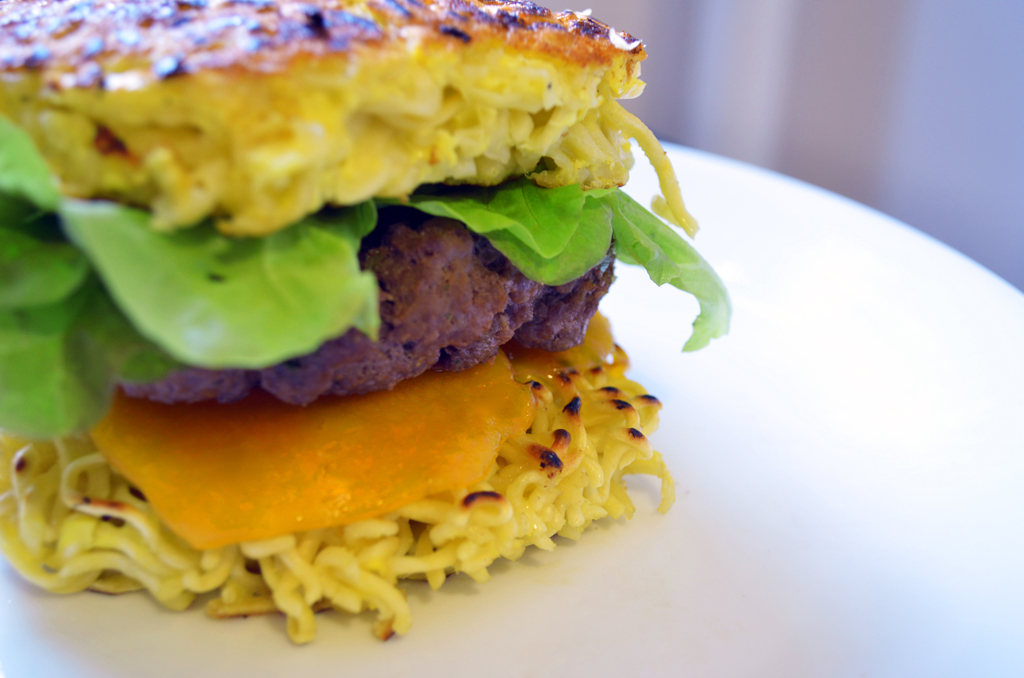
The instant ramen noodles are supposed to be quick, painless, and above-all, hassle-free. But when someone came up with the idea of turning ramen into burgers, what he ended up with was a craze that caught New York and the internet by storm.
Since they were introduced into the Western world (there have been several ramen burgers floating around Japan years already), people have put up recipes on how to make their own, since getting in line for one in New York takes hours.
I simply took one of the recipes online and made it, and I must say for the effort, the result was underwhelming.
It tasted alright; it took a little getting used to to biting into a soft noodle cake rather than a firmer bread bun, and implementing umami into the burger by adding scallions and soy sauce made it taste like the Asian meatballs my grandmother used to make.
But multiple skillets and pots were used in the process, many ramekins and much counter space were sullied in the attempt to create this — the exact antithesis of the instant ramen: mess-free.
Would I make it again? Maybe for a hoot to impress somebody. Would I make it again for myself? I don’t think I would.
Waking up was a non-traumatic affair; I slid out of bed easily, groggily perhaps, but without a fuss. Stumbling a little, I made my way to the kitchen and flooded the room with light. A pot on the stove, a hiss, three clicks and the roar of gas ignited as it rushes past the pilot flame and through the burner. Breakfast is being made.
I am preparing to go to work — today is the first day of my internship, and I am fairly excited. Fairly excited at having to wake up so early in the morning every day and perform the Rituals of the Working Man. Fairly excited at having found my way back to Path of Routine and Normalcy, as you did in the past with school and your previous internships.
After all, this internship validates my ability to stay in this country.
But I know that this isn’t normalcy, only the verisimilitude of it. This false routine does not change the fact that I am still without a job, and that I have not achieved what I came to this country for. Right now, I am merely pretending.
The inky blackness of night yields to a farmer’s blue of dawn.
What comes next? Oh yes, coffee, shower, change of clothes, go to work. The normal progression of things. Oh, and don’t get deported on the way out.
Today is marked pain, lots of pain. I woke up with a numb toe, and my back is somewhat stiff.
But today also marks the last day of the three-day NYC Unicycle Festival, and it would probably be another year before I get to see some of the people involved in the festival, or that many people coming together to practice unicycling. It might be another year before I get to play unicycle-hockey.
And thus, i return to Governor’s Island for the final day of the festival. Here’s with what I came home:
Sprained neck (can’t look to the left)
Skinned knuckles (right thumb and fourth finger)
Scraped shins
Scuffed elbow
Sore ankles
Scratches on my shoulder
Notice a bit of an alliterative pattern here?
Unicycle-hockey was intense because 1) The weather was incredibly humid and hot 2) The ground comprised cracks and loose gravel/sand 3) Some of the players weren’t particularly concerned if their sticks were hitting ball or human. Got roughed up a little there.
They changed up the unicycle-sumo rules, so that they are more in line with proper uni-sumo rules. Thus, instead of them rushing into the ring and knocking the opponent out with their weight and momentum, they’ve changed to using grappling to throw the opponent out of the ring or off of their unicycles, making the gameplay a lot more interesting to watch and participate. I had a lot of fun going against the Texans this time, even though I still lost to the person pictured above, as he still outweighed me, and I accepted my defeat. I still took some tumbles from uni-sumo, and added to the list of injuries suffered today.
I sat out of unicycle-football again because I didn’t want to die, and for the most part the day was less crowded than yesterday, and I took it pretty easy for the most part. I even had time to exchange pointers on doing pirouettes and discussing Asian-style freestyle.
I am sore all over, but I think it was worth it. This is the fourth year of the festival and coming back is like returning to a group of friends whom you know will be there. This year, they brought back unicycle-sumo, and introduced unicycle-football (American), played by a group of people who drove all the way up from Texas for this festival.
Unicycle-sumo and unicycle basketball were among some of the things I did, and they were interesting experiences, although the Texans who participated sort of made things kind of violent; their version of uni-sumo involved two sides simply ramming into each other from a distance, which isn’t really what uni-sumo is supposed to be.
I had a couple of scrapes from when I was bounced off my unicycle, for being severely out-weighted by the Texans. I challenged them to proper grappling rules (no ramming into your opponent, establishing hand contact before starting the match) and things became more evenly-matched.
I was roped into doing a makeshift performance with Kyle to open the skills demonstration. I guess my skills are getting recognised at this point? Looking forward to unicycle-hockey tomorrow; I’ve basically been waiting all year to be able to play it again.
There is nothing more heartening than a community recognising you and your name, even after what has been essentially a year since you last met or even talked.
The New York Unicycle Festival is now in its fourth year, and over time I have come to be recognised under a couple names, such as my own, or “Thundercalves,” or “that Asian person.”
On the first day of the festival, which was yesterday, there is usually a 13-mile ride from City Hall, Manhattan, across the Brooklyn Bridge into Coney Island. I usually end up leading the front simply because I go way too fast. This year, since I got a flat in my 29″ tire from my foray into Long Island, I was unable to join the long distance ride, but I took my 20″ and made it to the boardwalk by subway anyway, thinking that there might be an open-air demonstration of skills.
There wasn’t that, but there was Kyle Petersen’s show, which Shah’s dad kindly bought a ticket for me to go watch. The show was okay. I got a free ride on the Wonder Wheel!
But what I cherish most about this festival is always the familiarity of seeing friends, being recognised by them, and getting to hang out, chat, chat and exchange skills with people whom I’ve not seen in a year.
Today is the second day of the festival, on Governor’s Island. I’m going to be there to help out if they need help, and do some teaching if need be. Come to the island and attend the festival!






 The Hexacoto