The Cabbage Stripper

Once upon a time, there was a cabbage who wanted to be a stripper. And so it did. It started stripping and stripping and eventually died. The end.
–
This is the first part of a series of illustrated short stories.

Once upon a time, there was a cabbage who wanted to be a stripper. And so it did. It started stripping and stripping and eventually died. The end.
–
This is the first part of a series of illustrated short stories.
我好想念每当我被雨淋湿透时,回到了家门,阿嬤一定会问 “你有没有淋到雨?快点去换你的衣服。” 虽然我整身湿湿的,我的回答一定会是 “淋到一点。” 她就会重复 “快去换你的衣”,我就会说 “哦。”
我好想每次考完试时,回到了家,阿嬤就会问 “你今天考什么?” “文学” “考到怎样?” “可以啦。”
“你等下要吃什么?”
“随便.”
“下来吃饭!”
“哦。”
我不需要非常华丽的词来表达我心中的话。我阿嬤只会用简单的华语来说她要说的话。
(13 Dec 2009)
–
I miss whenever I get caught in the rain, when I reach home, Ah Ma will definitely ask, “Did you get caught in the rain? Quickly, go change your clothes.” Even though I would be completely drenched, my reply would always be, “Just a little bit.” And she would then repeat, “Go change your clothing.” To which then I would say, “Ok.”
I miss whenever I finished an exam, when I reach home, Ah Ma would ask, “What exam did you take today?” “Literature.” “How was it?” “It was ok.”
“What do you want to eat later?”
“Anything.”
“Come down for lunch!”
“Ok.”
I don’t need very fancy words to express the words in my heart. My Ah Ma can only use simple Chinese to say what she needs to say.
 Last night, I was chatting with someone who was doing a road trip through the Southern United States. He was in New Orleans, I think. As a joke, I said to him, “Watch out for the drop bears.” Which makes no sense because drop bears are from Australia anyway.
It turns out someone else also said to him, “Watch out for skunk apes.” That makes it two people who warned my friend of cryptids on his travels.
I was thinking, why can’t there be drop bears in New Orleans? If my friend could be a tourist there, surely drop bears can too.
Also, what are skunk apes? Looking them up, it is a bipedal ape-like creature that is incredibly smelly. A woman who supposedly sighted one believed it to be an escaped orang utan.
But unlike the skunk ape, drop bears are not cryptids, in that they are completely fictitious, created to tease tourists coming into Australia. According to Wikipedia, “various methods suggested to deter drop bear attacks include placing forks in the hair, having Vegemite or toothpaste spread behind the ears or in the armpits, urinating on yourself, and only speaking English in an Australian accent.”
I kind of really like the drop bear I created. I liked it so much I made it into a logo.

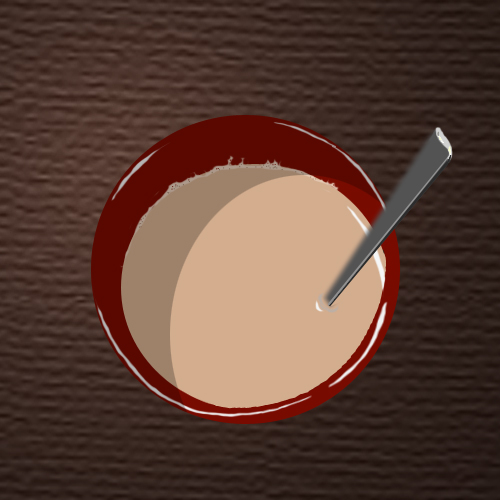 This evening, as I was sending out more job applications, I decided to make myself a cup of hot cocoa (technically, I made Milo, which is chocolate malt). After a while, I looked at my mug, and I realised that I could see the reflection of the ceiling lights off of the rim of the mug. I decided to look closer and then I noticed the edge of foam that looked like it was climbing out the side of the mug. Other things I noticed were that where spoon touched the liquid, the area around it was slightly darkened, and that the shadow of the top of the mug formed a neat crescent that bisected the cocoa.
I’ve never stared so hard at a mug of cocoa before, and I reckoned if I could see all these individual layers of detail, I must be able to illustrate them out.
I spent a long time trying to replicate each feature accurately: its colour, its location, its details. But after a while, staring so hard at these features, I started to forget that they were actually part of a mug of cocoa. In my excitement at being able to see fine detail, I forgot what the whole thing was.
Have I been similar in my job search? Although I’m trained in journalism and my speciality is international news, focusing only on getting positions that will land you where you were trained to do might have you forget that what you really want to do is write. Maybe applying for business writing isn’t a bad thing. Maybe writing about technology isn’t an end-all (But heavens forbid you write for the New York Post). What you need to be doing is to be moving, because you (I mean me, this is me speaking in second-person again) are currently being stagnant, and that needs to change.
Like what you teach people in unicycling, “Always keep moving. If you stop, you fall.” I should learn to take my own advice more often.
Persisting in fine-graining my search yielded the above snazzy illustration of my mug, but the hot cocoa turned cold, and became slightly less satisfying on this rainy, rainy evening.
I’ve been unicycling and spinning various stuff for about 10 years now, probably. I’ve spun in Singapore, and I’ve spun around the United States. I’ve seen buskers in the Czech Republic and in Germany as wells. One thing that always struck out to me was how similar Asian performers are with one another, but markedly different from Western performers, who are similar amongst themselves.
Let me show you two videos from the Olympics of unicycling, UNICON.
The above two videos show the winners of UNICON 16, Kazuhiro Shimoyama (Japan) and Janna Wohlfarth (Germany), of the Freestyle Expert category, Male and Female respectively. Notice the vast difference? Shimoyama does a lot of pirouettes, and is generally a lot more dance-attuned and rhythm-attuned to the music that’s playing. Wohlfarth, aside from the Marge outfit and the Simpsons soundtrack, looks more like a showcase of all the nifty skills she’s learnt.
And that actually quite sums up the difference between Western and Eastern performing. If you think I’m generalising, here‘s a link to the performance of Haruka Sato and Ryohei Matsuda (Japan), Pairs Expert, where Sato also came in second for Freestyle Expert, Female. And to compare, here‘s Philipp Henstrosa (Switzerland), who came in fourth in the Expert, Male category in UNICON 16, but this video is from UNICON 15. You’d see that the generalisations I made still pertain.
Such similarities transcend unicycles. Having been in New York for a while, other (Western) spinners never fail to be amazed by my movements, even though the tricks I’m doing are relatively simple. I can’t do a stand-up wheel walk or do a unispin or a flip; I can’t even do a hyperloop on a poi, but I do move my body a lot, and always in reaction to the music that’s playing. To me, music sense is very important to me, because it shows the audience how your mind and body interprets its surrounding and the music to the best of the limitations imposed by the props one is using and of one’s body.
In the spinning world, such a dichotomy is one of ‘Tech’ and ‘Flow’. ‘Tech’ is the pursuit of technical skills, the equivalent of stunts or tricks. They usually have a name, like “Rubenstein’s Revenge” or “Reverse Wheelwalk” or the ilk. Tech spinners tend be grounded on the spot and they let their skills speak for themselves. ‘Flow’ is simply movement. They don’t even have to be graceful and fluid; popping and locking while performing is a form of flow. It is the natural progression of the body as applied to the prop that gives flow its meaning. You can’t name ‘flow moves’, else it would be named something like “Hip-wiggly-thing-as-I-round-my-shoulders”. Less cool-sounding than tech moves.
Also fundamental difference, you can teach tech, but you can’t really teach flow.
I mean I do wish I were actually more skilled in tech. I always tell people “Nah, I just go flow simply because I’m bad at tech.” Which is not completely incorrect; my tech skills are very limited. But I do wonder why it seems almost racial that Eastern spinners tend towards flow (even if it’s crazy, mind-blowingly hard Japanese flow) whereas Westerners tend towards hard skills. I’m sure there are tons of tech-versed people who are trying to marry tech and flow, but the number who succeed, well. I’m not so sure.

I’ve been keeping myself occupied, none of these occupying things are going to lead me to an occupation. But it takes my mind off of less savoury things, like why haven’t the companies I’ve applied to replied.
Tomorrow’s the weekly Circus in the Park which I hold in Washington Square Park. It started out as a thing I did on my own, where I’d just practice poi and unicycling by the fountain. Eventually, people got interested in what I was doing and started to join me. That was how I got to know the spinning community here in the city, really. Even though we haven’t talked in a while (Dale, Gwen, Rappo, etc), I will always remember them opening my eyes to the magnitude and vibrancy of the spinning community.
Funnily enough, back home, I was always surrounded by lots of jugglers and nary a unicyclist, except among the Singapore Unicyclists. When I did my outdoor practice, those who would join me were jugglers. Here I find the opposite: many poi-and-staff spinners, and I did not get to know many jugglers until junior year in college.
A contributing factor to why poi is so much more pronounced here is simply because there are rave scenes. Poi and glow-sticking are essentially the same thing, and they are constantly a mainstay at rave scenes here in the city. Not to mention that there is a hearty drug market that goes alongside these raves. You can scarcely find a light-show back home save for tourist landmarks, and it’s a death penalty for drugs (I heard the ‘mandatory’ part has been repealed but that’s another story).
Anyway, I created the above cut-and-paste notice to bring to Circus tomorrow, and it’s something I’ve been meaning to do for a while but have never found the time. Guess what, I now have all the time in the world. Go me.
I must say, the tedium of drawing, cutting and pasting the drawings by hand has a certain charm to it. It gives me a sense that I’m doing work. Granted, it’s elementary, but it keeps my hands and mind busy.
Here is another set of pictures I’ve drawn for the circus club last winter.
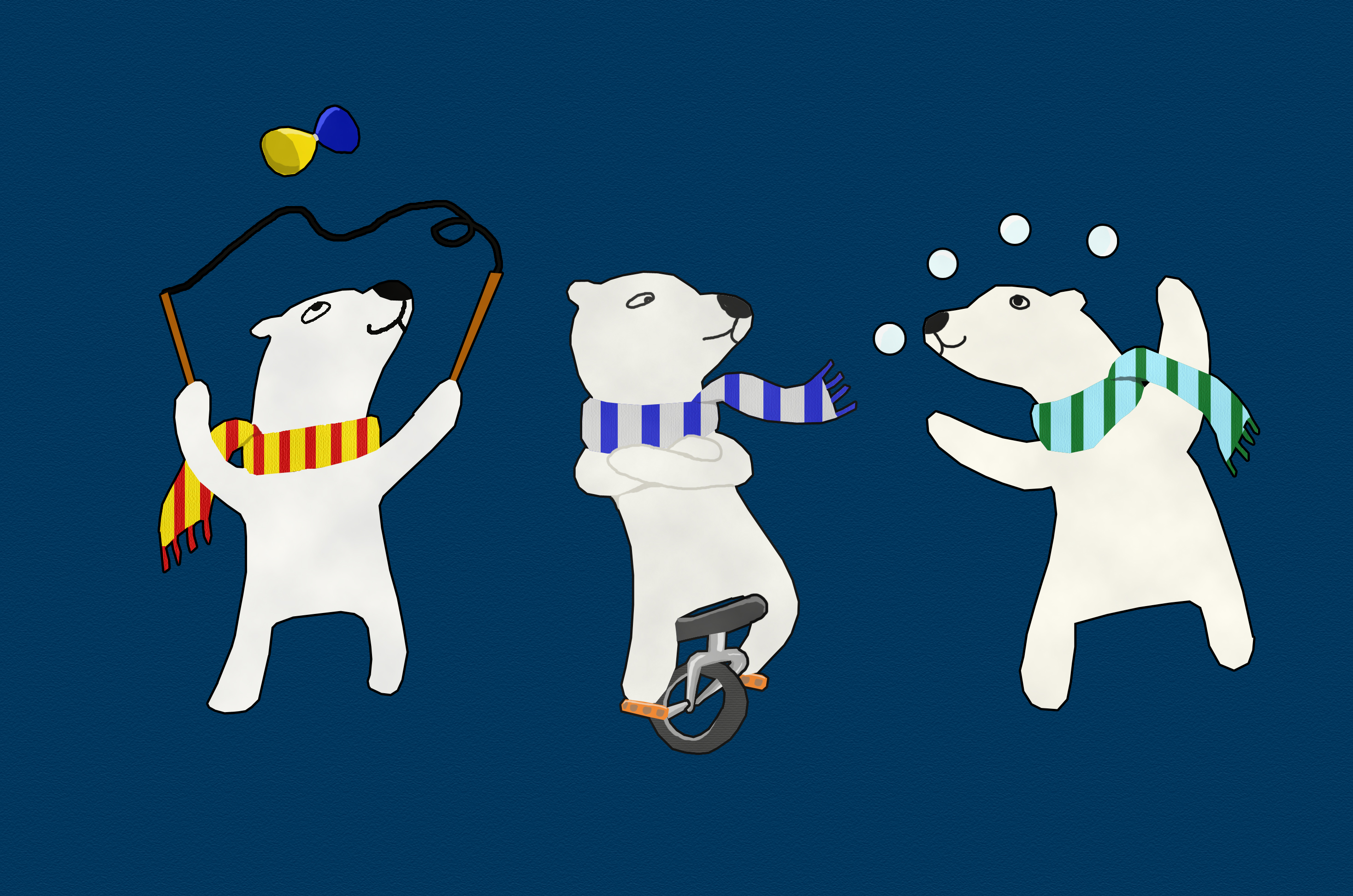

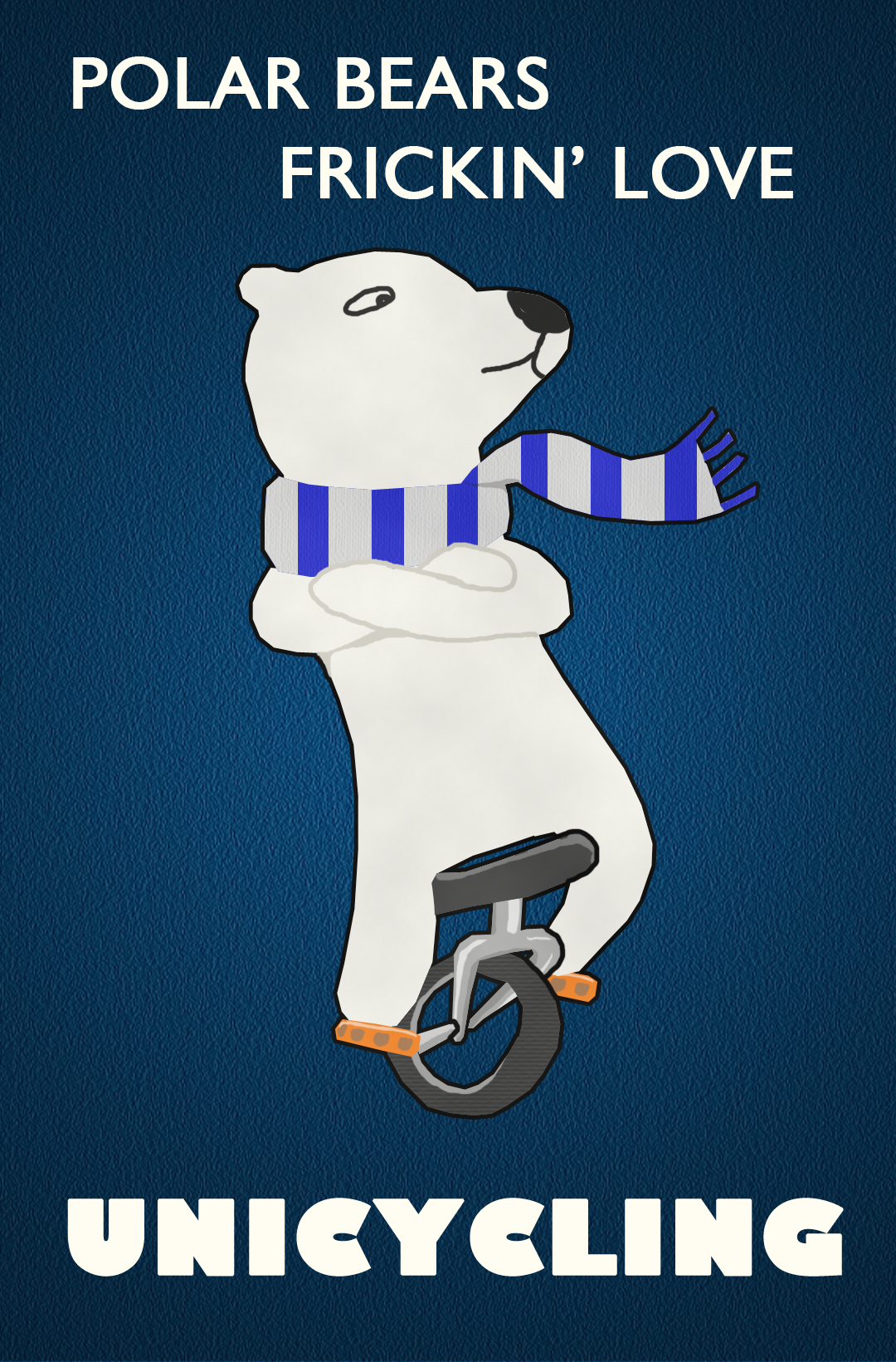

It’s funny how after four years of college, many internships later, when it comes down to paying the bills at this trying period of joblessness, neither my relatively good grades, nor technology-savvy, nor resourcefulness in my work field are any good. In the end, it is still street performing that is keeping me (barely) out of the red.
Today, I set myself a goal to go out and make some money busking. Usually, when I street perform, I never put out a box. The ability to spin freely without needing a permit, being tutted at, and actually having people interested in what I am doing is usually payment enough for me. Washington Square Park has been a very special location for me, because not only do I get such a sense of freedom to do whatever I want there, the space fosters creativity all around, as guitarists and singers play around the fountain why the b-boyers and breakdancers do their thing to the side.
So this time, I put out a box and put in some dollars of mine and hoped that money attracts money. I was also taking a risk by deciding to into the city to perform, since that means an automatic $5 sunk cost in transport, and I was unsure if I could even break even.
I made $37. Not too shabby.
I had on my fancy swishy belly-dancer’s pants, and at the end of the day, it was kinda soaked with sweat. I am achy and sore, but I think it’s worth it. Now at least I’ll have electricity for another month!
It’s funny that during the two hours that I was there, I received various compliments about how good I was doing whatever I was doing; people were saying I should go professional with it, but on the other hand, I’ve never received compliments about how good I was at journalism. I don’t know if I’m actually any good at journalism, but I get things done and I’ve (shameful to admit) done more than my fair share of digging up records of people, etc., to a point that borders on ‘creepy’. I mean, it’s all in the name of journalism, right? This makes me wonder maybe I’m more suited to hold a pair of spinning fans and flags than a pen and notebook.
Right.
The below isn’t from today, but it’s an idea of what I generally do.
When I was in primary four (fourth grade), I took part in a haiku competition on Children’s Day. It was also World Haiku Day or something, and everyone in school had a chance to participate. I submitted three, complete with drawings to go with them. One was about a spider, one was about a pig, and I can’t remember what the last one was.
I actually won something. I won a set of colouring pencils from Japan, with a Mickey Mouse motif. I was also given a book on haiku from children around the world. As a kid, I looked at the pictures more than I looked at the poems from children who were my age.
As I grew up, I would revisit the book every now and then. I also did something that I would never have done as a kid, and that was read the foreword and introduction. It was in Japanese, but there were translations. The foreword said to the effect of “Haiku by children are always the most precious things. They say things as they see them, and that is surely the true essence of haiku.” (I don’t have the book with me right now, I’m just writing from memory.
And that is quite true. If you look at haiku these days, people think as long as you keep the 5/7/5 syllable (or mora, in Japanese) structure, you basically have a haiku.
 The above is a t-shirt design from this online store Threadless. Haikus sometimes don’t make sense on sight, but like any poem, sometimes readers have to work at them to get them. This ‘haiku’ has nothing more to it than a buffoonery of what a haiku is. People sometimes think that because the structure of haiku is so simple, the only way to be smart and outstanding is to be clever with words.
But traditionally haiku is visual poetry for the mind. The words are unassuming, but in the images they conjure, they reflect, capture and convey some truth in the natural world. Let’s look at a famous example, Bashou’s “Old Pond”.
古池や蛙飛び込む水の音
From Wikipedia, it translates as: An old pond, a frog leaps in, water’s sound. All of them simple images but powerful.
The haiku book I had said children see these images best. Have we as adults lost this ability forever, to see the natural with simplicity of mind and words? Maybe if we try hard enough, we might realise that perhaps what seem lost to time is merely buried and forgotten, but a good shovel and with some arm work, we might possible recover it.
 It’s humid
I dropped my ice cream!
Don’t cry
Instead of the one-dollar cheapo sliced bread I usually get from ShopRite, for some reason I decided to buy this loaf labelled “Italian Bread” that cost 50 cents more, and it looks pretty good. It was sliced, had sesame seeds studded all over it, and had a good heft to it.
When I prised a slice loose from the loaf, it was the softest, fluffiest bread I’ve ever felt. It couldn’t be real: its white porous body yielded to my gentlest touch, I could roll it up and it would stay unbroken.
I hated it.
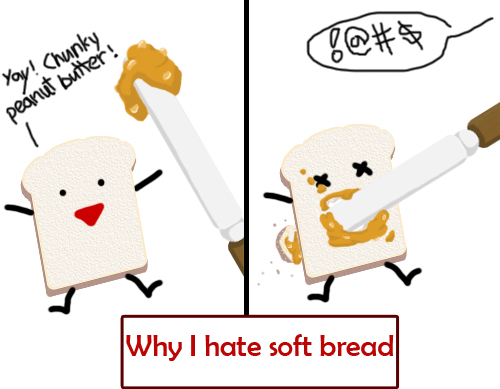
Seriously, why are sliced bread in America so soft? They flop around like limp, floppy fish and are useless against hardy condiments such as crunchy peanut butter. Have you tried applying chunky peanut butter against soft bread before? The moment a knife with a load of crunchy peanut butter meets soft bread, there is no way it can be spread because any attempt to do so results in a messy mutilation of the bread, where it ends up dented, misshapen or torn.
Are these bread made from cotton plants? Most bread I’ve had in Europe are much sturdier, as far as I could recall, so much so that stale bread become acceptable substitutes for frisbee throwing. Or for making knedliky’s (bread dumplings).
Last night, I was practicing being supine on the floor in my bedroom because the weather was really hot, and lying down seemed like a good idea. Despite having broken my glasses and being unable to see much, I still managed to see a mouse suddenly dart out from behind the dressers to the radiator and then back again.
This commenced an hour-long crusade where I attempted to bop the mouse on its head with a shoe.
I don’t know why I thought I could do it. Firstly, I could barely see. Secondly, trying to bop a mouse on its head with a shoe hardly seems like a very efficient method of getting rid of vermin. But it was already midnight, and the myth of a 24-hour convenience store where I could buy traps does not exist in my neighbourhood. Shoe it is then.
I wiggled the extension cord that ran behind my dressers, and the mouse ran out from the opposite side.
WHAP! WHAP! WHAP! I struck out. It ran under my bed.
I pulled and moved stuff out from under my bed, jostled things around, wiggled more wires, and it darted out again.
More whapping, more missing. There are now black scuff marks from the shoe on the door and the post. Hopefully they will come off. I also hope the neighbours don’t think too badly of me; I’m sure they would have done the same were they in my circumstance.
Eventually it crawled back into the radiator, where I could see it nestled between the coils. For a brief, mad, midsummer’s moment, I almost wished the radiator would turn on and kill the mouse by heat. So much vehemence. I blame the heat.
But then I realise sane people probably get rid of mice in their apartment with traps. So, to prevent the mouse from escaping to a place out of my knowledge, I proceeded to erect a fortress around the radiator, hoping to trap it in so that I may buy some time to buy some traps tomorrow. Here’s a schematic of the situation.
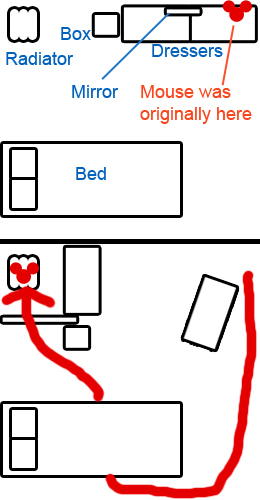 The image above shows the path the mouse took, and what I did to trap the mouse. Such tactics! Such strategy! Ballads shall be sung in my honour and my excellent exploits shall ring for all posterity.
The mouse wasn’t in the radiator the next morning when I woke up. Screw the fortress. I left the house to go buy some traps.
 The Hexacoto