The Hexacoto

Listening to the sound of one hand clapping

Tag: sadness

Extracting meaning in nonsense

Image credit to Wikipedia

‘Twas brillig, and the slithy toves
Did gyre and gimble in the wabe;
All mimsy were the borogoves,
And the mome raths outgrabe.

“Beware the Jabberwock, my son!
The jaws that bite, the claws that catch!
Beware the Jubjub bird, and shun
The frumious Bandersnatch!”

He took his vorpal sword in hand:
Long time the manxome foe he sought—
So rested he by the Tumtum tree,
And stood awhile in thought.

And as in uffish thought he stood,
The Jabberwock, with eyes of flame,
Came whiffling through the tulgey wood,
And burbled as it came!

One, two! One, two! and through and through
The vorpal blade went snicker-snack!
He left it dead, and with its head
He went galumphing back.

“And hast thou slain the Jabberwock?
Come to my arms, my beamish boy!
O frabjous day! Callooh! Callay!”
He chortled in his joy.

‘Twas brillig, and the slithy toves
Did gyre and gimble in the wabe;
All mimsy were the borogoves,
And the mome raths outgrabe.

— Lewis Caroll, “Jabberwocky”, 1871

This is one of the most well-known nonsense poems in the English language, and yet, as Alice in Caroll’s Alice’s Adventures in Wonderland and Through the Looking Glass says

‘It seems very pretty,’ she said when she had finished it, ‘but it’s rather hard to understand!’ (You see she didn’t like to confess, even to herself, that she couldn’t make it out at all.) ‘Somehow it seems to fill my head with ideas—only I don’t exactly know what they are! However, somebody killed something: that’s clear, at any rate’

Even though the words are nonsensical, we still get a distinct sense of their meaning. How is that achieved? What components of the words in this poem contribute to their meaning? From Wikipedia, it says “The poem relies on a distortion of sense rather than “non-sense”, allowing the reader to infer meaning and therefore engage with narrative while lexical allusions swim under the surface of the poem.” What that means is that when we see the words and hear the sounds of the words, the components draw upon our existing knowledge to draw parallels to words and meaning we already know, and extrapolate the meaning onto the poem.

Thus, the frications, the hisses and lullings of the tongue bring about certain images and parallels to words we already know. A modern example would be the word:

Professor Severus Snape

from the Harry Potter books. It’s a very simply usage of the visual and audio clues as to the kind of person a character with that name might be. From “Severus,” we can break it down phonologically — the repeated sibilant ‘s’ draws upon hissing sounds, starting and ending with an ‘s’ makes the word sound harsher, and the the labio-dental ‘v’ sound draws the speaker’s mouth into an involuntary snarl in order to pronounce the ‘v’. Orthographically, “Severus” looks like the word “severe,” and the “-us” suffix lends it the gravitas of faux-Latin, adding a touch of snobbery and sombreness. Similarly, for “Snape,” phonologically, it leads with an “s” sibilant, and the “SN” consonant cluster makes the reader involuntarily sneer. Ending the word with the plosive “p,” and a released, aspirated one at that, adds to the ideas of a curt, no-nonsense character. One can plausibly imagine Severus Snape (with Alan Rickman as him, of course) saying the words “Get. Up.” with an extra hard release of the final “p” sound. Orthographically, “Snape” looks like “snake,” contains the word “snap” in it, and words that begin with “sn” have usually a slight negative connotation to it. (Snide, sneer, snap, snore, sneak, snoot, snarl, sniffle, snark)

So we’re incredibly able to draw so many allusions just from a person’s name via its sounds and its sights, now imagine extending it to the entire Jabberwocky poem. Let’s just examine the first stanza of the poem:

  1. ‘Twas brillig, and the slithy toves
  2. Did gyre and gimble in the wabe;
  3. All mimsy were the borogoves,
  4. And the mome raths outgrabe.

And see if we can annotate it with relevant information that we know.

  1. It was brillig [N? Time of the day? ADJ? Brilliant?], and the slithy [Definitely ADJ. Slithering and lithe] toves [Definitely N, because of following line]
  2. Did gyre [V. Plural object-verb agreement (“toves gyre”). Gyroscope] and gimble [V. Gyrate and tumble? Rotating movement] in the wabe [N. Wet, plus extra wet connotations from “slithy”]
  3. All mimsy [Adj. Whimsy? Whimper? Miserable?] were the borogoves [N. Borrow-dove? A bird? Mangrove?]
  4. And the mome raths [ADJ-N, because of the following V. Home? Mope? Moan? Wrath? Rats? Moths?] outgrabe [out-grab+PAST? Gripe+PAST?]

Wikipedia compiles a possible interpretation of the words, which mine seem pretty close to.

The human mind is incredibly capable, almost desirous, of pulling meaning out of words, such that people arguing about semantics when they disagree with words used by other people seem almost silly. Previously, I have written about how the grammaticality we’re obsessed with contributes little to the understanding of meaning, and people who advocate and insist on a gold standard of grammar are quite misguided. Similarly, we see here even semantic-correctness seems secondary, if the words used have no semantic distinguishing from another, because they are not words in the lexicon in the first place, yet they contain content and semantic meaning.

Does it matter if I say, “The amalgamation of hydrogen and oxygen atoms yields water,” and “The combination of hydrogen and oxygen atoms yield water,”? There will be semantic purists who insist that the act of amalgamation is subtly different from a mere combination; that perhaps amalgamation is more nuanced.

Of course, I don’t deny that there are certainly words that are more nuanced than others. There is certainly a different between the words “happy,” “delighted,” “glad,” and “ecstatic” — they align differently on the superlative scale where one might construe “glad” to be the most slight and “delighted” and “ecstatic” to be on the other end. But even between these words, how is one to distinguish the semantic difference between “delighted” and “ecstatic,” where one is full of delight and the other full of ecstasy, that one is more superlative than the other other? Does ecstasy trump delight?

As such, insisting on absolutism for certain terms is imposition of one’s views on another. Splitting hairs semantically, like grammar-nazism, contributes nothing to the discussion if the intent of the speech is clear.

To end off, I’ll try my hand at “nonsense prose,” to see if I could, without using lexical words, tell a story.

“You seem morried,” Alex said, as he kriched up a klatch, and lit his smube. He took a long wheg. “Is everything milly-willy? Surely nothing fellish happened?”

“I’m afraid I’m a little tatchet,” I said, my shoulders smished, my haiths swanged.

Alex poff-poffed, for he whegged one too big. “Sorry about that. Come on, tich your bin up, kellyvale everything.”

I hished my feet, “You know what my pairrows are; they have viddied not an inch. Every burrise I wake, the same ol’ nubs, the same ol’ tracherns. I am still without work, and my time here is plivered. If I don’t get a job immish, I’m fanade I’m going to go wallyfaloo.”

“Surely it’s not that sapper,” Alex kippered, “You have your tumms around you, being snorm and glideful. Surely that clappas your situation?”

“I’m grateful for my tumms, yes,” I said, “But they can only clappas por piti. It’s been four yardas already, Alex, and the best I’ve bainaged was this mopstep.”

“I can’t movome back, Alex. That finta is unbelfortasible to me; I didn’t swarvvy thousands of loons and cross ninan lashes to come here, only to have to gallivog home. There is no syfe for me there, Alex. Although I have tumms and revelas back home, to have to be washorled by all that sikthorn and snurling pekvork will beshoy me. I’ll sooner slax myself than movome.”

“What are you going to do then?” Alex said.

“I can only prish it will be wingwag, Alex. I can only pope.”
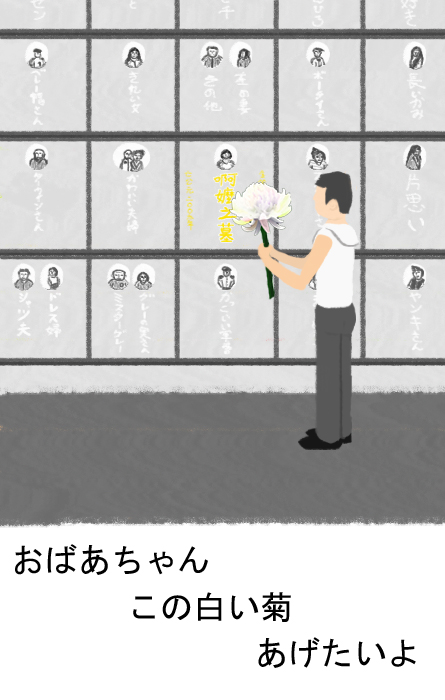
White chrysanthemums

shiroihanaGrandma

This white chrysanthemum

I want to give to you


Thoughts from Four Weddings and a Funeral

4weds2

There is nothing sadder than the laughter uttered
at the remembrance of a funny memory of a dearly departed
which is then immediately swallowed
because one is reminded that
the dearly beloved is no longer there.

All’s well that ends well

It is 5.45am.

Waking up was a non-traumatic affair; I slid out of bed easily, groggily perhaps, but without a fuss. Stumbling a little, I made my way to the kitchen and flooded the room with light. A pot on the stove, a hiss, three clicks and the roar of gas ignited as it rushes past the pilot flame and through the burner. Breakfast is being made.

I am preparing to go to work — today is the first day of my internship, and I am fairly excited. Fairly excited at having to wake up so early in the morning every day and perform the Rituals of the Working Man. Fairly excited at having found my way back to Path of Routine and Normalcy, as you did in the past with school and your previous internships.

After all, this internship validates my ability to stay in this country.

But I know that this isn’t normalcy, only the verisimilitude of it. This false routine does not change the fact that I am still without a job, and that I have not achieved what I came to this country for. Right now, I am merely pretending.

The inky blackness of night yields to a farmer’s blue of dawn.

What comes next? Oh yes, coffee, shower, change of clothes, go to work. The normal progression of things. Oh, and don’t get deported on the way out.

Steel me to strength, steal my fears away.

Handing over keys

Today marks the day that I should be handing over the keys to the circus club at New York University I helped create. A part of me doesn’t want to — I want to be able to still wield the access to the store and be able to keep my unicycle and other equipment on site. But all things must come to an end, and we must learn to let go.

It is not as if I’ll stop doing circus after today; even if I can’t attend the sessions of the school’s circus club, I will still do my own circus sessions. After all, you started out doing public circus even before the club at NYU started.

Rain clouds have gathered and the skies are grey. A fitting sombre farewell or reluctance to let me go?

I’d rather have blue skies and sunny weather, and let the transition happen as unnoticeable as possible, while still enjoying circus that I’ve grown accustomed to setting up each week.

Chasing the sun, away from the rain

Will you stay, or will you go?
When your fear turns to determination
to beat the hourglass from running out,
to send out missives,
so as to stay the night.
But how many nights do we have left?
— I dare not count the days
I’d rather keep chasing the sun,
burning legs be damned
fainting hearts be damned,
chasing the sun pursued by rain clouds;
and I really hate the rain.

But this time, I don’t know if I’d merely become
grumpy
or something more
dire.
That’s why I keep pedalling
away from the rain
into the sun.

In pursuit of happiness

A gay man is marrying a woman he will never romantically love, or even have sex with.

A friend is moving in with a woman he could never see as a lover.

Initially there was shock and outrage all around from the ones around him,

“Marrying a woman?” they’d say, “Have you lost your mind?”

A (spouse) and two kids, a dog, a kitchenette. The wholesome American dream. He could pull a Madonna and adopt one of the kids from Africa, he tells me.

Apparently he has given up finding love. Apparently he has given up on disappointments and hope.

In the past, we’d call that resignation. Today, he calls it “achieving the life he’s never had.”

“Is this what the whole fight for marriage equality was for, so that you could marry a woman?” I wondered to myself, but never actually telling him that.

Then I realised that in my judgement of his decision, not only did I realise what my own views on marriage are, but that had I told him off, like some of his friends did, I would be imposing my views on his. And who was I to curtail what my friends choose to pursue? If my friends choose ‘happiness’ in whatever forms they see fit, I will be supportive, even if they aren’t the same as mine.

So I only wished him the best in his pursuit of happiness, no matter whether he eventually walks down the aisle with a bride in hand or not.

To be driven to despair

Job seeker, 21, with 3 A-levels and 10 GCSEs, kills herself after she was rejected for 200 jobs

Read more: http://www.dailymail.co.uk/news/article-1267953/Job-seeker-Vicky-Harrison-commits-suicide-rejected-200-jobs.html#ixzz2bABkpoVL

After being unemployed for two years, and after over unsuccessful job application, 21-year-old Vicki Harrison kills herself. I read this today and I felt immeasurable sadness for her family, and empathy for her situation. While I have not been unemployed for two years, there are times when my mind have wandered into the similar regions of despair, self-loathing and frustration.

Every day gained is an extra day lost.

Time is ticking out for me; I’m currently on a visa that gives me a year’s grace to be employed in my field of study. A sixth of it has gone. Unlike Harrison, I don’t have two years.

Today, I bumped into the unemployed friend of mine on my way to circus. He told me that in the two years since he graduated from college, he has been unemployed for a total of 15 months when all his unemployment periods are added up. That’s more than a year, more than half of how long he has since graduated. It did not hearten me to hear that he could have been unemployed for that amount of time.

What if it happens to me? What if my year runs out and I still have yet to find a job?

The problem with being college-educated and being told that you’re good at what you do only sets you up higher for a bigger fall. Harrison has 3 A-levels and 10 GCSEs. I have 3 A-levels and 9 or 10 GCSEs, and a college degree. But these alone do not get you a job. Jobs these days want a minimum of “3-4 years work experience” for junior, associate or entry-level positions. Well, what are fresh-graduates supposed to do to get this magical work experience for entry-level jobs that are supposed to help them get experience? What’s the level below entry-level where graduates can glean experience from then? Friends have told me that internship experience counts, but I can scarcely imagine a hirer choosing a fresh-graduate with only internship experience over someone who has actual work experience from a time when entry-level was really meant for people to enter into the industry.

I wonder how long I can hold out before my font of optimism snuffs out?

The inevitability of translating poems

There will always come a point where poetry written in one language cannot be accurately translated into another, because of the very nature of the language itself. It is often cited that certain words in certain languages have such precise meanings that they usually cannot be translated into English. Common examples are ‘schadenfreude’ in German and ‘wabi-sabi’ in Japanese.

But a much simpler reason some poetry cannot be easily translated is simply for its puns, stress, rhyme or rhythm. A Czech person once told me in English, “I was smashed on concrete too much last night,” and that actually turned out to be a pun. In Czech, concrete is ‘beton,’ but it is also the name of a mixed drink ‘beton,’ which is short for ‘becherovka’ and tonic water. So simply saying you were smashed on concrete in English slightly takes away the meaning of the pun.

Such shortcomings become a lot more apparent in Chinese and Japanese, when many words share the same sound, and are only truly differentiated by context and the characters used.

用心听,用心走
Listen with your heart, walk with your heart/Listen carefully, walk carefully

听一听,只听见心在跳的声音
Listen, and only hear the sound of the heart beating
为过去的遗憾而跳
beating for past regrets
为现在的疑问而跳
beating for present doubts
为将来的一切而跳
beating for everything in the future
所作所为
but when all’s said and done
尺有所长,寸有所短
there are goods and bads
而这一页
and this chapter
将会结束
will end
我只能不理不睬心在跳的声音
I can only ignore the sound of the heart beating
往不定的前程
headed for an uncertain journey
往前走
headed forward

This was something I wrote that I found hard to translate, especially when the words were rife with double meanings. The title 用心听,用心走 means two things at once, depending on how you bind the words. “用心” as a compound means to be careful, but as a verb-noun construction means to use your heart.

Regrets, doubts and everything (遗憾,疑问,一切) are three different words, but they all share a fundamental sound of ‘yi’ at the beginning, creating a repeating rhythm and linking all three concepts to a basic fundamental. That is untranslatable in English.

The cadence of the past, present and future is also untranslatable. The structure used was “For the past’s regrets, it jumps/ For the present’s doubts, it jumps/ For the future’s everything, it jumps” where the heart “beating” and “jumping” use the same characters.

The line of ‘There are goods and bads’ is actually a proverb which literally means “A foot is as long as it is, an inch is as short as it is,” and a part of that section of the poem was written in four syllables per line, which cannot be adhered to in English.

Waking dreams

It is often said that dreams are manifestations of the subconscious; I find that very plausible. As if spending every waking moment being reminded that I have yet to find a job is not enough, I am dreaming about them in my sleep too.

I have always had the ability to remember my dreams pretty well, though I am not sure that’s a gift.

I am back in Singapore, but instead of returning to my parents’ home, I go to my grandmother’s. “You’re back,” she says, happy to see me return, and I said, “Yea, but I will have to go back soon.”

“You should call your parents and let them know,” she says.

“Ok, I will do that later.”

And then I procrastinated by going grocery shopping. Being back home, I need not scrimp and save when it came to shopping to feed myself. I did not have to forgo buying meat because it was a tad expensive, I did not have to buy the hardiest vegetables and produce so that they last in the fridge the longest. I could sense the temptation to just embrace this purchasing-power-freedom.

I made it home, and then I called my mother’s mobile phone, instead of my father’s, but a bad connection forced me to call the house’s landline instead.

“Mom, I’m back.”

“That’s great. When did you return?”

“Earlier this morning,” I lied; in the dream I returned last night. “I’m at grandma’s now.”

“Ok, will you come over for dinner later tonight?”

“Yea, sure.”

“How were things in the States? How was the flight?”

“Er, we’ll talk more when I go over. See ya later.”

“Alright.”

I could sense that my father was there in that room when I was talking, and it was an uneasy feeling.

The dream ended, I never got to go over to meet my parents for dinner. Maybe I didn’t want to.