The Hexacoto

Listening to the sound of one hand clapping

Category: Musings

Brave New Korea

soma.zoom_.detail.g.1[1]

Image taken from T-Shirt shop, The Affair

It has been reported for a while that the North Korean government has been manufacturing methamphetamines, also known as ‘crystal meth.’ In fact, due to the fact that they are a government-led effort, extremely high quality meth is produced, and they are highly-sought after overseas, according to defectors. In fact, North Korean diplomats have even been made to peddle these drugs, tasked to sell 20 kg (about 44 pounds) and raise $300,000; money that the country desperately needs to fuel its nuclear programs as well as its ruling elites’ lavish lifestyles.

Newsweek reported in 2011, when China, North Korea’s main target of its meth exports, tightened its border security on drugs, North Korea suddenly found itself with a surplus of meth that it couldn’t sell, and thus they started selling it within its own borders.

Inside North Korea, observers say, many use meth in place of expensive and hard-to-obtain medicine. “People with chronic disease take it until they’re addicted,” says one worker for a South Korea-based NGO, who requested anonymity in order to avoid jeopardizing his work with defectors. “They take it for things like cancer. This drug is their sole form of medication,” says the NGO worker, who has interviewed hundreds of defectors in the past three years.

A recent study in the journal, North Korea Review, suggests that about 40-50% of the people in the area bordering North Korea and China are addicted to meth. People in the north of the country have apparently started cooking their own meth to feed their addiction.

The idea of state-produced drugs turned on its own people to keep them docile, or otherwise benumbed to the pain, hunger, and suffering brought about by dismal living conditions from a dysfunctional economy is strikingly similar to Aldous Huxley’s ‘soma’ in his novel Brave New World.

“..there is always soma, delicious soma, half a gramme for a half-holiday, a gramme for a week-end, two grammes for a trip to the gorgeous East, three for a dark eternity on the moon…”

“I don’t understand anything,” she said with decision, determined to preserve her incomprehension intact. “Nothing. Least of all,” she continued in another tone “why you don’t take soma when you have these dreadful ideas of yours. You’d forget all about them. And instead of feeling miserable, you’d be jolly. So jolly,”

”Hug me till you drug me, honey;
Kiss me till I’m in a coma;
Hug me, honey, snuggly bunny;
Love’s as good as soma.”

Like in Huxley’s London, meth abusers in North Korea see their drug as non-lethal — merely recreational, even medicinal. However, while people in Huxley’s London consume soma on a daily basis with no side effects, other than a strict addiction, Kim Jong Un’s North Korea cannot continue to see sustained use of meth in the long term, not without repercussions.

While it was reported that Kim Jong Un has ordered a crackdown on drug abuse in 2011, which remained largely unsuccessful, when the drug, which he has sanctioned the production of, is responsible for putting money into his coffers, and funding the state’s military program, what incentive does he have to stop? Furthermore, the surplus of meth being used as a substitute for more expensive medicines and painkillers help reduce the state’s healthcare costs. One’d imagine that the reclusive Brave New Korea is headed in a euphoric direction away from the rest of the world, its head wrapped up in its never-ending haze of drug-riddled poverty,

Learning politically-correct fairy tales

pri1-1[1]Photo credits to Catch Forty Winks

A motherhood-blogger shared a picture from her friend’s Facebook (above); her friend’s first-grader son’s test paper and how he apparently got a question wrong.

The question is one of those “arrange the words” type to form sound sentences. The boy apparently wrote “The fairy godmother turned the handsome prince into a snake” and “The castle was on the beautiful green field” and they were marked as being incorrect. The teacher indicated that the answers should have been “The fairy godmother turned the snake into a handsome prince” and “The beautiful castle was on the green field.”

Why were the answers marked as being wrong? They were all grammatically sound, but because they didn’t adhere to some standard of what fairy tales should have been. some poor child’s rather creative construction  got neutered.

Not that I would like to repeatedly lambaste Singapore’s education system, but this sort of inflexible marking shown by the teacher is precisely what’s wrong. The government and the public lament that our students turning out to be uncreative and un-innovative, and I wonder why that is so. When everything has to adhere to a preset, every fairy godmother has to be benevolent, and every castle has to be beautiful.

It is not known if the student’s parent confronted the teacher over this stunting marking.

The blogger felt that should her son encounter this situation, she would do the following:

1. Meet the teacher, and explain my view on why this answer should be marked as correct. However, this will be dependent on whether I have already sized up the teacher to find out more about her personality. If she is open and accommodating to parental feedback, she might feel a little apologetic and then change her marking on the paper. Or if the teacher is by-the-book and inflexible, my child might get unnecessary attention amongst the 29 other kids in class or just get ignored eventually.

AND / OR

2. Explain to child that conformity is part of societal expectations, model answers and behavior is needed to get approval from teachers and school. However, share with child that his answer is correct according to English language structure and rules. And continue to encourage creativity in modules of creative writing, problem solving and life in general, apart from school.

In the immortal and forever-wise words of the movie Mean Girls, I quote:

There are two kinds of evil people in this world. Those who do evil stuff and those who see evil stuff being done and don’t try to stop it.

Not confronting the teacher and letting the issue slide does more harm than good. Would the teacher continue marking every prince that has been turned into a snake as incorrect? Then, telling a child that conformity is what is needed in society is just as harmful — this tells the child that deviance isn’t accepted in our society, be it good or bad. How is having the child cripple himself to fit our society’s narrow-minded confines going to be useful in the future?

How would this blogger react if the child grows up expressing views that are deviant from societal norms? What if he grows up wanting to study the humanities, or wants to become a chef, or turns out to be homosexual, or decides that he wants to become a fashion designer — all outcomes that do not conform to the Singaporean norm. What then? Would the parent still tell the child that he or she is still expected to conform? Where does one draw the line?

But I deviate. Not only should the child know that his answer is perfectly acceptable, he or she should be encouraged to make more of such creative sentences. Why stop at the fairy godmother turning the prince into a snake? How about a snake turning a fairy godmother into a snake? The parent could even engage the child’s artistic faculties by asking the child to imagine how something like that could happen, and make an illustration! Take the opportunity to turn such an event into  a way for a child to exercise his or her creative juices.

prince

The fairy godmother turned the handsome prince into a snake by the castle on the beautiful, green field.

Experiencing Darshan?

This slideshow requires JavaScript.

I went to the exhibition “Darshan” at the Clampart gallery. The word “Darshan” means “sight” in Sanskrit, but it is used in the context of receiving “spiritual vision,” or the moment of theophany. It is a way of being able to see the divine directly through a medium, be it art, sculptures, landscapes, or great people. Some call it “divine inspiration,” but I like to think of it as the moment of being in awe  in sublimity in the presence of great spirituality.

It can be akin to being taken by the Holy Spirit in Catholicism, a sort of event that happens in the consciousness.

I went to the exhibit hoping to receive that experience, where it claims to recreate that connection one gets in a Hindu temple through the images, incense and invocations, but sad to say I was sorely disappointed.

The pictures on the wall were highly masterful, that’s for sure. All but one of the pictures was not photoshopped or digitally touched, and every element in the frame was the result of real people posing and the arranging of props. That was highly impressive, and the attention paid to detail was delightful.

However, it failed on delivering anything close to any experience I’ve had physically stepping into a Hindu temple.

There were incense urns but not incense lit, and the gallery room was sterile and too white. There was not even anything of the sounds one encounters in a temple, and the gallery felt claustrophobic. Temples are usually designed to impress by vastness of scale, with high ceilings elaborately decorated and such.

Image credit to Wikipedia

Very often, it is the gopuram of a temple, or its monumental tower at the entrance gate, that begins the process of darshan for me rather than just the idols itself.

To think that the darshan of a Hindu temple is received solely through religious images is highly lacking — it involves the sights of the images and colours, the smell of incense and the age of the temple, the sounds of other devotees and occasionally prayer but also the sound of tranquillity, and especially, the touch of cold stone against the bare feet, the grind of dust against one’s foot.

Also, I think that using that faux-devanagari (Hindi) script was a let-down. It’s like using faux-Asian scripts in Chinese restaurants or something.

Where childhood education begins, childhood ends

Previously, I wrote about the breakdown of the Singapore education system, and how divisive it was to the population’s children.

When you have schools that are seen as “elite” and schools that are seen as “neighbourhood” (regular), you have a nation of parents desperate and eager to send their offspring into these “elite” schools. As with demand and supply, seats are limited at these prestigious places and thus school children have to work ever so harder to outdo each other.

This means cram schools, or as they are called in Singapore, tuition centres.

After-school tutoring has become a thing where previously students who were slightly weaker went to to catch up, to a thing today where it is necessary to send one’s child to or else lose out to the other children, whom themselves are taking after-school tutoring and enrichment classes. It is reported that 97 percent of students in elementary and middle school in Singapore today are enrolled in tuition and enrichment centres, double from that of twenty years ago.

Children as young as in first and second grade are having to spend time after school going to these tuition centres, where they spend hours practising math drills.

Children in the Western world don’t even have proper homework until much later; perhaps some light reading exercises in the lower grades, but nothing in the likes of worksheets and homework assignment books.

There were many times in first and second grade where I have been punished (a smack on the palm with a wooden ruler) by the teacher for not having completed my homework.

And not even just homework, students begin taking year-end examinations as early as in first grade.

And so, going to tuition centres in Singapore to just keep up has become endemic, to the point that bringing a child up in such a competitive environment seems almost an affront the kid’s childhood. A Singaporean blogger Ian Tan notes:

For many parents, enrolling their children for tuition is not about the desire for top grades, but because of the fear that their children cannot catch up enough to get a decent passing grade.

Then, any free time the child has is sucked up by travelling to tuition classes or doing tuition homework. Where do they get the time to enjoy outdoor activities, learn new hobbies or other things that make them well-rounded individuals?

This is coupled by increasingly difficult standards of homework (actually only math, really) and exams that students receive, of which the same blogger notes:

…school teachers sometimes do not have the opportunity to reinforce the basics of simple arithmetic, and are forced to make their students do sums that are more useful in weeding out mathematical geniuses than genuinely impart knowledge. Within the cramped periods of each school day, it is simply impossible for teachers to cover all the bases in today’s punishing curriculum.

So if students have to resort to after-school tutoring to even maintain a level playing field, guess who loses out?

That’s right, those who can’t afford to send their kids to these tuition centres.

This situation of constantly having to bolster a child’s “education” with supplementary classes is socio-economically divisive — the rich can afford to keep their children at the top of cohort, who will end up being able to go to elite schools, and appear more attractive to employers when their educational resume boasts of top schools and top grades. Poorer families, where sometimes even the children might have to chip in at their parents’ stalls at the market or hawker centres, are just unable to keep chucking money at external agencies to help with their children’s education, locking them in a cycle that they currently are. Thankfully, given the level of subsidies and assistance available to students in the country, most students are able to go to high school (junior college, Centralised Institutes and polytechnics) and the local public universities (National University of Singapore, Nanyang Technological University, and Singapore Management University), should they work hard enough, but most families will be locked into their socio-economic grouping and upward-mobility, of which education plays an important role, is incredibly hard.

I end by quoting an observation by (yet again) the same blogger I’ve quoted twice before:

If a brilliant student comes from a disadvantaged background and goes to a school where most of the kids have no access to expensive tuition or sometimes even have to help out at their parent’s hawker stalls, what are his chances of reaching his real potential?

I see parents spend thousands of dollars sending their kids to swanky tuition centres (which themselves show off their wealthy clientele by displaying iPads and cute pets at the window dressing area). Yet I am fully aware that these are the top 10-20% of society.

Of course, these kids would have a far better chance of doing well at PSLE compared to equally bright kids who have never stepped into these tuition centres. To make things worse, the primary school exams and assessments of today are ridiculously hard even by adult standards. Without the aid of tutors or full-time mothers, most kids would be quickly “filtered” out by these trick questions.

Understanding the Chinese consumer culture

5ded67931ece9ff43ebbcafd3e671518[1]

Photo credits to South China Morning Post

Ikea bends over backwards to accommodate Chinese keener on sleeping than shopping, but sees unprecedented growth

Shoppers sleeping on display beds; couples taking “selfies” in the showrooms; thermos flasks of drinks and plastic bags containing food sit on the display kitchen tables, with shoppers actually eating and drinking off of them — these sorts of behaviour would be unthinkable anywhere else, but in China, they seem to be the norm.

And it is not as if the store actively encouraged it. In the article, store staff Jason Zhang says that every day, he wakes up about a hundred of them.

Ikea was certainly not expecting such behaviour, and has certainly bent over backwards to accommodate these shoppers in hopes of chasing their yuan, and it has certainly worked — their turnover in 2012 exceed 6 billion yuan.

Understanding why they behave that way requires the understanding of two conflicting ideals: Being insensitive to criticism and the needs of others (having a thick skin), while being sensitive to scrutiny at the same time.

There is a certain lack of awareness of others among the Chinese; if the Japanese are overly-conscious about the considerations of everyone around them, then the Chinese would be the antithesis. Only by having a skin thick enough to brush off admonishments from their inconsiderate acts could they even behave they do in the first place. If the customers at China’s Ikea considered about other customers using the products in the future, they would be more careful with it. If they cared enough about not appearing to be uncouth, then they would not spit in public or be disruptive. If they cared enough about the people trying to get out of the trains, they would not be rushing headfirst as the train doors open.

As such, you have people doing whatever pleases them, oblivious to the disapproval of those around them.

According to Tom Doctoroff, an expert on Chinese consumer psychology and author of What Chinese Want, … going to Ikea may not be too dissimilar to visiting a theme park. Generally, Doctoroff explains, Chinese people tend to take a more recreational approach to consumption. “Shopping in China is far more about the experience itself than it is in the West,” he says.

Blindly charging ahead, in pursuit of their ‘experience.’

Doctoroff also says:

For Chinese consumers, products for domestic consumption are secondary to the more visible status offered by Western brands such as cars, watches or even Haagen-Dazs ice cream and Starbucks coffee.

This is a rather salient point about Chinese consumer culture: buying things is very much less for its utility than the perceived status it affords. Therefore, a brilliant sofa from Crate and Barrel would be inferior to a Gucci handbag, and people would rather tote around a Starbucks cup containing average coffee than a cup of fair-trade organic coffee.

What this means is that just as they brush off criticisms of their actions, they are at the same time sensitive to how people perceive their prestige, and the easiest way to obtain that is through acquisition of material goods. They are eager to be seen wearing their expensive clothing and bags, and eating, drinking and socialising at establishments that boast of an affluent lifestyle.

This obsession with flaunting status is not something new: traditionally, in restaurants, a Chinese host would often order more dishes than anyone at the table could finish, resulting in incredible wastage. This is so that the host can display his generosity and capability of affording such lavishness.

The Chinese equate goods that are expensive, and easily-recognised brands with social standing. One needs only to go to premium outlet malls such as Woodbury to witness the whimsy with which they buy bags and purses from Coach, or Prada, or Gucci. Of course, to afford these goods, they have to have a certain amount of wealth in the first place, and indeed the ones causing the most antagonism worldwide in their squabbling ways are those who can afford to leave the country to tour, travel, work and vacation.

For example: A teenager was caught defacing a 3,500 year old Egyptian temple, Thai message boards were abuzz with complaints of Chinese tourists being a nuisance in public and spitting, a French boutique hotel announcing that they would bar Chinese visitors — the burgeoning affluence of China has opened the doors to the world to its newly-rich, and the rest of the world feels it.

“That China is a lawless, poorly educated society with a lot of money is going to take its toll on the whole world,” said Hung Huang, a popular blogger and magazine publisher in Beijing.

Ms. Hung, the blogger, blames the Communist Party’s tumultuous rule for China’s uncivilized behavior abroad. “There’s an entire generation who learned you don’t pay attention to grooming or manners because that’s considered bourgeois,” she said. While Chinese are more open to Western ideas now, that has not necessarily sunk in when actually interacting with the outside world. “They think, ‘The hell with etiquette. As long as I have money, foreigners will bow to my cash.’ ”

Despite the bad rep, countries are still bending over backwards to accommodate the Chinese, for they represent revenue to be made. As reported in the New York Times, 83 million mainland Chinese spent $102 billion abroad — overtaking Americans and Germans — making them the world’s biggest tourism spenders, according to the United Nations World Tourism Organization.

Wedding companies in South Korea are trying to lure Chinese couples with bling-heavy ceremonies inspired by the viral music video “Gangnam Style.” A coastal county outside Sydney, Australia, is building a $450 million Chinese theme park centered on a full-size replica of the gates to the Forbidden City and a nine-story Buddhist temple. France, one of the most popular destinations for Chinese tourists already — 1.4 million visited in 2012 — is working to further bolster its appeal.

Parisian officials recently published a manual for the service industry that offers transliterated Mandarin phrases and cultural tips for better understanding Chinese desires, including this tidbit: “They are very picky about gastronomy and wine.”

Such pandering, however, encourages the poor behaviour of these Chinese tourists. Be it countries abroad, or Ikea in China, letting revenue permit the lack of social grace is as myopic as the Chinese who spit and litter wantonly on the streets: focusing on whatever is pleasing now and not having to worry about consequences or how it might affect others.

Perhaps shops should enforce orderliness, and firmly rebuke those who are disruptive, even if it might cost them some business. Perhaps greater social education should be emphasised upon in schools. Change will not happen overnight, and in fact, given the vastness of the country, China may not even see a betterment of its ungraceful problem for many generations, but leaving this wildfire rampant and unchecked is not a solution either.

Chinese innovation

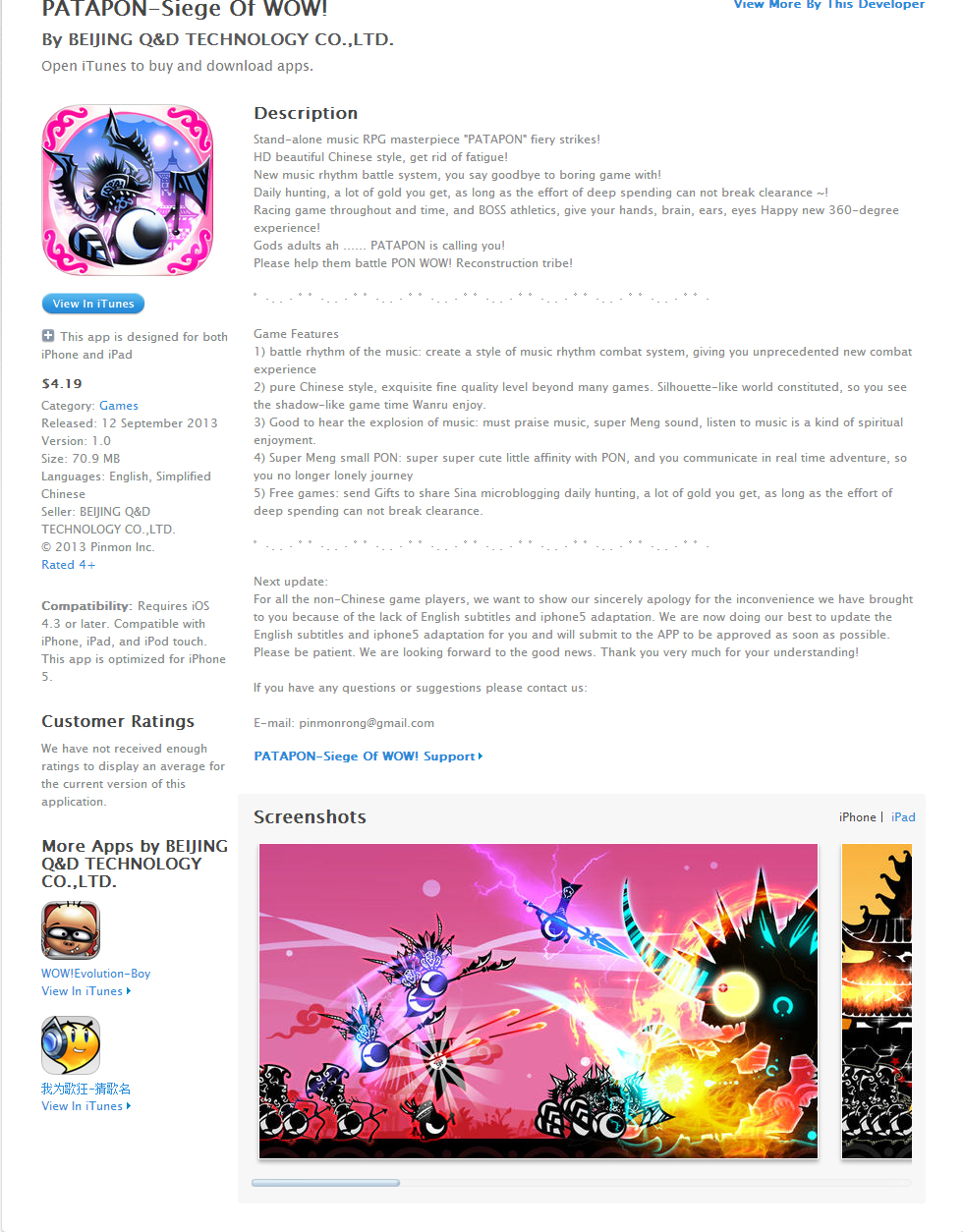
pataponripoff

“Stand-alone music RPG masterpiece “PATAPON” fiery strikes!
HD beautiful Chinese style, get rid of fatigue!
New music rhythm battle system, you say goodbye to boring game with!”

PATAPON — Siege of WOW really does make one go “WOW.” As in, “Wow, what else will the Chinese not intellectually plunder?”

Loathe as I am to rail on the Chinese for intellectual theft and misappropriation of entire stores such as IKEA and Apple stores, there seems to be no letting up for copying wholesale the innovation and hard work of others. PSP game Patapon was next in line.

This Beijing company didn’t even bother to properly translate their “game’s” description on the Apple iTunes store — it was most definitely put through an online translator from Chinese. I’m surprised there were no errant Chinese characters left in the text.

Also, apparently the game is in Chinese only. For a game that speaks in a language that goes “PON-PON-PATA-PON,” why bother releasing the game on an international platform if the texts are going to be in Chinese only?

That said, some effort has been put into the visuals, to make it seem like things have been changed up a little.

pataponripoff2In the first screen, one can distinctly see a Chinese-style flanged roof structure, and the clouds are a stylised form of typical Chinese renditions of swirly clouds.

null

Image from Wikipedia

The second screen shows another Chinese-style castle, and you see lotus flowers and a traditional goldfish art in the third. The fourth has a Chinese-looking pavilion and the last has some pillars that looks like a monk’s spade, most famously used by Sha Wujing (Sand Friar) in Journey to the West.

An “A” for effort I guess.

Roald Dahl day

1236162_10151650161726173_584199288_n[1]

So apparently, today is Roald Dahl day?

That’s very cool. I wonder how many children still read Roald Dahl today? I grew up with Dahl’s books, and went on magical journeys with the various characters through different books. I definitely tried to move objects with my eyes like Matilda did; I fantasized about one day opening a bar of Wily Wonka chocolate containing a golden ticket inside; I wondered what frobscottle would taste like.

Dahl’s books are one of those rare kinds that introduce children to the joys of reading and holds them there.

My introduction to Dahl began in second grade, when a friend and I missed our school buses back home because we were busy cleaning the classrooms after school ended. The next day, the principal called us to his office, and apparently he heard of our deed. He praised us for being hard-working kids, and gave us each a Roald Dahl book. I received The Giraffe and the Pelly and Me while my friend got The Twits. I distinctly remember coming up with my own tune (that I still remember how to hum today) to the song that the animal trio sings in the book.

Eventually, I went on a path of devouring all of Dahl’s other children books. My favourite definitely was Matilda, where the idea of a precocious kid with supernatural powers appealed to me, and many times I have tried (even today, sometimes) to move things with the power of my eyes and concentration.

In middle school, we had to read Roald Dahl’s collected short stories, and I didn’t know Dahl wrote anything other than children’s fiction. Apparently he also wrote a couple of adult short stories too. We had to do a book review by presenting  a story from the collection in class — I pantomimed Lamb to the Slaughter,  where I was Mary Maloney, the murdered husband, and all the characters in that story.

Even today, when I’m up for some light reading, I would usually gravitate towards children books, with Dahl being a hot favourite. His well-fleshed characters and engrossing plot makes for an easy read and most definitely an enjoyable one too.

I remember

I remember a day when I travelled to Australia, the year was 1999. I was in fifth grade, and the school band was going on a trip there for an exchange. We breezed through the gates with nary a snag. Security took minutes; I didn’t have to undo my belts or shoes. I had a bottle of shampoo in my backpack, because I forgot to pack it into my luggage. I didn’t have to throw away my bottle of soda. Kids could even visit the pilots in the cockpit, occasionally, or so I’ve heard.

I came back with lots of souvenirs: I had a model of a sarcophagus with a mummy inside; I had this wooden block toy that unfolded upon itself endlessly, held together by straps; I had a letter opener, fashioned after a sword. I had them all in my backpack.

But then, I remember, two years later, everything changed.

Liquids had to be put into tiny ziploc bags, bottles of water had to be thrown out. A fear of assault by nail clipper gripped airports around the world, and many an errant nail could not be clipped on the flight. Like a polite guest at an Asian household, we had to remove out shoes to enter a doorway that shot invisible waves at us, painting a portrait of us in greens, yellows and reds (if you caught a glimpse of the screen after you’ve stepped through). Belts were undone, pockets had to be emptied, veins were throbbed as frustration and annoyance coursed through them as an ever-expanding line of people waiting in the queue fumed at that one person who had a little trouble repacking his things back into his carry-on at the end of the scanner conveyor belt.

All because on this fateful day, twelve years ago, two skyscrapers came tumbling down, brought down by aeroplanes driven by religious fervour.

Thoughts from Four Weddings and a Funeral

4weds2

There is nothing sadder than the laughter uttered
at the remembrance of a funny memory of a dearly departed
which is then immediately swallowed
because one is reminded that
the dearly beloved is no longer there.

Pre-packed life choices

Previously I wrote about the breakdown of the Singapore education system and how elitist and dichotomising it is. It is known as being competitive and stressful, but what is little known about it is by making one choose one’s path from as young as in middle school, it results in a situation where the “choice” involves very little choosing at all.

By the time we’re in secondary school (middle school), at the end of secondary two (eighth grade), Singaporean students start subject specialisation and are able to pick the subjects they would want to study for the rest of their secondary education. Like in the UK, students have options such as taking “triple science” (physics, chemistry and biology — reserved for top-performing classes usually), or go more of an “arts” route (literature, geography, history, drama, etc.). Students will also get the chance to take Advanced Math (calculus).

These choices don’t seem like they matter much at this stage, but they actually do. The subjects one picks determine which post-secondary school the student is able to enter, which in turn affects not only which university the student can enter but even the major the student can take.

For example, were I to go on an “Arts” route in secondary school (which I did) and took more humanities than sciences and math, I would not even have been able to enter what is called the “Science stream” in grammar school (high school), I’d have been only able to enter the “Arts stream,” because a good grade in math and science are a requirement to enter the “Science stream.”

In the British/Singaporean education system, where a student declares a major before he or she enters university, what majors one is able to declare is dependent on the subjects one took in grammar school. Want to declare Engineering? You’d need a good grade in physics or chemistry and math. Want to declare law as a major? Probably stellar grades in English, math, humanities, basically everything (I doubt law school would admit anyone with less than straight ‘A’s)

Having dropped Advanced Math in middle school, and not getting an ‘A’ in regular math for my ‘O’ levels, I was prematurely excluded from ever entering the “Science stream” in grammar school, which means that I could never have been able to even study any of the math or science majors in university in Singapore.

All that because I chose to study literature and geography in middle school.

But when a child is forced to make these decisions that ultimately impact his or her life at the age of 14, 16 and 18, how is that child supposed to make those decisions when even people in their 20’s and 30’s don’t even know what they want to do with their lives?

As such, these students merely make pre-packed life choices — not knowing what they want to do with their lives, they can only shoot for the best they can achieve, and hope that it’d all work out. For example, most simply aim to enter “triple science” in secondary school. since those classes are reserved usually for the best, without consideration if they would actually want to pursue a career in science later on in life. Students figure that if they have the best grades possible, it gives them the most options later on.

In high school, students have to choose about three to four ‘A’ levels subjects to take. If the students mostly took science classes in middle school, chances are, they’d probably be going for the “Science stream” in high school as well, even though the “Arts stream” is available. To them, they think that taking the arts limits their options because they cannot envision getting into university through the arts, and hence default to taking the sciences and math. Students take subjects because they’re good at it, not because they like they subject.

In my high school, the ratio of science to arts classes was 31 to 8.

The majority of my high school peers in the “Science stream” ended up declaring engineering or business or some sort of science/math-related major to enter university, because that’s what they have been studying their entire lives from the point where they had to “make a choice.” They chose not to have to think about choice, and chose a default, pre-packed path in their life of math and science, because they’ve been told everyone needs that to get at least some sort of a job.

Did my friends want to become engineers and businessmen? They still don’t know what they want to do with their lives. But they know they have a career of math and science in which they can apply for jobs, because that’s what they studied in university.

In Singapore, it is not so much “What do you want to be when you grow up?” because the end is not so much a want as it is an inevitability.