The purple cabbage Majora’s Mask

I was making some cabbage stir-fry, and as I cut open the purple cabbage, lo and behold! What seems to be the Majora’s Mask staring back at me.
What does it all mean?

I was making some cabbage stir-fry, and as I cut open the purple cabbage, lo and behold! What seems to be the Majora’s Mask staring back at me.
What does it all mean?
On the way back home early this morning, on the subway, this Israeli guy started talking to me.
“Hey! Are you from China?”
I said I was not.
“Japanese?”
I told him I was from Singapore.
“Oh I thought you might be Chinese or Japanese, you have the same eyes as my girlfriend,” and he proceeded to tug the sides of his eyes, “She’s half-Japanese, half-Italian, and your eyes are similar. I love my girlfriend, but I disagree with what she believes in.”
Casual racism aside, I asked, “What do you mean?”
She was a teacher who taught in a school for Arabs, he said. As a result, she sympathises with the plight of the Arabs in the whole Israel-Palestine conflict, and takes the sides of the Arabs in the country instead of the Jews, which he is.
“She says things that are crazy, just like the rest of them,” he said, “They’re all brainwashed.”
I thought it was funny that he should say that, because the Arabs in the country probably thought the same of the Jews. In fact, a couple months ago, I got to meet a recent immigrant from Israel who echoed the same sentiments, almost verbatim.
“The Arabs will not hesitate to take over Israel if they could,”
“They’re all brainwashed from young into believing their nonsense,”
“You give them a little, they keep wanting more. They’re not satisfied with equality,”
These were some of the sentiments that both the Israeli men, whom I met several months apart, echoed, almost word for word. It was as if they were reciting from something learnt in the past.
Then, the guy on the subway asked me,
“So, whose side do you take? What are your views on this issue?”
I opted for the safe path and said, “It is not in my place to comment; I’ll let them Jews and Arabs, Israeli and Palestinians work it out.”
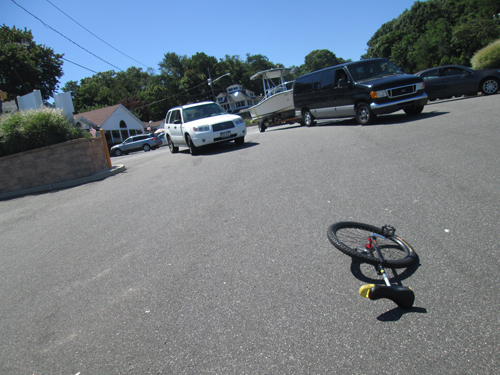 It’s been a while since I last did a long-distance unicycle ride, but I decided to go visit my friend on Long Island, and that’d give me an excuse to do some long-distance. The route would have been about 67 km/41 miles. I was to start in Queens and meet him at the Three Village Shopping Center just north of Stony Brook University. Because WordPress.com does not allow embeddable live maps, here’s a picture of the route. Scroll to the bottom to skip to the stats.
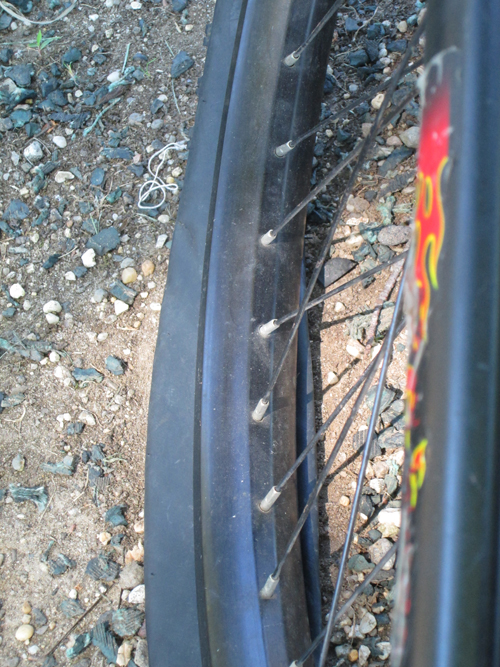
 You’ll come to realise that the trip stopped at 58km, that’s because I got a flat tire and had to stop. And I was so close! I had about 9km to go and I was forced to stop.
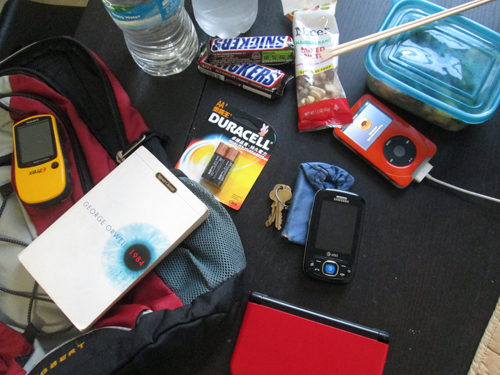 My rations for the trip: GPS, a book for the train journey back (I wasn’t going to ride all that distance back!), extra batteries for the GPS, my wallet and phone, MP3 player, 2 Snickers bars, 2 litres of water, some nuts, potato salad, and a Nintendo 3DS to see how many steps the pedometer in the 3DS registers the journey as.
I started out in Queens, since I figured if I were going to hang out with my friend, I probably shouldn’t be completely pooped out by the time I arrive. Had I left from my apartment in Brooklyn instead of Queens, that would have added an additional 13km to the journey, making it 80km total, which would have wiped me out.
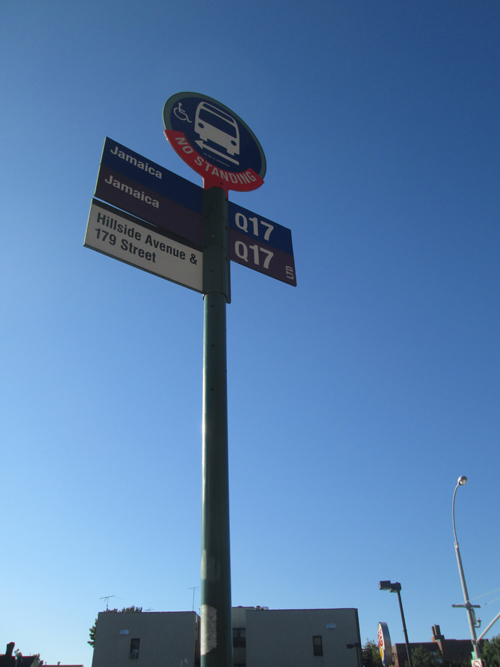


Queens roads are the absolutely terrible; potholes, roads that are not level, cracks, and glass shards. I was worried my legs would be over-taxed early into the journey. I unicycled past lampposts that was utterly covered in staples and nails, and a really cute barn-like pit stop. This was all still in Queens.


My first stop outside of Queens was this town called East Williston; it has a pretty church and a pretty train station. That’s about it. The rest of the journey alternated between boring suburban towns, some fairly nice neighbourhoods with ritzy residences and industrial towns.


I ended up on the expressway and panicked a little — I thought I was lost and was not supposed to be on it. Luckily, when I saw some other bicyclists on it too, I relaxed. Other highlights of the trip include numerous fresh produce farms and when I made a wrong turn and ended up on King’s Park Wharf.
The journey was on the overall not too hard, until the last leg after I got lost, where it was killer hills, rocky roads and more killer hills. In fact, that was probably why I had the puncture, from going downhill a little too quickly on a rocky road on a killer hill.
Here are some stats summing up the entire trip.
Total elapsed time: 4 hours 36 minutes
Total moving time: 3 hours 37 minutes
Total stopped time: 58 minutes
Maximum speed: 29km/h
Total UPD’s: 2 (One downhill, one when I hit a sand bank)
Total roadkill count: 14
Total garage sale count: 11
Steps counted by the 3DS: 29,611
Breaks taken: 5
I unicycled into Long Island and all I came back with is a weird tanline.

Today marks the day that I should be handing over the keys to the circus club at New York University I helped create. A part of me doesn’t want to — I want to be able to still wield the access to the store and be able to keep my unicycle and other equipment on site. But all things must come to an end, and we must learn to let go.
It is not as if I’ll stop doing circus after today; even if I can’t attend the sessions of the school’s circus club, I will still do my own circus sessions. After all, you started out doing public circus even before the club at NYU started.
Rain clouds have gathered and the skies are grey. A fitting sombre farewell or reluctance to let me go?
I’d rather have blue skies and sunny weather, and let the transition happen as unnoticeable as possible, while still enjoying circus that I’ve grown accustomed to setting up each week.
Today, we have two headlines from Asia:
When was the last time the news talked about either North Korea or of the Fukushima nuclear plants? After the buzz over Kim Jong Un succession and vague threats made died down, after the outcries at the displacement of citizens and the following nuclear contamination have but settled, what now? No one pays attention to these countries any more, because these stories are not shared around on the internet as much as they were when the events freshly happened.
That is the way the news work, I suppose. It is as much the news creating what the readers want to read as it is the news telling readers what to read.
It makes one wonder what is the point of being up-to-date with global news unless one was directly affected by it, or has vested in it. What is the point of me being aware that the Fukushima debacle isn’t yet resolved, and that Kim Jong Un, while no longer relevant to the current interest of the American public, represents a continuation of a long history of human rights abuses?
Other than the self-satisfaction of knowing that I know what’s happening around the world, what’s the value of that knowledge? Conversation fodder? Surely the news must be worth more than that.
I think being involved in world news is part of what being a global citizen is about — that we’re connected, and that as humans we care for each other, no matter how remote.
 It began in Williamsburg. “I know this is a weird question, but are you going to ride on that?” asked a fine folk working at the Meatball Shop, pointing at my unicycle. “Yes, I will be riding home on it,” I said. “Ooh, can we see you ride on that when you do?”
The skies were overcast and the clouds above were getting chummy with each other.
“I’ll sweeten the deal. Would you like some free cookies?” the lady said.
Who’d turn down free cookies? “Uh, sure,” I said, slightly taken aback.
So I waited a couple minutes more and received some delightful chocolate chip cookies. I ate one, gave my friend one, and took the last one in my hand and got ready to go. Half the staff came out to see me ride off triumphant with their cookies in hand. A couple drops of rain landed on my head. I hugged my friend goodbye, mounted awkwardly on my 29″ unicycle whilst trying not to drop the cookie. A car behind me honked angrily as I took some seconds to gain momentum.
The staff and my friend cheered. I was a celebrity! And then I took off. The cookie lasted the length of North 8th Street to North 9th Street.
And I commenced my six-mile dash back to Prospect-Lefferts.
I could see that the sun still shone warily from behind the consternation of the angry clouds some distance ahead, while behind me the rain was starting to become heavier and heavier. I was chasing the sun, pursued by the rain. Pedalling as fast as I could, I could feel the rain less and less. Down Union Ave I went until I hit Atlantic Ave. Curses, a red light! As I waited for light to change, the slow but steady clouds crept up and dropped its vindictive, wet victory over my attempt to outrun it. Green light! I sped off again, swerving the wretched potholes that comprise Brooklyn roads.
My legs were starting to burn and I started to sweat profusely from exertion. Down Brooklyn Ave, I had gained the lead on the rain clouds and only the slightest rain drops landed on me, but at this point where the rain failed to get me wet, I was doing a fine job of wetting myself with my own sweat; it was impossible to tell if I was wetter from the rain or from sweat.
I turned onto Nostrand Ave and continued down. The storm clouds yawed away and the sun came out to announce my victory. Yes! Score one for man, over Mother Nature. I reached home and hobbled up the stairs to gloat my sweaty, hard-earned victory.
“Get me out of this dream, tear it apart,” some teenager told me in my dream.
This is certainly one of the weirdest and most self-destructive dreams I’ve had, where a member of my dream tells me to rend my dream world apart so that I could wake up.
I had a cup of tea before bed, because I was thirsty. I could still fall asleep regardless; caffeine doesn’t keep me awake as it does other people, but its diuretic properties still apply. So basically when I drink coffee or tea, I don’t get particularly energised, just the urge to pee a lot.
Anyway, I dreamt that I was going deep-sea fishing with a group of people on a yacht. The yacht was going really fast, that it was hard to walk properly on the decks. Suddenly, within the dream, I felt like I needed to pee. So I went down into the cabins to use the toilets. As I proceeded to pee within the dream, I heard a voice say, “You know that peeing in the dream is not going to absolve your need to pee in real life, right?”
I finished peeing in the dream and opened the toilet door, and there was a teenager.
“I need to pee,” he said.
“You can have the toilet,” I told him.
“This one doesn’t work. You know it doesn’t mean anything.”
“So what do you want me to do then?”
“Get me out of this dream,” he said.
“What?”
“You heard what I said. Get me out of this dream, tear it apart,” the teenager said.
The yacht was still buzzing and vibrating as they do when they’re in operation, and the yacht was still rocking from speeding on water.
“Ok fine. I’ll get you out,” I said.
We backtracked through the cabin.
“You’re not doing anything!” the teenager whined.
“I am, hold on! You can’t just tear a dream apart so quickly like that. You have to do it in stages,” I said, whilst still walking. I pushed a double-door apart forcefully. It stayed opened, but the world was still intact; the yacht was still a yacht. While a part of me wanted to stay in the dream, I knew I was already dismantling the dream apart.
“Do it more forcefully. Rip it to shreds!” he said.
I said nothing, and continued striding out of the cabin. We walked up the stairs that would lead to the deck. There was one final double-door, made of glass and wood.
“Fine,” I said, and pushed the doors apart forcefully, and this time as the doors were pushed apart, there were claw marks and parts of the door were in shreds and hung as if it were made of cloth.
We were on the back of the deck and continued walking forwards. It took only a few steps before we walked over the edge of the yacht and started floating in air, but we kept walking.
“Tear it apart,” the teenager said again.
I tore the scene in front of me — the turtle-green sea stretching out in front of us and below us and cherry-blue skies above us — apart and stepped through it.
Then I woke up, felt a little sorry for all the inhabitants of the dream that I destroyed, and went to the toilet for real this time.
I’ve heard it said before that the purpose of philosophy is to solve the problems and conditions of the human mind. Philosophy seeks to find truth, understand how we get truth and the why we get it. But when those who do philosophy get so enmeshed with finding simply finding truth and lose sight of the how and why and what for, is there purpose to their philosophy?
Consider this: Compare classical philosophy, from the times of Socrates to Descartes, and today’s modern academic philosophy. There is a stark difference in what each is trying to seek and for what purpose.
Yesterday, I had a discussion with a friend who did philosophy in college. We were comparing three things: classical philosophy, academic philosophy and commercial philosophy, which comes in the form popular books for consumer’s purpose such as Zen and the Art of Motorcycle Maintenance.
I asked him, do you think classical philosophy is superior to commercial philosophy, comparing the two? He said that both have their merits, but consumer philosophy adds nothing new to the literature; they’re simply taking what exists and people already know and packaging it in a way that people can understand. By that virtue, they are making philosophy accessible to the public, which is a good thing. Classical philosophy on the other hand sought to explore what people didn’t know and tried to explain them, even if they sometimes got them wrong. Both are still philosophy, because both still reach truths and conclusion using similar methods.
Then I asked him, what about academic philosophy these days, where they are constantly adding new things to the literature all the time, but what they do seems to be so obscure and so dense that many of them appear to have no apparent value to the society? I asked him, what good is philosophy if it serves no purpose to the society? He agreed that philosophy should have a purpose, and we both felt that many-a-times academic philosophy seeks truth and adds it to the literature simply because they’re expected to and because they can, even if the ‘truth’ discovered has little relevance to our lives.
Commercial philosophy, even if by dint of its commercial nature, has to make its material easily digestible by the reader. At least it tries to serve purpose to society. In comparison, academic philosophy doesn’t even try to make itself readable to even other academics. Bad writing and unclear direction in so many modern philosophical texts begs the question: For whom are they writing philosophy?
Some modern philosophy reveal a lot about the condition of our modern selves, but for every one good one, there exists a lot of other PhD theses that write texts akin to intellectual masturbation.
No wonder we get the sentiment of “Philosophy is a useless field of study” from the masses these days, because philosophy as made itself irrelevant.
Philosophers were well-respected in the past; no one would have dismissed the great thinkers of Nietzsche or Wittgenstein, for they were concerned about the society they live in and sought to de-construct the way society was, and hoped to allow people to understand the way they operated. Be it philosophy of religion, language, politics or science, it added an extra edge to simply practising religion, speaking language, participating in politics or conducting science. It allowed for the development of ethics, philology, and other branches of thought that make these respective fields more humane.
While I’m pretty sure a text like “Hegellian Responses to the Post-Surrealist Inclinations of Photography over Traditional Painting” (I made this up) could make for an interesting read, I’m not sure it would ever be as helpful as a book that rehashes hackneyed interpretations of Zen Buddhism as applicable to motorcycle repair.
I am not a religious person. I am not atheistic either — I do not vehemently believe in the non-existence of a god.
Last night, hanging out with a friend brought about an interesting discussion about religion. We were talking about how in the medieval periods, churches used stories of hell, fire and brimstone to scare people into believing in Christianity. My friend said people eventually started going to church to be intentionally frightened because it was on some level, entertaining. I said how I learnt that because most people were illiterate, religious art in that period were dramatic, flamboyant and scary, to achieve the same effect of scaring people into belief.
That reminded me of a conversation I had with another friend a week before about the eternal soul. That friend is Catholic and believes in a higher power. I asked him, “What do you think happens to us when we die? Do you believe that we have an eternal soul that endures beyond our physical bodies?” He said he believed that there must be something beyond just the finality of death, and he believed in an eternal soul. I then asked him, why must we have an eternal soul; is it that bad if whatever we know and think ends when we die? He said, wouldn’t that be depressing if all we ever are just stops there, and that he feels that we exist to achieve a higher purpose.
That, to me, sounds a little like the fear of letting oneself simply end; to die. The ego prizes itself so much that it creates an afterlife to exist in the minds of those still living, so that fears of its finality may be placated. In a way, that is the premise of the Christian hell, isn’t it? Just as good souls go to heaven, for bad souls to go to hell, the soul must be eternal first, before it can go anywhere after a person’s death.
The fear of hell isn’t a fear of hell itself, but a fear of what might happen to one’s eternal soul.
If you told a person he could be condemned into hell, but be untouched by hell’s eternal damnation, the “fear” of hell dramatically decreases. Likewise, if you told a person his or her soul would ascend to heaven, but the soul lies in a perpetual possibility of a fall to hell, heaven becomes less desirable. It is a person’s conception of their own soul that creates the existence and purpose of a heaven and hell, and not vice versa.
The key to religious faith is not in external entities; not in a god/God, not in a heaven or hell, but in that one does not simply die after one dies. That is all it takes.
We console ourselves that our dearly departed are better in the afterlife, because we believe they have continued existence after death. When we think about the ghosts and souls of others, in essence we are reminded of our own because we believe that we will one day be like them, enduring in the minds of others.
After being unemployed for two years, and after over unsuccessful job application, 21-year-old Vicki Harrison kills herself. I read this today and I felt immeasurable sadness for her family, and empathy for her situation. While I have not been unemployed for two years, there are times when my mind have wandered into the similar regions of despair, self-loathing and frustration.
Every day gained is an extra day lost.
Time is ticking out for me; I’m currently on a visa that gives me a year’s grace to be employed in my field of study. A sixth of it has gone. Unlike Harrison, I don’t have two years.
Today, I bumped into the unemployed friend of mine on my way to circus. He told me that in the two years since he graduated from college, he has been unemployed for a total of 15 months when all his unemployment periods are added up. That’s more than a year, more than half of how long he has since graduated. It did not hearten me to hear that he could have been unemployed for that amount of time.
What if it happens to me? What if my year runs out and I still have yet to find a job?
The problem with being college-educated and being told that you’re good at what you do only sets you up higher for a bigger fall. Harrison has 3 A-levels and 10 GCSEs. I have 3 A-levels and 9 or 10 GCSEs, and a college degree. But these alone do not get you a job. Jobs these days want a minimum of “3-4 years work experience” for junior, associate or entry-level positions. Well, what are fresh-graduates supposed to do to get this magical work experience for entry-level jobs that are supposed to help them get experience? What’s the level below entry-level where graduates can glean experience from then? Friends have told me that internship experience counts, but I can scarcely imagine a hirer choosing a fresh-graduate with only internship experience over someone who has actual work experience from a time when entry-level was really meant for people to enter into the industry.
I wonder how long I can hold out before my font of optimism snuffs out?
 The Hexacoto