The Hexacoto

Listening to the sound of one hand clapping

Tag: poetry

Let me read your writing

Friends, let me read your writing, let me read your blogs,
let me read your diary, let me see your thoughts.
When we speak, we speak frankly,
directly, quickly, without much care
for how the words come out
save for how they’re wrought.
But in your diaries,
you edit, censor, redact, and scratch out
offensive lines and statements that would have left you
seeming anything less than pristine
because writing is posterity
because writing makes it so.

So let me see your way with words
and the way you write your tales,
and the way you leave your trails,
let me see your red ink
and read your silences, ellipses, spaces.

To match nature

bluefields

There lived a man in Utah, who loved for things to match.
He had a picture of his farm, and in the photo, there he was,
clad in his Sunday best:
right in front of his prized wheat fields,
in a striking blue suit and pants.

But as he loved for things to match, and this picture was no exception:
the fields in the background matched the smiling man’s suit
for he had painted them blue.

Chasing the sun, away from the rain

Will you stay, or will you go?
When your fear turns to determination
to beat the hourglass from running out,
to send out missives,
so as to stay the night.
But how many nights do we have left?
— I dare not count the days
I’d rather keep chasing the sun,
burning legs be damned
fainting hearts be damned,
chasing the sun pursued by rain clouds;
and I really hate the rain.

But this time, I don’t know if I’d merely become
grumpy
or something more
dire.
That’s why I keep pedalling
away from the rain
into the sun.

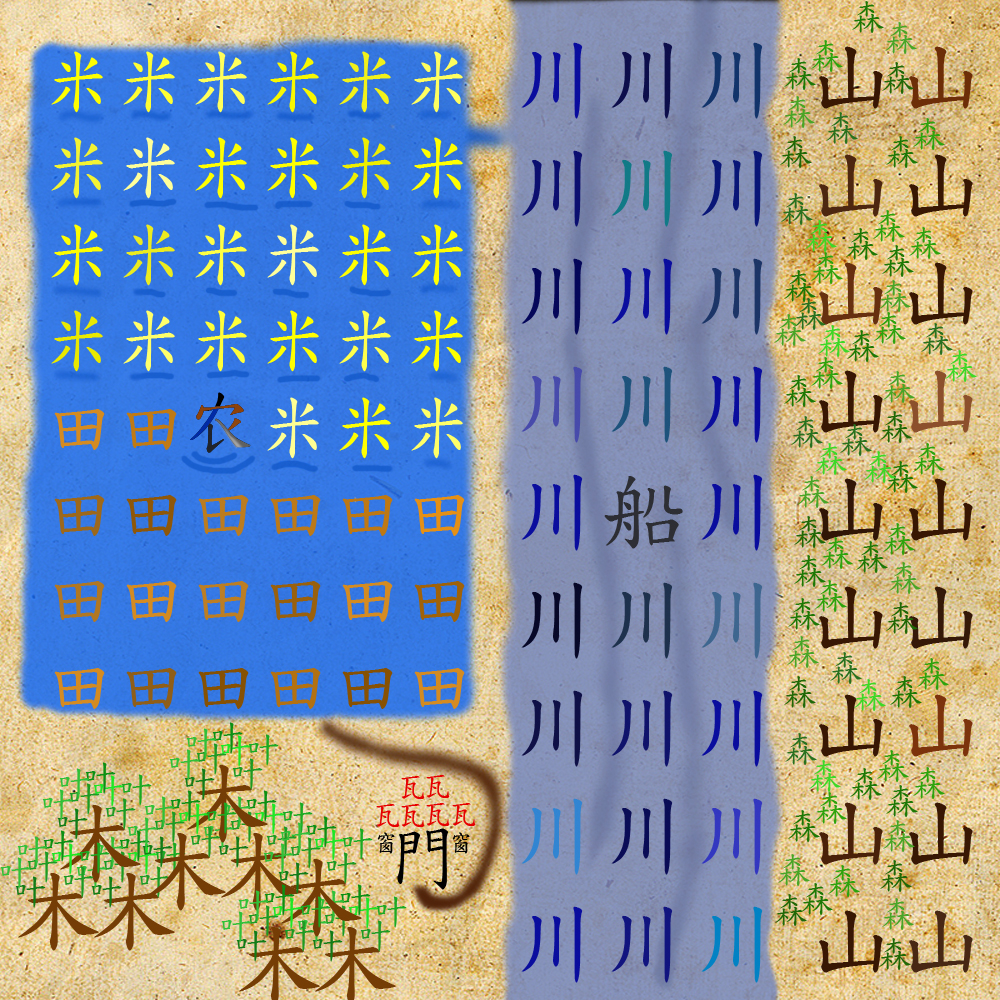
Landscape of a rice harvest by the river and mountains

rice harvestMany know that Chinese characters began by looking like the thing they describe, and even today, many of the characters still do. For example, the character for man (人) looks like a man with two legs.  Other characters, by combing, form other characters, such as the character for forest (森) which is a composite of three wood (木) characters stacked together.

I can’t be the first one to do this, but since Chinese characters are pictograms, why can’t they just be used in a picture wholesale? Thus this illustration, Landscape of a rice harvest by the river and mountains.

On the top left is the rice field, where bushels of golden rice (米) wait to be harvested by the farmer wearing a hat (农) and wielding a sickle. The already-harvested rice simply turn back into fields (田). His field is irrigated by the river that flows (川), and there is a boat (船) that is floating on it. The river is lined by the mountains (山), covered by forests (森).

The path leading from the field leads to the farmer’s home, It is but a simple house, with a single door (門) flanked by two windows (窗) and topped by red tiles (瓦). The house is by a forest, build out of large trees. A tree is essentially wood (木) topped by leaves (叶), yet the difference between wood and leaves are the little circular mouths (口) that feed the tree without the roots.

Last Summer

sword

We were singing little ditties
all summer.
We were singing little songs
of peace.
We had hopes to dare, to soar, to crash,
for we were little scamps
that summer.

We were riding adventures
all summer.
We fought hand-in-hand
together.
We braved far lands,
through bogs, our parents.
With our wooden swords we staved off dragonflies,
last summer.

But last summer
had come to an end.
Last summer did, as all summers are wont to do.
We were made to grow up
and say our goodbyes.
We may have traded our suits of armour
for suits of linen,
our swords become mantelpiece attractions.
But I will always remember
our summers.

The inevitability of translating poems

There will always come a point where poetry written in one language cannot be accurately translated into another, because of the very nature of the language itself. It is often cited that certain words in certain languages have such precise meanings that they usually cannot be translated into English. Common examples are ‘schadenfreude’ in German and ‘wabi-sabi’ in Japanese.

But a much simpler reason some poetry cannot be easily translated is simply for its puns, stress, rhyme or rhythm. A Czech person once told me in English, “I was smashed on concrete too much last night,” and that actually turned out to be a pun. In Czech, concrete is ‘beton,’ but it is also the name of a mixed drink ‘beton,’ which is short for ‘becherovka’ and tonic water. So simply saying you were smashed on concrete in English slightly takes away the meaning of the pun.

Such shortcomings become a lot more apparent in Chinese and Japanese, when many words share the same sound, and are only truly differentiated by context and the characters used.

用心听,用心走
Listen with your heart, walk with your heart/Listen carefully, walk carefully

听一听,只听见心在跳的声音
Listen, and only hear the sound of the heart beating
为过去的遗憾而跳
beating for past regrets
为现在的疑问而跳
beating for present doubts
为将来的一切而跳
beating for everything in the future
所作所为
but when all’s said and done
尺有所长,寸有所短
there are goods and bads
而这一页
and this chapter
将会结束
will end
我只能不理不睬心在跳的声音
I can only ignore the sound of the heart beating
往不定的前程
headed for an uncertain journey
往前走
headed forward

This was something I wrote that I found hard to translate, especially when the words were rife with double meanings. The title 用心听,用心走 means two things at once, depending on how you bind the words. “用心” as a compound means to be careful, but as a verb-noun construction means to use your heart.

Regrets, doubts and everything (遗憾,疑问,一切) are three different words, but they all share a fundamental sound of ‘yi’ at the beginning, creating a repeating rhythm and linking all three concepts to a basic fundamental. That is untranslatable in English.

The cadence of the past, present and future is also untranslatable. The structure used was “For the past’s regrets, it jumps/ For the present’s doubts, it jumps/ For the future’s everything, it jumps” where the heart “beating” and “jumping” use the same characters.

The line of ‘There are goods and bads’ is actually a proverb which literally means “A foot is as long as it is, an inch is as short as it is,” and a part of that section of the poem was written in four syllables per line, which cannot be adhered to in English.

Le regard neuf de l’enfant sauve même les trottoirs de l’usure

enfantThe fresh perspectives of a child will save even the sidewalk from attrition — Romain Gary

I learnt this phrase from a friend from France who turned up at my weekly circus. We talked about haiku and I mentioned about the naive perspectives of children being one of the most beautiful things about it, and he told me about this quote. I found it poignant and decide to illustrate it.

Every day I wake up less and less sure of myself — I open my email inbox with my breath held, expecting to be disappointed. Expectations were met. No response from any of the jobs I have applied at.

Every time I write I become less and less sure of my ability — I used to think that being capable got you places, and I was sure that I was pretty capable. Now am I less confident that that is the case, or that maybe I’m not that capable after all.

And then I realise that perhaps what I need is a fresh perspective to stop this attrition of the self and of the mind. I left college with a font of hope and optimism, and thought that sufficient to last me till I transition into the next phase of my life; where I start working. I guess I did not consider that this transition might take longer than I expected, and hoping to merely brave this foray with what I had would not be sufficient.

I will need to renew my view on how I take each day that does not bring me the news I so fervently wish.

Write less, say more

I’m not a big fan of long poetry. I admire people who do write them, and sometimes there are some that catch my eye, but for the most part I like my poems clean, smart and above all, short.

There is something beautiful about making the most out of scarcity. As I see it, we are born into this world and we are bounded by the limitations of our resources and our bodies. But yet we can achieve so much with so little.

I’ve once read that Coleridge once said that in a poem every word counts, but Poe went one further and said that not does every word count, but the position of each word counts too. Applying frugality to word choices makes one more aware of the effect of each word used.

How long is too long? Long enough to drive home what you need to say. Anything else that merely shows off the skill of a writer can almost be considered masturbatory. While it is hard to create the perfect rhyme to agree with meter and image, etc., it is a lot harder to convey a message with a paucity of words.

The words unsaid are the ones that
ring loudest.
Unfettered by noise,
they sing directly to the heart.

The images unseen are the ones that
are sharpest.
Neither myopia nor senescence
will diminish visions viewed by the  mind.

Invitations of a candle

DSC06253

Little moth, O little moth,
will you dance with me?
I sparkle and shine
all pretty and bright;
a beacon in the night.

Brave moth, O brave moth,
do I not inspire?
My flickering ways
set your passions aflame;
your goals, ambitions, aims.

Never mind the pile
of charred moths before you
lying at my foot.

Because you, illuminated and blinded
by my warm light
cease to be a moth for a night,
but become a butterfly
like they who flutter by;
unfazed, unhurried,
because you, with your Icarus wings,
know that you can make it.

So come and dance with me.

Don’t cry

When I was in primary four (fourth grade), I took part in a haiku competition on Children’s Day. It was also World Haiku Day or something, and everyone in school had a chance to participate. I submitted three, complete with drawings to go with them. One was about a spider, one was about a pig, and I can’t remember what the last one was.

I actually won something. I won a set of colouring pencils from Japan, with a Mickey Mouse motif. I was also given a book on haiku from children around the world. As a kid, I looked at the pictures more than I looked at the poems from children who were my age.

As I grew up, I would revisit the book every now and then. I also did something that I would never have done as a kid, and that was read the foreword and introduction. It was in Japanese, but there were translations. The foreword said to the effect of  “Haiku by children are always the most precious things. They say things as they see them, and that is surely the true essence of haiku.” (I don’t have the book with me right now, I’m just writing from memory.

And that is quite true. If you look at haiku these days, people think as long as you keep the 5/7/5 syllable (or mora, in Japanese) structure, you basically have a haiku.

threadlesshaikuThe above is a t-shirt design from this online store Threadless. Haikus sometimes don’t make sense on sight, but like any poem, sometimes readers have to work at them to get them. This ‘haiku’ has nothing more to it than a buffoonery of what a haiku is. People sometimes think that because the structure of haiku is so simple, the only way to be smart and outstanding is to be clever with words.

But traditionally haiku is visual poetry for the mind. The words are unassuming, but in the images they conjure, they reflect, capture and convey some truth in the natural world. Let’s look at a famous example, Bashou’s “Old Pond”.

古池や蛙飛び込む水の音

From Wikipedia, it translates as: An old pond, a frog leaps in, water’s sound. All of them simple images but powerful.

The haiku book I had said children see these images best. Have we as adults lost this ability forever, to see the natural with simplicity of mind and words? Maybe if we try hard enough, we might realise that perhaps what seem lost to time is merely buried and forgotten, but a good shovel and with some arm work, we might possible recover it.

mushiatsuiIt’s humid

I dropped my ice cream!

Don’t cry