The Hexacoto

Listening to the sound of one hand clapping

The Rich White Neighbourhoods ride

4

A lot of my long-distance rides have been around the city, and I’ve not ventured out of the city in a while. Not on a unicycle, at least. I wanted to ride to a beach on Fire Island, but that was perhaps 60 km and I was not ready for that yet. So I chickened out and chose to cross state lines instead, and head into Connecticut. This is probably the first GPS-recorded ride I’ve done in a year, with the last being my ride into Stony Brook, Long Island, last year around this time.

Here’s a picture of the route I ended up taking; click to see the larger picture. Skip to the end for ride stats.

ride190714

As always, for such trips, I went packed with supplies!

1

This time round, I had: a GPS, MP3 player, 1 Milky Way bar, a box of 5 granola bars that I bought for $1, a pack of chilli lemon peanuts that also cost a $1, spare battery pack for my phone, some AA batteries, keys, Nintendo 3DS for the pedometer, 3 litres of water, and my phone.

2

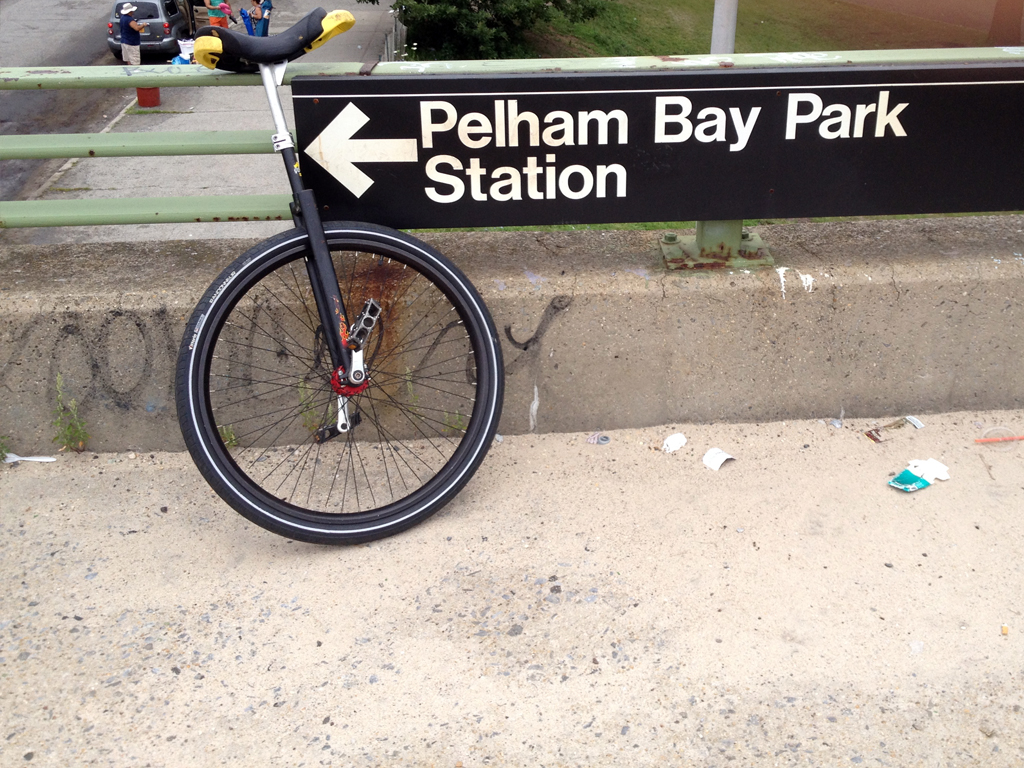
I started at the Pelham Bay Park station. Although I could probably have ridden from my home, which would have added an additional 20 km, I wasn’t ready for that kind of commitment yet. So the Bronx it is!

3

I crossed the Pelham Bridge, which was pretty, and everything proceeded to be pretty for the next 10 km or so. I rode past numerous mansion, golf courses, horse riding trails, basically affluence. I saw houses that looked like this.

5

You know what’s funny? Apropos of its name, this property is on PARK LANE, which is one of the pricey dark blue properties on Monopoly! Also, I broke my max speed ever (I think) and hit 31.4 km/h on a steep downhill! In retrospect I probably shouldn’t have done all the crazy downhill sprints I did because I think that burnt my legs out faster over the course of the entire ride.

6 7

I rode into New Rochelle, where I bought some iced coffee and had my first real break. I probably tripled the Asian population by being present there, but it was pretty. Rode past Larchmont, and into Mamaroneck, which was also really pretty. Geez I could probably sum up the ride with “Everything looked rich and really pretty.

9

Things were slightly less pretty when I rode too far inland (I was supposed to be hugging the coastline and following the train tracks) and I got slightly lost. Thankfully a dog in a car pointed the right way back to the coast for me and things were pretty again.”

16

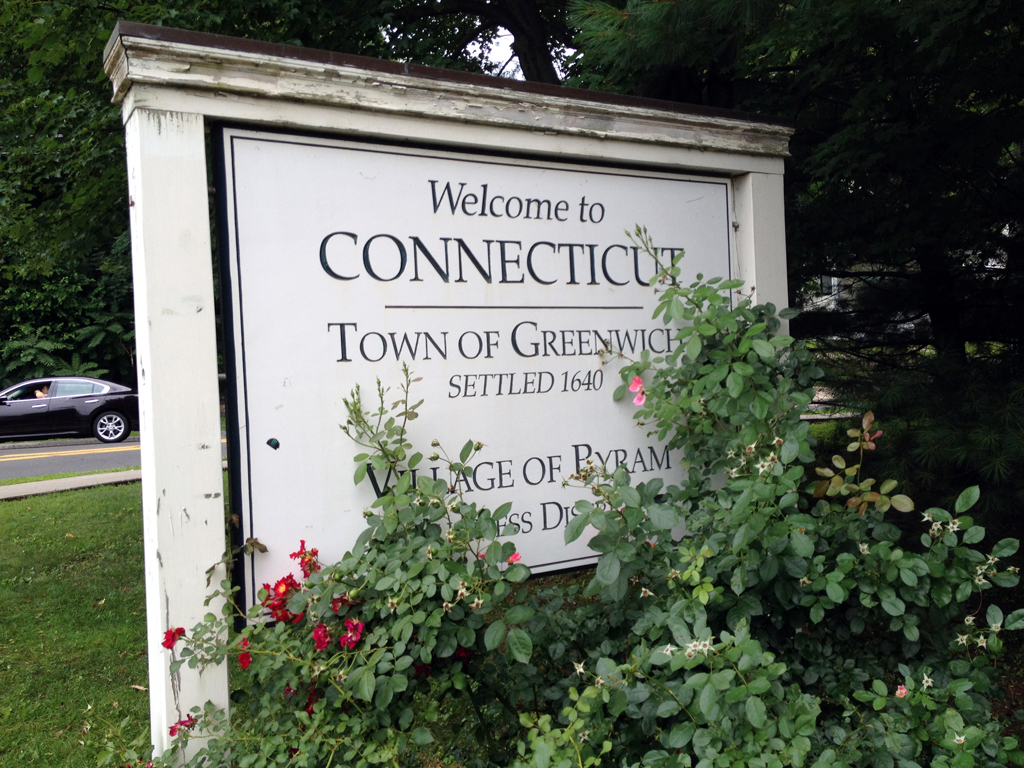
I made it into Connecticut! By this point my legs had already cramped up once (just prior to the dog-car meeting) and I was set to cramp up a couple times more in CT because it is so damn hilly. I expected Connecticut to be flat. Guess I should have just ridden into Iowa or Kansas or something.

17

First Whole Foods sighting, though it seems to be fancier than just regular Whole Foods, and is called Whole Body instead? Whatever Greenwich, CT. I just sat around in the parking lot eating my $1 peanuts and drinking my bottled water.

19

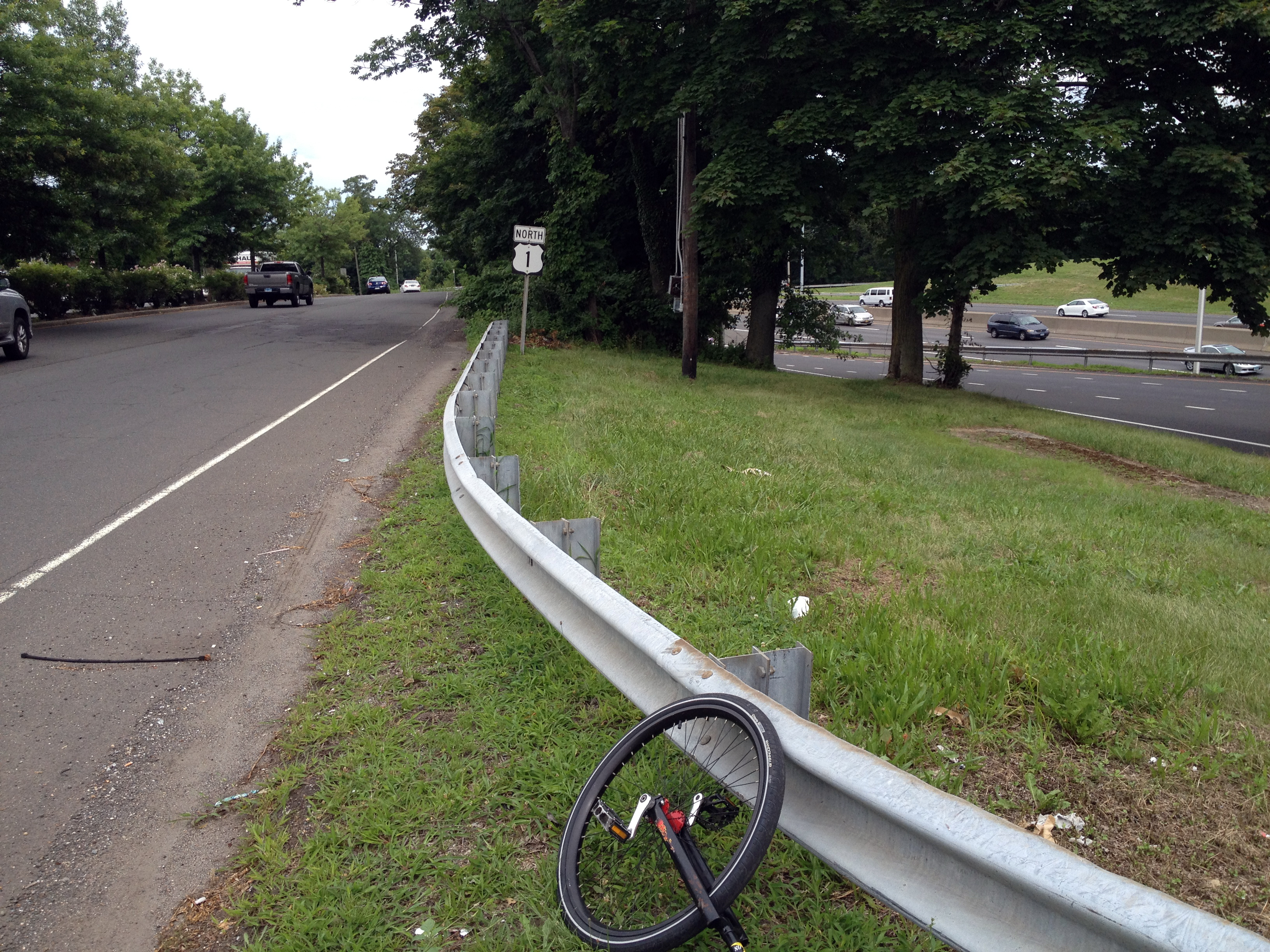
Once again we meet again, my nemesis: highways. It seems like every time I go on a long distance ride out of my comfort zones, I run into highways. I sit here wonder, “Should I enter and risk actually ending up on some highway?” or is this actually a local road? Thankfully it was merely a tricky local road that looked very highway-ish.

20 21

Yay I made it into Stamford, CT, which was where I was supposed to be. Surprisingly the only injury was from my backpack strap chafing my shoulders.

22

I got to live the true suburban life by hanging out in the mall, drinking Starbucks, and getting chased out of the mall by security. Apparently the Landmark Square Shopping Center is a bit of a grump when it comes to people holding onto a wheel and just sitting in the mall; my friend told me even people holding on to kick scooters and skateboards get kicked out. But push strollers are OK. I don’t know why.

24 23

Stamford, and by extension many of the other towns I rode past, is pretty, but that is all there is to it. It really has no character, to its streets. And given by the treatment I experienced at the mall, which is supposedly the crux of what there is to do in Stamford, this town is soulless, glossed over by a veneer of pretty.

I don’t think I could ever live here, dazzled by pretty architecture, but dismayed by inflexible authorities and a lack of celebration of alternative culture. In some sense, it is really similar to Singapore, filled with impressive futuristic buildings, towers ceaselessly piercing the skies and reaching ever new heights, but so lacking when it comes to building life at the ground level. Life and community does not begin in the air but in the hearts at the ground level. I end this ride with this amusing picture I came across at the MacDonald’s, which redeemed Stamford somewhat for me.

25

Final stats for the trip.

Total elapsed time: 3 hours 45 minutes
Total moving time: 2 hours 45 minutes
Total stopped time: 60 minutes
Maximum speed: 31.4 km/h
Total UPD’s: 1 (Early into the ride next to the horse riding track, as I was trying to set my GPS)
Number of crazy downhill sprints: 5
Number of times legs cramped: 3
Numbers of uphills walked up: 5
Steps counted by the 3DS: About 20,000
Breaks taken: 4

All Men In North Korea Are Now Reportedly Required to Get the Same Haircut as Kim Jong Un

This is way too funny not to reblog. At least the “undercut” was popular in North Korea before it even hit the States!

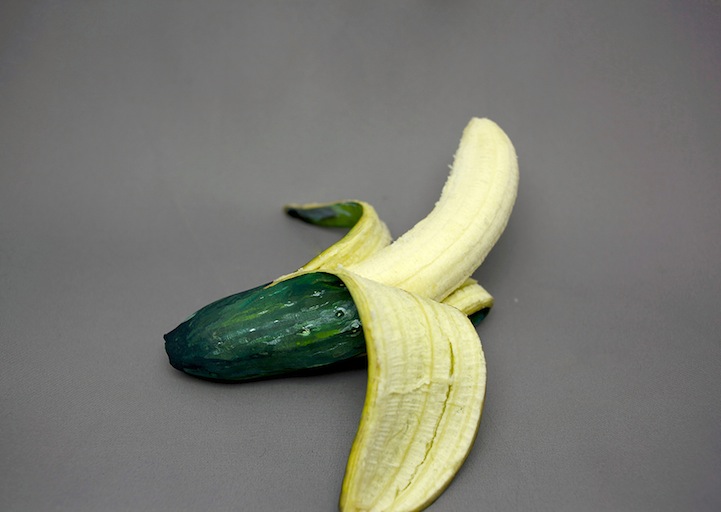
Ceci n’est pas un concombre


HikaruCho6

HikaruCho7

Japanese visual artist Hikaru Cho is known for her transformative paintings — turning things into something else through her application of paint. In this series, she turns various food items into looking like other food items, such as the banana above into a cucumber. She also did the same with turning an egg into an eggplant, and a tomato into an orange.

But Hikaru Cho does really amazing (and creepy) work with transformative painting on humans. Here are some of her best works:

Her site’s definitely worth checking out!

Bot or Not? Poetry does not compute

compupoem

Passing Time
Your skin like dawn
Mine like musk

One paints the beginning
of a certain end
The other, the end of a
sure beginning

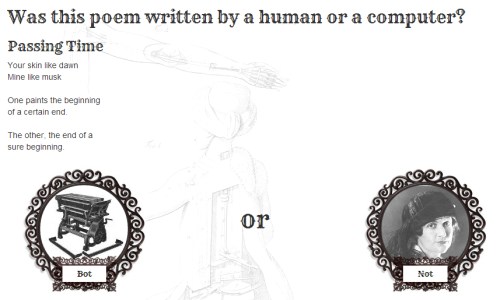
Do you think the above poem is written by a human, or generated by a computer program? That’s what site bot or not seeks to achieve: a Turing test where people try to discriminate computer-generated poems from human-written ones. By the way, the above poem, “Passing Time,” was written by a human Maya Angelou.

I have previously written about reconciling the idea of programming code as poetry, whether it’s possible to achieve “poetic beauty” in code. I posited that there might possibly be an inherent “poetic beauty” in poetry that we recognise when we decide a piece of writing is a poem. With bot or not, the idea of what makes poems poetry is taken in a different step: by identifying whether the “poems” are human or computer-generated, there must be something common with human effort that is visibly distinguishable.

That means that any piece of writing that is seen as containing enough of the essence of “poetic beauty” to be counted as a poem, can be further sub-divided into being human effort or algorithm-derived. There must be commonality between “computer poems” and “human poems” that we can decisively say, “Yes, this is the work of a human” or “This is clearly computer-generated.”

The Showcase

The site lists some of the top poems easily recognised as human or computer-written.

Poem

Generated by botpoet using JGnoetry (93% said “bot”)

Published on desserts and from pink. Symptoms
Start, 2013 as other poetry does anyone
Word in thailand and write reading one mother
Order they deserve. Well, 2013 recently released
My pants and serve throw from is a beautiful
Insane surreal once hours playing once.

Personal Space

Generated by botpoet using JGnoetry (87% said “bot”)

New poetry I might help you currently
Have been, snapping male, but it’s a rocket,
Kid man been forever idea of
My wearing a punk and brought old robot
Smog thing. Professional grown-up looking
In dusty old men remaining his tibia.

Bright

Generated by Jim Carpenter using Erica T Carter (85% said “bot”)

The name ghosts second, destroying.
The quite normal letter to the dutch throne after one year destroying the still stuck ridged snow, interpreted.
Undimmed radiance curves, primming like the column.
Lounging, as other as very high score.
Loafing a booby.
Lounging and spends.
Normal occasion joints.
Early letter gets the personal experience from the individual.
Getting, tarries however in cell.
Lounging.
Obsesses the disturbed surface.
Obsesses the abyss.

As can be seen, the above poems are mostly verbiage, and make no sense. We compare that with the poems most recognised as being written by humans.

The Fly

William Blake (87% said “human”)

Little Fly,
Thy summer's play
My thoughtless hand
Has brushed away.

Am not I
A fly like thee?
Or art not thou
A man like me?

For I dance
And drink, and sing,
Till some blind hand
Shall brush my wing.

If thought is life
And strength and breath
And the want 
Of thought is death;

Then am I
A happy fly,
If I live,
Or if I die.

Untitled

Shelby Asquith (86% said “human)

His smile was loud,
and me in my silence—
I thought it was meant
for me. Momma warned
me about boys like him.
Told me that the kinds
of boys that shined a little 
too bright might just be 
trying to distract me from 
the balled fists, the fury.
I was a fly and he lured
me straight into the light.
And oh how he burned
me, how he burned me.

O Fool

Rabindranath Tagore (84% said “human”)

O Fool, try to carry thyself upon thy own shoulders! 
O beggar, to come beg at thy own door! 

Leave all thy burdens on his hands who can bear all, 
and never look behind in regret. 

Thy desire at once puts out the light from the lamp it touches with its breath. 
It is unholy---take not thy gifts through its unclean hands. 
Accept only what is offered by sacred love.

Especially with Blake’s poem, these top poems display some things that computers can scarcely replicate. In Blake’s poem, there is a very strong meter and rhyme scheme going on. The other two read very coherently, where the ideas contained within the lines agree with each other, and a message flows from the poem to the reader. What does it take for a piece of writing/poem to resemble human effort? We look at computer-generated poems that people thought looked human.

#6

Generated by Janus Node using Janus Node (69% said “human”)

you

  are

      inscribed
          in the
           lines on the
     ceiling

      you

 are

   inscribed in
         the depths
   of
         the
    storm

A Wounded Deer Leaps Highest

Generated by Poets using Ray Kurzweil’s Cybernetic Poet (67% said “human”)

A wounded deer leaps highest,
I've heard the daffodil
I've heard the flag to-day
I've heard the hunter tell;
'Tis but the ecstasy of death,
And then the brake is almost done,
And sunrise grows so near
sunrise grows so near
That we can touch the despair and
frenzied hope of all the ages.

some men

Generated by Every Google User using Google Predictive Search (67% said “human”)

some men just want to watch the world burn 
some men just want to watch the world learn 
some men just want breakfast

In these instances, how did algorithmically-generated sequences of words suddenly gain the verisimilitude of human effort, whereas the computer-like computer-generated attempts shown above failed? Finally, we look at poems written by humans that people thought were computer generated.

Cut Opinions

Deanna Ferguson (76% said “bot”)

cut opinions tear tasteful
hungers huge ground swell
partisan have-not thought
green opinions hidden slide
hub from sprung in
weather yah
bold erect tender
perfect term transparent till
I two minute topless formed
A necessarily sorry sloppy strands
hot opinions oh like an apple
a lie, a liar kick back
filial oh well hybrid opinions happen
not stopped

Cinema Calendar Of The Abstract Heart – 09

Tristan Tzara (69% said “bot”)

the fibres give in to your starry warmth
a lamp is called green and sees
carefully stepping into a season of fever
the wind has swept the rivers' magic
and i've perforated the nerve
by the clear frozen lake
has snapped the sabre
but the dance round terrace tables
shuts in the shock of the marble shudder
new sober

Red Faces

Gertrude Stein (69% said “bot”)

Red flags the reason for pretty flags.
And ribbons.
Ribbons of flags
And wearing material
Reason for wearing material.
Give pleasure.
Can you give me the regions.
The regions and the land.
The regions and wheels.
All wheels are perfect.
Enthusiasm.

The Experiment

That we have seen the most human-like human/computer-written poems, and most computer-like human/computer-written poems, can we draw parallels for what constitutes human effort in poetry? On the technical side, can we say that, as per Blake’s poem, prosodic and auditory cues such as stress, meter, and rhyme give poems a sense of human effort, such as where by reciting “Tiger, tiger, burning bright/In the forests of the night,” we can not only hear the rhyme but feel a sense of constant rhythm to the poem?

Surely that can only be achieved by humans? Not rightly so. Assuming a bot program has access to a dictionary, and the stress, meter, and phonetics of all words contained therein all mapped out, how hard would it be to code for something that reads like human poetry? (Following is not real code, but an idea of how the code should behave)

<write human poetry>
component: alternate stress, strong-weak
component: vowels at end of line match; SET1:AAB SET2:CCB
SET1
component structure line1: [pronoun][conjunction][pronoun]
component structure line2: [verb][preposition][location]
component structure line3: [verb][noun]
SET2
component structure line1: [pronoun][verb]
component structure line2: [conjunction][verb][noun]
component structure line3: [conjunction][pronoun][verb]
And I just described:

Jack and Jill
went up the hill
to fetch a pail of water.

Jack fell down
and broke his crown
and Jill came tumbling after.

A bot could browse through a dictionary and probably come up with something similar. Granted, I “retro-wrote” the code, where I already had a poem in mind and wrote the “code” after, but if I can break “Jack and Jill” down into an algorithm that can be reproduced, using auditory and prosodic cues, then surely it is solely not that that determines human effort in poetry? However, if a program relies solely on prosodic and auditory cues, what’s to prevent it from putting in random words that fit those cues but make no sense in sequence? For example:

Bird and ball
swirled by the mall
and cocked a round of seaweed

Truth flew out
where running lout
and cops were sniffing soft beads

The prosodic and auditory cues of the above poem match “Jack and Jill” yet it makes no sense, and it is likely that people would judge it to be written by a bot. So what else is required for poems to be recognised as human effort?

The other thing you’ll notice where human-like poetry trumps computer-like poetry is coherence of ideas. In the poems that read human, most of them have ideas that agree with either a general theme, or the lines preceding and following them. The ideas contained in each line also display a progression, where there is something being explored or developed. The computer-like poems tend to show disjointedness of ideas.

Perhaps humans are predisposed to pass continuity and coherence as hallmarks of humanity.

Is coherence then unique to humans, or can computers imitate coherence as well? Let’s see if we can imitate coherence with an algorithm as well, with added prosodic and auditory cues. To achieve that, we need thematic cues. I’m going to use the following poem, “I wandered lonely as a cloud” by William Wordsworth.

I wandered lonely as a cloud
That floats on high o’er vales and hills,
When all at once I saw a crowd,
A host, of golden daffodils;
Beside the lake, beneath the trees,
Fluttering and dancing in the breeze.

<write coherent poem>
component: alternate stress, weak-strong
component: SET last line: [alternate stress, weak-strong]=false
component: vowels at end of line match; SET:ABABCC
component: [CENTRAL X(n)] designate IDEA
component: [CENTRAL X(n)]; X=verb, noun, adverb, preposition, adjective
component: [CENTRAL X(n)] must agree with THEME
component: [CENTRAL X(n)] must agree with [CENTRAL X(n±≥1)]
component: [CENTRAL X(n)] either expand or progress [CENTRAL X(n±≥1)]
SET
component structure line1: [pronoun][CENTRAL verb(1)][adjective][preposition][CENTRAL noun2]
component structure line2: [conjunction][CENTRAL verb3][adjective][preposition][CENTRAL noun4][conjunction][CENTRAL noun5]
component structure line3: [conjunction][adverb][pronoun][CENTRAL verb6][noun]
component structure line4: [noun][adjective][CENTRAL noun7]
component structure line5: [preposition][CENTRAL noun8][preposition][CENTRAL noun9]
component structure line6: [CENTRAL verb9][conjunction][CENTRAL verb10][preposition][CENTRAL noun11]
THEME:nature
(1) verb-noun agrees with (2); (2) agrees with THEME
(3) verb-noun agrees with (2);(4),(5) agrees with (2); (4),(5) agrees with THEME
(6) verb-noun agrees with (7)
(7) agrees with THEME
(7) preposition agrees with (8),(9); (8),(9) agrees with THEME
(10),(11) verb-noun agrees with (7); (10),(11) agrees with THEME
IDEA1:[(1),(2)]–>IDEA2:[(3),(4),(5)]
IDEA3:[(6)(7)]–>IDEA4:[(8),(9),(10),(11)]

Does the above make any sense? It took me a while to try to break down “I wandered lonely as a cloud” into a vague enough algorithm that in my opinion still represents the poem while hypothetically still able to reproduce another poem. Let me explain the above “code.”

The poem has various components, including a weak-strong stress meter; but the last line of the set breaks the meter. The last phonetic features of certain lines must match; in this case ABABCC. Within the poem, there are certain things, designated as [CENTRAL X] where X can be a verb, noun, preposition, adverb, or adjective. These [CENTRAL X] designate a contained IDEA, which is a sense of what that line means. The [CENTRAL X] must agree with a preset THEME, which in this case, is “nature”; where the words must be somehow relevant to “nature.” such as “hill,” “daffodil,” and “cloud” being all words related to “nature.” Not only must [CENTRAL X] agree with THEME, it also has to agree with each other, one or more preceding or following it. It does so not only grammatically, but also has to expand or progress it in a logical way.

IDEA1 contains [CENTRAL (1),(2)], which progresses into IDEA2, containing [CENTRAL (3),(4),(5)]. IDEA3 contains [CENTRAL (6),(7)] which progresses into IDEA4, containing [CENTRAL (8),(9),(10),(11)].

You know, even after so much postulating, I’m still not sure I have successfully “retro-coded” Wordsworth’s poem. Maybe it is coherence of idea that seem unique to human effort, and that humans are predisposed to finding order in nature. My head hurts from trying to break poems down like that. Maybe someone else can do this better than I can. Feel free to leave comments.

Bespoke education and entertainment, or risk it?

bespokeTwo days ago, I was at work transcribing an interview one of the interviewees used the word “bespoke.” That was a word I haven’t heard in a while, and I just shared my thoughts on Facebook, “I think “bespoke” might be my favourite word of the day, today.” It’s a simple word that means something one would not associate with how it looks and sounds: it basically means something that is tailor-made to individual preference.

My friend Kevin Allison, who hosts a podcast and runs the live comedy show The Risk! Show, commented, “I tried to cut it from a recent RISK story because I didn’t know what it meant.” I asked if he could not have simply checked the dictionary and he said something that struck me: “If I don’t know what a damn word means, plenty of listeners won’t either!”

This forced me to think a lot about the role of those delivering informational content, be it via print or broadcast such as newspapers (print/online) or the radio. Is it our role to expand the vocabulary of those watching/reading/listening, or should we create a bespoke program easily digestible and understandable by readers?

I’ve always been impressed with the balance of hefty words and simple terms that the New York Time achieves, and constantly learn new words or remember old ones I’ve forgotten. English is a beautiful language, the bastard amalgamation of some many languages from continental Europe, that in its plenitude are niche, forgotten gems we should celebrate.

But in our consideration of the audience, especially here in America, we (content producers) amputate ourselves to fit the ready-to-serve boxes that the audience expects. As my journalism professor once said, “Why used ‘dollar words’ when a ‘fifty cent’ one suffices?” Maybe because sometimes there is beauty in the complexity contained within the brevity of “dollar words.” The best uses of difficult words are those placed supremely in a sentence where the context allows the readers to read and extract the meaning without having to stumble over it, and upon reflection on the use of the word, appreciates that that word is not run-of-the-mill. Where a “dollar word” is pivotal in the sentence, and the meaning known only to Webster-Merriam, that is untenable. We use many clues in context and morphology to help us understand words we don’t, harkening back to ye ol’ grade school days of “reading from context.” Morphemes like “un,” “mal,” “pro,” etc. contribute to the understanding of the word, even if the reader doesn’t know the word, and writers should take that into consideration when trying to achieve beauty with their words.

But ere we lose the readers in a mire of SAT vocabulary list, there is nothing more exhausting than having to refer to a dictionary every couple of sentences. I think content producers, in an ideal world, should challenge the limits of the audience’s knowledge every now and then, and achieve a balance between inspiration and information.

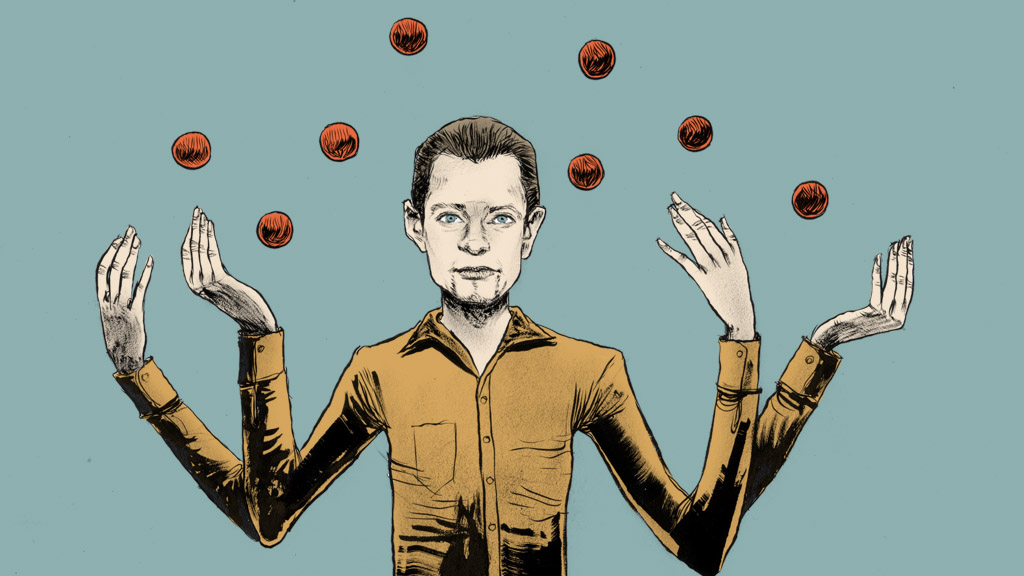
[Reblog] Dropped – The story of how the world’s greatest juggler fell off the face of the world

Image credit: Grantland

Image credit: Grantland

Dropped

Why did Anthony Gatto, the greatest juggler alive — and perhaps of all time — back away from his art to open a construction business?

BY JASON FAGONE ON MARCH 18, 2014

The greatest juggler alive, maybe of all time, is a 40-year-old Floridian named Anthony Gatto. He holds 11 world records, has starred for years in Cirque du Soleil, and has appeared as a child onThe Tonight Show, performing in a polo shirt and shorts, juggling five rings while balancing a five-foot pole on his forehead.

His records are for keeping certain numbers of objects aloft for longer than anyone else. Eleven rings, 10 rings, nine rings, eight rings, and seven rings. Nine balls, eight balls, and seven balls. Eight clubs, seven clubs, and six clubs. To break this down a little: There’s one person in the world who can juggle eight clubs for 16 catches,1and that’s Gatto. As for seven clubs, maybe a hundred people can get a stable pattern going — for a couple of seconds. It’s difficult to evenhold seven clubs without dropping them; your hands aren’t big enough. Gatto can juggle seven clubs for more than four minutes. “That’s insane,” says David Cain, a professional juggler and juggling historian. “There’s no competition.” …Read the rest of the story here.


This fairly long article speaks to me a lot about what it means to be a performer and what my craft means to me. Anthony Gatto, whom the jugglers I grew up amongst raved about all the time, fell off of the face of the performing world, after having received so many accolades. Were there to be a “king of juggling,” even today I believe jugglers in the know would not hesitate to crown Gatto still.

Fangone, the writer, did not manage to actually score an interview with Gatto, which is disappointing, but supplements his article with thoughts and analyses to try to explain why Gatto stopped performing to go into construction. Fangone wrote about, or quoted some of Gatto’s words that struck me as circus folk:

By now, though, Gatto’s relationship with the juggling community had shifted. He no longer regularly attended conventions or entered competitions. Gatto didn’t want to impress other jugglers. “Nobody cares about good jugglers in the performance world,” he later wrote in an Internet forum. “They care about entertainers.”

and this

Gatto’s frustration with young, Internet-native jugglers boiled over in 2008, when he got into a sort of arms race with Galchenko, the YouTube phenom. It began when Galchenko appeared on an NBC show called Celebrity Circus. He was there to set a record for doing as many five-club, five-up 360s as he could in one minute. He ended up doing the trick 21 straight times without dropping, breaking the previous record. After the show aired, Gatto posted a video of himself doing 24 five-ups in a minute, breaking the record Galchenko had just broken. Galchenko then posted footage of himself doing the trick 29 times in a minute. It went on like that for several more rounds.

A reporter for the Boston Globe called Gatto at the time and asked why Galchenko’s TV appearance had bothered him. Gatto praised Vova as a “great juggler,” but he also said of younger jugglers, “Until those kids grow a personality, they’re not going to wow anybody. The audience doesn’t care if you juggle 20 rings.” The reporter added, “Gatto now says he regrets getting involved in the 360s competition — though he says he can still go higher — because it sent the wrong message. The only way to judge a juggler, he says, is to watch him onstage, under the bright lights, over the course of a career.”

And finally.

(Gatto) gave in. He grew to accept the necessity of kissing the ball and lobbing it gently into the crowd with a grin. He also learned to make hard tricks look hard, to pantomime the exertion and self-doubt of a man working at the edge of his ability even though his ability stretched on and on. He learned to entertain, because for some reason, even though we exist in a physical universe defined by the relative attractive powers of massive objects, the mere demonstration of a lush and lovely control of gravity is not enough. He labored to please an audience that could never appreciate his greatness. Then he got older and watched a new wave of jugglers abandon the stage for the flicker of computer screens, sneering at the bright-light mastery he’d worked so hard to gain.

It’s at times when reading things like these that makes a practitioner of a performing craft wonder: What am I, and what do I want to be? What do I want to achieve what I want with my craft?

Do I want to push the boundaries of technical circus? My own skill have been stagnating for a while — even though I’ve over 10 years of unicycling, poi/flag spinning/etc. under my belt, my skills have not leapt beyond those “Youtube whizzes” who pick up the sport mere months ago and are coming up with insanely technical and difficult Youtube videos on their progress. I picked up the pirouette on the unicycle maybe six years ago, and the pirouette is very flashy and crowd-pleasing, but I haven’t picked up much else since then. It was only recently, as of a year or two ago that I started to push myself to go beyond, and learn something that would please less the audience and more those in the know; circus folk.

But very often I wonder if it’s worth it, as Gatto might have, when the fancifulness of its difficulty is lost on the audience. I’m not sure Gatto ever fully achieved that stage, where he could reconcile his integrity as a practitioner of juggling and perform to the extent of his ability, with what the audience can see and understand.

Answering the question, not the counterfactual

The above image made its rounds on Reddit the other day. The question asks “If you choose an answer to this question at random, what is the chance you will be correct?” The options are:

a) 25%
b) 50%
c) 60%
d) 25%

Since the randomly choosing one out of four answers is a 25% chance, so it’s a)… and d)? So since there are two correct answers, out of four choices, that is 50%, which is b). But there’s only one b), it’s 25%, so it’s a) and d)… ad nauseam.

STOP. You’re doing this wrong. Let semantics easily (and hopefully painlessly) tell you how to solve this question.

Let’s look at the question again.

“If you choose an answer to this question at random”

Let’s break it down:

IF [You] [choose 1 answer randomly] to [this] question, [percentage answer=TRUE?]

The secret is in the word, “IF”. It summons a counterfactual version of you, that you are able to discuss things in an “if” world, while not being constrained to answer by “if” rules. Thus, [counterfactual You] is supposed to pick 1 answer to [this], where [this] is self-referential to a world that has 2 correct answers out of 4. The answer is 50% for you in this world, not the world [counterfactual You] inhabits.

Hence, in your reality, not the [counterfactual You] in the question, just answer the question that they asked about counterfactual you, simple as that. An equivalent question, substituting counterfactual you with a third person, is:

Kevin has to randomly pick 1 answer out of four. However, 2 of the answers are identical and correct. What is the percentage that Kevin will pick a right answer?

Don’t sweat the counterfactuals, just stick with this reality. The right answer is B.

(No need to read the below if you don’t want technical explanations)

If you want a really convoluted discussion about semantics and counterfactuals and why we can discuss counterfactuals without being constrained by counterfactual rules, it’s simple. In counterfactual semantics we often discuss the death of Aristotle (or was it Plato?), such as “Aristotle might not have been a philosopher if he had died as a kid.” This relates to the topic of indices and what names refer to, largely researched and discussed by many linguists and philosophers, such as Kripke.

A quick answer, without going too in-depth, is that if we are bound by the indices of the counterfactuals we refer to, we will be unable to talk or respond because the counterfactuals are in an infinite loop. Thus, we can talk about Aristotle’s death without having to go back in time to kill him, or talk about what would happen at the end of the world without destroying the world to be able to talk about it. Take the following multiple self-indexed sentence.

If I were you, I would kill me

There are two people involved in the conversation, “you” and “me”, yet to our minds there seems to be a conventional understanding of what the sentence means. It means that “I am such a terrible person that if there were another person, and that person were talking to me, he would hate me so much that he would kill me.” For such a short sentence, it takes such a long sentence to elaborate. Thank goodness for indices! This is how the above sentence works with indices:

IF [counterfactual I][sees]me, [counterfactual I][wants][kill] me.

There you go.

The persistence of comprehension

chinesefup

Some time ago, Instagram user jumppingjack posted the above image of a note she left to her mum. She said that her brother secretly added extra strokes to the characters in the note. The result is interesting though: even though extra strokes were added, the note is still readable to most competent Chinese speakers. This phenomenon is very similar to one not too long ago in English, coined “Typoglycemia,” a portmanteau of “typo” and “glycemia” and a pun on “hypoglycaemia,” where as long as the first and the last letter of the word is preserved, the middle can be scrambled and the words are still understandable.

This is an interesting case in what I call persistence of comprehension, where comprehension of words persists despite efforts to thwart it.

The Preamble

Unlike English, which uses the alphabetic system where each letter is a phoneme, or Japanese, a syllabary system where each character is a mora, Chinese uses a logographic system, using “pictures,” or logographs to represent words. So unlike the other two systems where there are things to scramble, it is hard to “scramble” a picture, and scrambling a picture is no different from adding or subtracting strokes from a character, which is what jumppingjack‘s brother did.

Before I go further, let me type out what the note intends to say:

妈妈,明天的午餐因为
人数不够,他们把这个
活动换到下一个星期
(可是下个星期六中午我的
公司有个午餐)

谢谢 🙂  (我明天应该有吃午餐)

Mum, for tomorrow’s lunch because
there aren’t enough people, they have
changed this activity to next Monday.
(But next Saturday afternoon my
company has a lunch event)
Thanks 🙂  (I should be eating lunch tomorrow)

So how does persistence of comprehension occur in Chinese? I shall illustrate some of the characters that are easily understood despite the scrambling and the ones that threw me off (and my friends) the most. (Also, note that the person mis-wrote the character for 期 where he switched the 月 and 其 around, not of her brother’s doing. But the brother added an extra radical as well)

chinesemessy

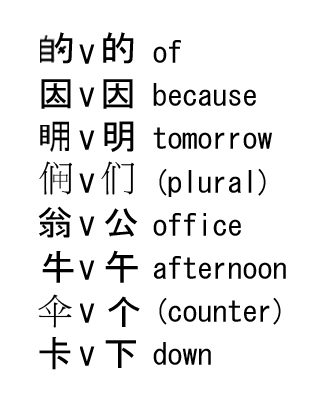
The image above sorts some of the words in the note in order of persistence of comprehensibility from top to bottom, with top being easiest to understand despite scrambling and the bottom being the hardest. The scrambled word is on the left and the proper word is on the right. Note that the bottom four scrambled words are all actual Chinese words, which I will talk about shortly.

The scrambling of the 的 character is one of the easiest to understand, because despite the additional stroke, it still mostly resembles its original character, and does not resemble any other words in the language. The added stroke is a not a radical, a graphical component of a word that is often semantic, unlike the scrambling of the character 明 (tomorrow). Similarly for 因, the added stroke turns the 大 in the 因 into a 太, but on the overall the word is not a real word and mostly resembles its original.

Now we look at the addition of a stroke in 明, turning the 日 (sun) radical, usually used for weather-related words, into a 目 (eye) radical, usually used for vision-related words. The resultant scrambled word is still not a word, but the morphing of a semantically-relevant radical into another makes one pause when reading the sentence. Also, the addition of a stroke to the 月 (moon) component turns it into a 用 (use) character, making comprehension even more difficult.

One step after the 明 character is the 们 character, where not a stroke but an entire 中 (middle) word has been inserted in the middle (haha) of 们. Some of my friends disagree that it is harder than the scrambling of 明, and I’m inclined to agree, and I’d put it as a toss-up between the two. However, I feel that the insertion of an entire word as opposed to a stroke or radical morphs the word enough to the point that it becomes alien enough not to even resemble its original, but does not resemble any other word in Chinese.

Lastly, the last four words, 公,午,伞,and 下, have strokes and/or word components added to them, that they actually resemble other words in the language, 翁 (old man), 牛 (cow), 伞 (umbrella), and 卡 (card). With such resemblance to real words, little wonder people have difficult understanding the words as they read them.

The Analyis

How is it that we are able to understand the note with little difficulty?

In the English “Typoglycemia,” it has been suggested that we identify words not solely by letter position in a word, but by context, shape of the word, and position of word in the sentence. I’m going as far to suggest that in English seeing the individual letters of a scrambled word draws upon our stored memory of the word, further aiding comprehension of a scrambled word. Compare:

  1. Adcnirocg to rrasceeh at a ptaruilacr ureitnvisy
  2. Aoincdrg to rcseerh at a plaaicutr uesvtniiy
  3. Aroindg to rearech at a pluiraacr utrisveiy

Example 1 is classic “typoglycemia” where persistence of comprehension is strong, example 2 removes one non-essential letter from each word, and persistence of comprehension is still relative strong. Example 3 removes what I consider an essential component to the memory of the word, which are usually consonants and not vowels. Take this example:

  • I cnt blve u dd tt!

In English, vowels can be removed quite easily and the comprehension of the word is still possible. This suggests that consonants play a slightly more important part in the reading of words. In that aspect, comprehension of written English has some similarity to comprehension of written Arabic or Hebrew, where typically vowels are not included in the writing (in the way English does anyway). Thus, it is harder to understand “aroindg” as “according” because

  1. An essential component has been removed (3 syllables, essential components in bold: a-cc-r-dng). This might be so because consonant representations are tied up with its phonetic properties. This is why “cc” or has to be removed as opposed to just “c” from “according” for comprehension to fail, because “cc” in the word correlates to the /k/ sound in /əˈkɔː(ɹ)dɪŋ/; even with just one “c” or it is sufficient to clue us in that there might be a /k/ or sound in the scrambled word.
  2. It is the first in the sequence of essential components, suggesting that perhaps we process essential components sequentially in our head. It could be that when we see the word “according,” we could be drawing upon the idea that “according” has the components “a-cc-d-ng” in that order. Hence removing the first component “cc” impedes comprehension as it cannot give the subsequent components context of what the word might be (compare understanding: “aroindg” (“cc” removed) with “aocrcdg” (“in” removed)).

How does this relate to Chinese? If we can say that we draw upon essential sequences of components in the comprehension of written English, perhaps there is an equivalent of that in the comprehension of Chinese. I believe that in reading Chinese, there is a stored visual memory of what the character looks like in general, and also an idea of what strokes the character should contain (“legal strokes”), and what it should not (“illegal strokes”).

First, we address whether modifying a Chinese character sets off alarm bells to the reader. Adding legal strokes to scrambled characters should stand out less to the reader, causing him to accept the character as a real word visually. We look at the following example where this is demonstrated:

chinesemessy2

In the note, a floating shuzhe (vertical-bend) stroke is added to the 够 character, and in the Chinese language there is no such occurrence of a floating shuzhe; they are always attached to other strokes, such as in 喝 (with some exceptions, like 断, which may or may not be attached). Being visually alerted that there is something wrong with the character, we immediately visually discount the scrambled 够, and are able to extract the original word. In the example of 他, the pie (leftward-slant) stroke is added on top of the 亻radical, creating a 彳(step) radical, which exists. Thus when reading the scrambled word of 他, it does not jump out at the reader visually as the shuzhe stroke in 够 does, and we are likely to gloss over it and accept it as it appears to us and are less likely to question whether the character is out of place contextually or not.

Next, adding a legal stroke to scrambled words causes more confusion when the stroke turns the original word into a semantically different word. There is extra confusion when the meaning of the new word does not fit in the context of the sentence, especially when the word has been accepted as it is, as explained in the previous paragraph. These can be seen in the following examples:

chinesemessy3

If my premises are right, in example 1, readers should be able to identify the error most easily and yet still read the sentence in its original context. In example 2, they should gloss over the wrong character, and since it still resembles very much like the original, is not a new or any word at all, persistence of comprehension should still be strong. In example 3, this is where comprehension begins to be thwarted, where 他能够卡去吃午餐 (He is able to card go eat lunch) and 他能够下去吃牛餐 (He is able to go down and eat cow meal) don’t make any sense as the scrambled words have both legal strokes and are real words, and the meaning of the scrambled words are contextually out of place in the sentence.

The Conclusion

What I have coined “the persistence of comprehension” is a seemingly little-researched area in English, much less Chinese. I offered the following reasons explaining the persistence of comprehension in English “typoglycemia,” where through the combination of context, length of word, letter position, shape of word, word position in a sentence, and (what I have demonstrated with examples) identifying the letters, which draw upon phonetic representations of the word in our head, we are able to read English.

In the more interesting case of Chinese, which is logographic, I posited that there are legal and illegal strokes which can be added to a character. Legal strokes are less likely to be noticed than illegal ones. If the scrambled word is a real actual word, the effect of having legal strokes masks the fact that the word has been scrambled, and when we read it, the sentence doesn’t make sense because we do not suspect a character has been tampered with.

All in all, more extensive research must be done, than what this blog can provide. I don’t know if I will be able to do so, but if anyone wants to hear my notes on this topic, feel free to reach out to me at ws672[at]nyu[dot]edu.

Note: In the original version of this post, I wrote that jumppingjack was male, when she is female. Corrections have been made.

Always returning home to Asia

By the way, I have started on my job as an editorial fellow at Jing Daily, a publication about China’s luxury business. While not exactly at the top of the list of things I dreamed I’d be writing about, it is a start for my journalism career, I suppose.

There, I write things like:

Sotheby’s World-Record Jadeite Necklace Primed For Top Chinese Bidders

and

Luxury Pushes Hong Kong’s Sky-High Retail Rent To Top Global Spot

It seems that I often write about very Asian-related thing; on this blog a lot about Japan, and now at work, exclusively about China. At one of my previous internships, it was also at Asia Society, which I enjoyed enough, writing about Asian current affairs to an American public.

For a person that took such pains to leave Asia, it seems it has come full circle to bite me in the back by having me write so much about Asian issues. As much as I don’t wish to sell myself as the “That Asian guy writing about Asian news,” that’s what I seem to have been doing lately.

Is that necessarily a bad thing? I’m not sure. I mean, is it a bad thing that I have access to Asian news and understanding, having actually hailed from thence? Maybe one day I’ll get to graduate from writing about Asian news.

The covenant between a reporter and an interviewee

Bitcoin traders Kolin Burges, right, of London and Aaron, an American who gave only his first name, hold protest signs in front of the office tower housing Mt. Gox in Tokyo on Tuesday. (Associated Press)

Bitcoin traders Kolin Burges, right, of London and Aaron, an American who gave only his first name, hold protest signs in front of the office tower housing Mt. Gox in Tokyo on Tuesday. (Associated Press)

The Story

An article on the Wall Street Journal today on Bitcoins, Shutdown of Mt. Gox Rattles Bitcoin Market, jointly written by Robin Sidel, Michael Casey, and Eleanor Warnock, talked about the closure of Mt. Gox, the Tokyo-based Bitcoin exchange, and the lack of regulation of the virtual currency.

In a nutshell, it talked about Mt. Gox stopped all transactions on Tuesday, and that it has been experiencing technical difficulties for months, including a hacking attempt two weeks ago and an alleged loss of almost 750,000 Bitcoins, about 6% of the Bitcoins in existence and valued at $400 million. Overall, it cast a pretty grim outlook on the future of Bitcoins as a reliable trading currency due to its volatility and lack of regulation.

One of the subjects interviewed for this story was Erik Voorhees, a Panama City-based investor of Bitcoin startups, whose mention in the story was:

Erik Voorhees, another investor in bitcoin startups, said he has given up on a stash of more than 550 bitcoins that he has at Mt. Gox. At current prices, they are valued at about $300,000.

“That’s gone now,” said Mr. Voorhees, who is based in Panama City, Panama. “There’s no chance of getting that back now.”

No one knows how many investors face possible losses or how much money is at stake. Mt. Gox has been losing trading volume in recent months to rival exchanges. Efforts to reach Mt. Gox officials were unsuccessful.

Voorhees (whom the author misspelled as “Veerhoos” originally) felt that his quote was heavily misrepresented, and his interest in the matter completely warped. He posted an open letter to the reporter, Casey, on Reddit:

Hello Mr. Casey,

I read your WSJ article today. I feel deceived by you.

You requested to speak with me, so I took time out of my day to do so. We talked for 20 minutes, during which time I conveyed to you my sentiments about the Bitcoin ecosystem and the matter of MtGox’s collapse. My message was unambiguously a positive one. I didn’t focus whatsoever on the personal funds I lost at Gox. Indeed, the impetus for your call was my heartfelt post on Reddit.

Yet, you ignored everything I said. The only quote that you published from me in the Journal’s cover story was “”That’s gone now,” said Mr. Veerhoos, who is based in Panama City, Panama. “There’s no chance of getting that back now.””

Is that really the takeaway you had from our call and from my letter? Is that your idea of journalism? Did I come across with the sentiment of a despairing investor whose confidence has been rattled? It seems you were happy to completely ignore my sentiments, preferring instead to cherry pick the one fact that is least important, in order to paint a narrative that Bitcoin’s biggest problem is that it’s not “regulated.” I didn’t expect you to quote everything I said, but should you not have maintained at least a modicum of fidelity to my message?

I have dedicated my life to building and supporting the Bitcoin project. I don’t give a damn about the money I lost at Gox. That’s not important. What is important is that Bitcoin is resilient and enduring, and will continue to grow and change the world for the better. It is a story of human progress through technology. It is a story of the good seeping into the cracks of a corrupted financial system. It is a story of passionate people struggling against all odds to remedy the calamities brought down upon society from the most potently misguided people and institutions on Earth.

Next time you spend your efforts casting a pall over this cause, please don’t ask me to contribute mine.

-Erik Voorhees

PS – I will be posting this letter openly on Reddit. I will post your reply if you’d like. And if I do, I won’t cherry pick the most misleading points of it, and I will spell your name correctly.

The Ethics

This invites the the question of the integrity of journalists — constrained by word space and the angle they have to push, how much liberty can journalists take with regards to the quotes they get from their interviewees? Any reasonable reading of the article will find not a shred of a positive light regarding Bitcoins, what with lines like:

But the unregulated currency isn’t backed by a central bank, raising alarms about which bodies can intervene when crises arise.

Or:

The Mt. Gox mess hasn’t changed the enthusiasm of Overstock.com, which began accepting bitcoin for payment in January.

It is clear that the authors were trying to push the angle of the unreliability of Bitcoins. However, interviewee Voorhees’ given interview was that of a positive one with regards to Bitcoin usage and its future, according to his post on Reddit. The reporter Casey then seems to have misrepresented Voorhees’ interest by cherry-picking quotes and placing them out of context.

From an ethical point of view, that seems dastardly. I understand that writers have to pick a strong, consistent angle to sell the story, and Casey picked the one about the unreliability of Bitcoins, and had to ensure that the theme is consistent throughout the article. But when the trust in journalists to protect the integrity of given interviews is lost by the interviewees, who will be left to give any more interviews in the future? While not on the same level as Judith Miller refusing to disclose her sources, there is an expectation from interviewees that the journalists whom they have agreed to grant an interview to will no misrepresent them. This is a covenant between the reporter and the interviewee that should never be broken.

One then would also have to wonder about the blame of the editor, who is responsible for making sure the story is as sell-able as possible. In this case, we have not heard back from Casey regarding the decision to cherry-pick Voorhees’ quotes, whether was it his editor that pushed for that decision or was it purely Casey’s. While it is the reporter’s job to do the legwork of collecting the facts and quotes, the editor, who puts things together and rearranges them, is as much a part of the journalistic process as is the journalist.

Interestingly, Chris Lamprecht, known as the first person in the world to be banned from the internet, commented on Voorhees’ predicament.

Erik,

A long time ago, in 1995, I was the first person banned from the Internet, and my case was in the news. An honest journalist once told me something very important that I never forgot. I was asking him if he could include certain things in his article. He said:

“Chris, you have to understand that journalists are not your PR agency. Journalists have their own agenda. They are going to write whatever story they want to, or whatever story their editor told them to write.”

Any honest journalist will tell you something similar. Unfortunately, not enough journalists care about writing an accurate story.

Thanks for being a good voice for Bitcoin.

Truer words never spoken, and an unfortunate but accurate description for what journalists were and still are today. Why do we tolerate such shoddy standards though? It is not as if journalism has to be that way.

The Answer?

Journalism has always been a reader-led effort — not only what the readers want to read, but how they want to read it, journalism has always answered and provided. If readers want salacious content, then salacious content becomes “journalism.” If readers want their content speedy, where the first medium to produce the article is the most efficient, then hasty journalism becomes journalism as well.

And then we proceed to complain about why journalism these days is so poor in content, and poorly fact-checked.

We have to realise that journalism is what we want to read, and until we decide that we want accurate, fair, and balanced journalism, we will always have shoddy, subpar works that obfuscates as much as it tries to tell a story.