The Hexacoto

Listening to the sound of one hand clapping

So is Zuckerberg fluent in Chinese or not?

Image: Tsinghua University

Image: Tsinghua University

Mark Zuckerberg recently made news because of a dialogue he gave at Tsinghua University in Beijing, China, where he spoke (Mandarin) Chinese. Here’s the link to the full video, 30 minutes long.

There have been news coverage about Zuckerberg’s Chinese language skills, from laudatory “Of course he speaks fluent Mandarin” headlines to less-than-favourable comparisons to that of a seven-year old. It turns out that there is a problem with the mixed coverage of Zuckerberg’s student dialogue — the news and the public often get confused what language “fluency” is.

Zuckerberg’s spoken Chinese, while mostly coherent, and with some interruptions, mangled most of the tones that the Chinese language is widely known for. BBC’s coverage pointed out that Zuckerberg’s failure to properly produce tones led him to claim that Facebook had just “11 mobile users” instead of “one billion.”

To understand how “fluent” one is when talking about mastery of a foreign language, one needs to understand the difference between “competence,” “performance,” “fluency,” and “proficiency” — four terms often used in such discussions. I’ll attempt to explain the differences between these four concepts.

Language competence and performance are the two biggest things that people are actually talking about when discussing a person’s L2 (foreign-language) “fluency.” Simply put, competence is a person’s grasp on the language’s grammar, phonological/phonetic rules, etc. Thus a person can be completely competent in a language but unable to perform as well. An example would be a person completely able to understand and speak Spanish, but unable to roll one’s R’s.

The distinction between competence and performance was notoriously made by Noam Chomsky in 1965. However, Chomsky’s notion of grammatical and phonological (linguistic) competence was expanded by Dell Hymes in 1966.  It included the knowing of appropriateness of topics and politeness (sociolinguistic), understanding how to combine language structures into different oral and written types (discourse), and knowing how to repair communication breakdown in the presence of interference (strategic). These concepts came to be known as “communicative competence” in literature.

Zuckerberg’s Chinese performance with his tones was bad, but he understood most of the questions asked. He was also able to answer simple to moderately complex questions in grammatically-sound Chinese. His use of humour and appropriate politeness further signals competence. It can be said that he’s mostly competent in Chinese.

Fluency is the measure of the ease of production of the language. It can be measured by speed, sustainment, and/or lack of breaks. Fluency includes not only speech fluency, but reading, writing, and even listening. Thus a person could be illiterate and have a limited vocabulary, but can be considered fluent if the speech occurs at a smooth pace. Zuckerberg’s speech does contain many pauses in parts of his speech, to the point that it might be hard for the listener to understand what he’s trying to say. He may not be very fluent, but through context of his speech, listeners (especially native speakers) are able to repair the content of his speech mostly.

Lastly, proficiency is the mastery of how well one uses the language, and can usually be tested by means such as the TOEFL or JLPT. One thing that was pointed out to me is that in language testing, proficiency is usually norm-referenced; that means that test takers are tested on how well they did in comparison to other test takers. This is different from criterion-referenced tests, such as the GCEs and GCSEs, where test takers are measured if they meet a set of pre-defined criteria. Once again, a speaker can be fluent in the language, but not necessarily proficient.

Singapore’s obsession with “tsap”

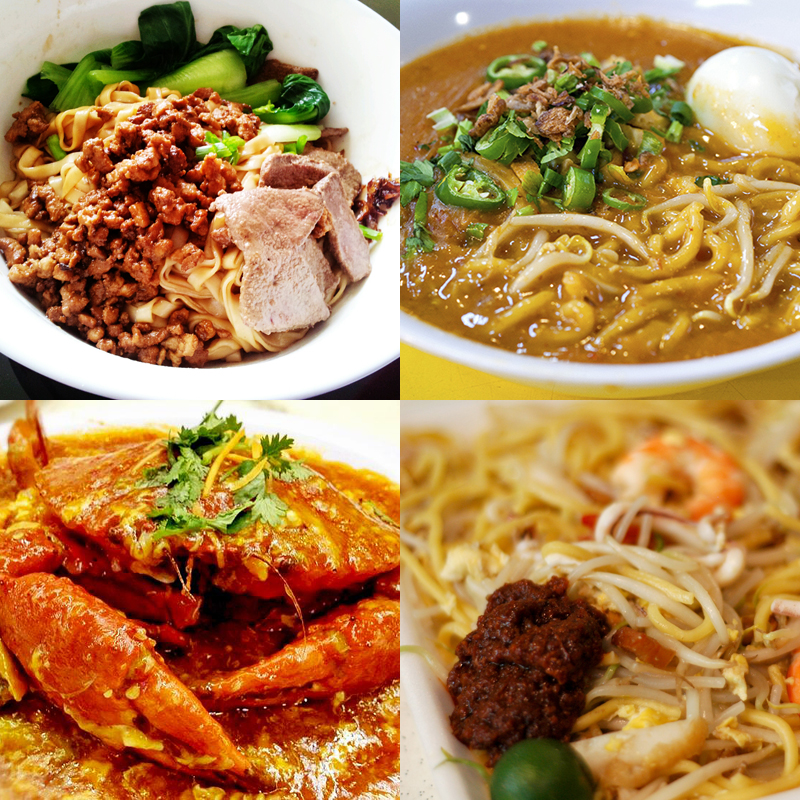
These four have something in common: "tsap".

These four have something in common: “tsap”.

Many of Singapore’s many iconic dishes: bak chor mee (minced meat noodles), chilli crab, Hokkien prawn mee, to name a few, tend to have a commonality — more often than not, they all have “tsap” (汁) or sauce/gravy in them. No matter Malay, Indian, or Chinese, Singapore dishes are sauce-heavy and gravy-generous. Singapore’s love for sauces and gravy doesn’t stop at local dishes, but extends its saucy reach to foreign cuisines localised in the country. It is hardly ever talked about, but even in “tsap” can we tease out what it means for a dish to be “truly Singaporean”.

How does Singapore’s love affair with “tsap” contribute to establishing identity? The answer lies with how we localise foreign food. Cuisine localisation anywhere in the world takes into consideration local preferences, and modifies the dish accordingly. For example, mapo tofu in the United States is generally always saltier and less spicy than its Asian counterparts (true can be said for most Chinese food in the U.S. really).

Now in Singapore, discussion of food localisation usually surrounds taste: food is usually made less salty, less greasy, etc. But modification of texture to imported cuisines goes unnoticed, because something as simple as sauce is so basic to a dish that we forget it exists, just as we don’t think about how we breathe and taste. That does not mean we cannot learn something about our psyche and approach towards food from “tsap”.

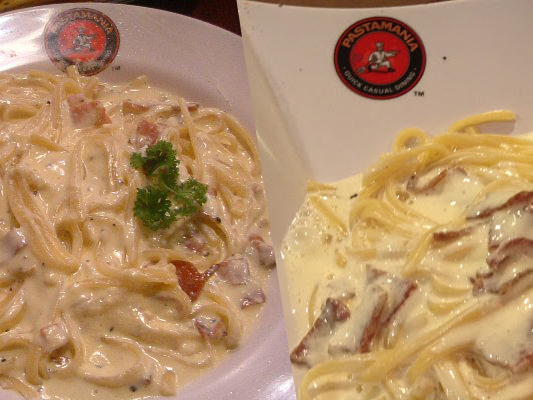
Case in point: carbonara pasta and pasta with marinara sauce. Carbonara in Singapore is usually heavy on the cream sauce — Singaporeans want to see their pasta sitting in a pool of it, and one of Singapore’s biggest pasta chain Pastamania serves their pasta carbonara swimming in sauce.

Two examples of how carbonara is served in one of Singapore's largest pasta chains.

Two examples of how carbonara is served in one of Singapore’s largest pasta chains.

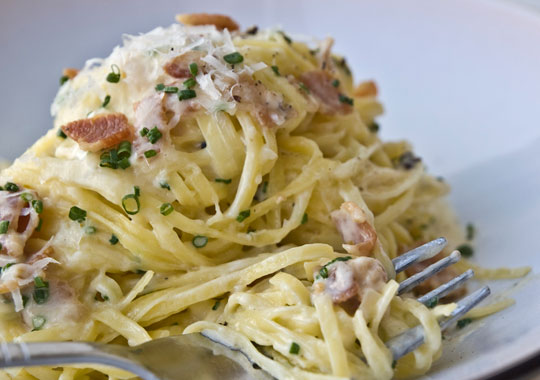
However, real carbonara is actually pretty dry. Be it in the United States or in Europe, most of the carbonara I’ve had outside of Singapore tend to not drown the noodles in “tsap”.

car3

Proper carbonara lightly clings to the pasta. Not only just with carbonara, but Pastamania’s marinara dishes are akin to soup.

Pastamania's marinara vs. some other country's marinara

Pastamania’s marinara vs. some other country’s marinara

Of course, one can say that Pastamania, as a chain restaurant, isn’t representative of how the food is supposed to be served and that they serve bad pasta, but that is besides the point. What we’re looking at is how these companies think Singaporeans would like these foreign cuisine best, and their verdict: swimming in a lot of “tsap”. In my experience, not only Pastamania, but many other local pasta establishments, from chain restaurants to slightly fancy “atas” restaurants tend to be heavy-handed on the sauces.

Has anyone ever stopped to think “What makes Singaporean food so Singaporean?” Many will quickly point out that spiciness is an aspect. But just as Singaporeans can be pointed out in a crowd in a foreign country purely by accent alone, “tsap-heavy” food is idiosyncratic to Singapore and is an identifying element when local dishes are compared internationally. An example of “what makes X food so identifiably X?” would be Japanese dishes and their philosophy of preserving the natural flavours of the ingredients, so much so that they serve individual dishes on separate serving dishes so as not to mix flavours.

A reason, I suspect, why Singaporeans love gravy so much could be our mantra of being kiasu, or the fear of losing out. The idea that “more is better” sticks very close to our heart — why would you have less gravy when you can have more? Singaporeans get ecstatic when their dishes come more liao (料), or toppings, and having extra “tsap” comes close. Just think of how people advice when ordering cai png (economic rice) to never forget to ask the server to drizzle/drench the food with sauces, curry, and gravy in hopes of getting extra food morsels. Our desire for value (or fear of losing it) manifests itself in extra “tsap”, so much so that the gravy is sometimes as much the dining experience as the entrée itself.

When ordering cai png, never forget the gravy or curry.

When ordering cai png, never forget the gravy or curry.

Another possible reason could be that Singaporeans are culturally averse to eating anything that is purely dry. Compare eating a baguette with eating a baguette dipped in chilli crab sauce or curry. Compare eating a plain roti prata with roti prata drowned in curry. Think about how even when we eat Khong Guan biscuits, there is a desire to dip it in hot Milo or kopi. I wonder if the heavy usage of steam and moisture in many of our cooking have led us culturally to prefer hot and moist food. Many Americans I know have no qualms about eating cold pizza (gag). In the Chinese language, hot food can be described as re pen pen (热喷喷), literally hot and spewing, and I imagine it is spewing steam; an element of moisture. I guess in English there is “piping hot”, but it conveys less the image of moisture as it does purely heat. I cannot speak for the other major languages in Singapore whether they have similar food adjectives. Gravy and “tsap” do have excellent heat-retaining properties, and are pretty wet too.

What does this say about us as a culture and the way we like our food — which is hot and wet? Well, not much, except that we like our food hot and wet. It is possible to extrapolate and say that philosophically hot food to Singaporeans is a source of comfort, and that gravy on our food not only adds flavour but serves additional soothing properties, but that is a bit of a stretch. However, simply being able to distil what makes Singaporean food so Singaporean is an exercise that can be applied to many other aspects of our lives — what makes Singaporean writing so Singaporean, or Singaporean English so Singaporean, etc etc?

So the next time someone asks “What makes Singaporean food so Singaporean?”, the answer is: If we love it, we lin (淋) a lot of tsap on it.

Subway Series Haiku: 4 – Perspective

Maternal display:
Rat leads its young on the tracks
— They are seen as filth.

Subway Series Haiku: 3 – Blessed

“Sorry to disturb”
“Need to feed my kids at home”
“God bless everyone”

Subway Series Haiku: 2 – Livelihood

Man at the turnstiles
Selling swipes for two dollars
— Twelve dollars an hour

Subway Series Haiku: 1 – Transit

Strangers on a train
Stealing glances through the trip
Then one has to leave

We danced, we laughed, we skipped around. And then we were twenty-six.


I wish you good luck.

I wish you good luck.

Captain

We became friends, and we were friends, and then one day, friends no more.

What does one do when a friendship, whose tethers are time-worn and frayed, comes loose and slips away? Time ebbs, and the vessel departs, do I fling myself to reel it back?

Or do I set it alight and let it go, in a Viking’s funeral, remembering that it once burned, with the last memory of its light in sight?

And now that I find myself aware of all the ropes around me in varying stages of decay, do I darn them, mend them, let them be?

Lines

“Let it go,” it says. “Let it go. It is the way of life. Two parallel lines may never meet, but if they differ enough, will remain close enough that they merge for a really long time. But eventually, they will depart, and then it is time to go.”

“But why does it have to be that way?” I ask. “Our lives are not simple straight lines. We meet by circumstance, but it is by virtue of entanglement that we remain hurtling through space bound; entwined.”

“All things tend towards chaos,” it says. “And in chaos squared, tangled lines come unwound, and come free of each other. That is the very essence of life. A static line is a dead line.”

Inexorable

We must grow up, but must we grow apart? Perhaps part of growing up is learning to let go, perhaps part of letting go is to know — when to say hello; when to say good morrow; when to say good bye, and say no more.

Perhaps one day, I will hear from you again. Until then, fare thee well, I’ll keep these memories.

shaf

Unicorns on a unicycle at UNICON 17 Part 2

Previously, on Part 1 of Unicorns on a unicycle at UNICON 17…

I arrived in Montreal, went to a naked bike ride, attended some UNICON events, made some friends.

mtl8

What’s the point of bringing two unicycles into Montreal and not doing a ride, right? A long distance ride was in the cards, because I wrote “Long Distance Ride” on them.

I wanted to go to Habitat 67, because the last time I was in Montreal I got lost and did not make it there. Habitat 67 was my first introduction to Moshe Safdie and his works, and subsequent introduction to brutalism and architecture movements. The best I got previously was a blurry view of the site from a distance in the evening, because the island Habitat was situated on is incredibly confusing.

Anyway, I set off from my friend’s place, with whom I was staying, and realised it was a pretty straightforward ride. However, what was not so straightforward was riding on the roads. Because:

Montreal roads are utter shit.

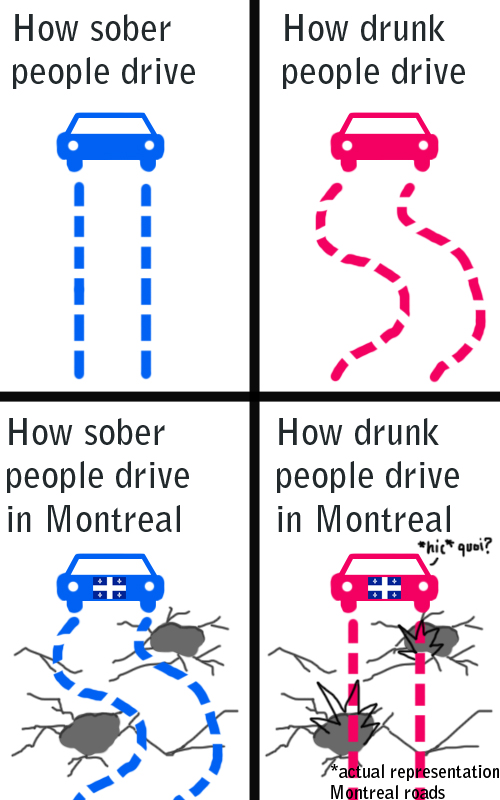
Seriously, did they pave them out of sugar? Potholes, cracks, and dragons waiting to snare the unsuspecting (uni)cyclist to break their mothers’ backs. I must have broken mine many times, because I fell many times. According to my local friend Mike, this is a local wisdom:

montrealroads

This is how I unicycle in Montreal:

moncafeglace

I dropped an iced coffee while riding Montreal’s treacherous roads. It was half-full too! (Is it optimism if I drop a half-full cup of coffee or half-empty cup of coffee?) I bemoaned loudly my dismay (in French of course, because we’re in Montreal. Come on.) at the city’s lamentable roads.

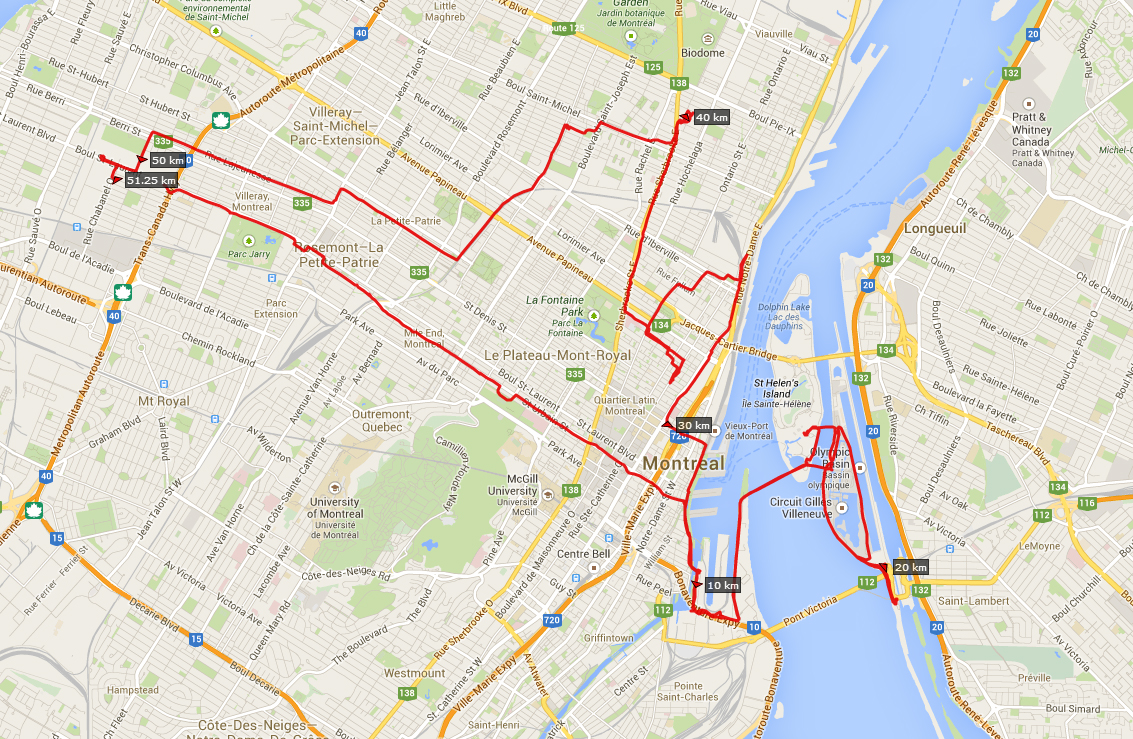
Lost coffee aside, I did manage to eke out a 51 kilometre ride. Here’s the map of the route, click image for larger picture.

090814

Somewhere early in the ride, I hit a hidden pothole when I was going downhill and I flew forward really hard. I was really worried I was going to land on my bare knees and had to roll on the roads, but luckily I managed run out the momentum. I must have been going at 22km/h. While I was alright, my unicycle apparently bumped around and into the rear of a car, whose family was standing around. Then I had to worry if I damaged his car, but luckily there was no damage. After ascertaining that his car was fine, then he asked if I was OK which I said I was and sped off, albeit more cautiously this time.

mtl9

All that talk about getting to Habitat 67, I finally got there and took pictures like an architecture nerd. Sated, I cycled onto the islands of Parc Jean-Drapeau. I had fun riding around the F1 track and going “broom broom.”

mtl11

I thought I would be able to get out the other side and then find my way out by going north, but then I ran into this:

mtl10

A raising bridge was raised so some private yachts can pass through. Meanwhile, us non-1%-ers twiddled our bicycles (and unicycle) while we waited for the bridge to come back down. I didn’t wait long enough for it to come down, because 15 minutes later the bridge was still up. So I backtracked all the way I came — something I really hate to do — and made it back onto the mainland of Montreal.

mtl12

I had lunch at Beaudry, which was the gay district of Montreal. It was very pretty and gay. I had lunch at an A&W, something I hadn’t seen in years! It also had free wifi, which was great.

mtl5

I cycled back to the college, and then to the apartment where the other Singaporeans were staying, and then back to Mike’s. Here are the final stats of the trip.

Total elapsed time: 4 hours 30 minutes
Total moving time: 3 hours 16 minutes
Total stopped time: 1 hour 14 minutes
Maximum speed: 27.9 km/h
Total UPD’s: Frickin’ SEVEN. 4 times alone on that accursed Rue Sherbrooke. 1 time speeding downhill and unicycle bumped into a car.
Number of potholes dodged: Infinity
Number of iced coffee spilled: 1
Steps counted by the 3DS: About 21,000
Breaks taken: 4


Unicorns on a unicycle at UNICON 17 (Part 1)

unicorn

I went up to witness UNICON for the first time. For those who do not know what UNICON is, it is a unicycle convention, kind of like the equivalent of the Olympics for unicycling. For the first time, UNICON is held in a location that is financially accessible to me, and it would be remiss of me to miss it again.

And so it was a trek to Montreal to attend UNICON 17, where some other Singaporeans would also be attending. Going up would also mean that the Masticating Bunnies From Hell from Ride the Lobster would be reunited for the first time in six years.

However that reunion would be tardy because Jiahui, one of the team members, would be so exhaustively busy traipsing all around Montreal visiting friends while we friendless people huddle around and twiddle thumbs.

mtl1

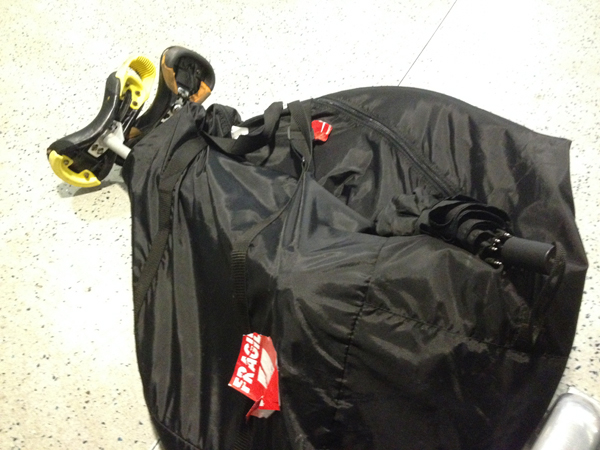
I’m surprised my well-worn and falling apart bicycle bag has held it together for so long after all these years. It last saw use on my trip back to Singapore in January, and with each subsequent use, it falls apart bit by bit. A zipper pull fell out previously (the zipper itself was still intact) and I wonder what else would break on this trip to Montreal.

And of course, it had to rain on my way to Penn Station. I brought an umbrella along with me, and holding on to one bag of two unicycles, a plastic bag with some food to last the 11-hour train journey, an overstuffed backpack, and an umbrella should probably be a Cirque du Soleil act of its own.

I got to the train station an hour early and I was like “Great! Maybe I’ll get a chance to snag an early seat.” I totally forgot one had to check in luggage from States-side, and because I didn’t do so, when the train opened for boarding, I had to go check in, and ended up being the last to board.

mtl2

Thankfully there was a backward-facing wheelchair-reserved seat available. I was feeling pretty much handicapped by that point, and I had the right number of wheels (big ones, at least), and there were no real wheelchair people in need, so I took it. It wasn’t too bad, I got stretch out, as I hurtled backwards all the way towards Montreal.

So, I was supposed to meet some of the Singaporeans at the college, where some of the events are held. Interestingly, no one bothered to tell me the instructions on getting there, only providing me with a street address. Well, I don’t have wireless internet on my phone, but thank goodness for being old-fashioned, and I had to ask three people how to get there. The first older station attendant didn’t speak much English (why is he working at the information kiosk at the main train station then?) but I understood enough to get to Berri-Uqam. There, I asked a younger English-speaking lad who told me to get to Pie-IX (pronounced “pea-neuf”), which I retrospectively probably remember the older station attendant mentioning something like that, but “pea-neuf” and “Pie-IX” didn’t connect as being the same thing in my mind because je ne parle pas français. Anyway at Pie-IX some teenager told me to just go down a road, at which point I took out my 20″ unicycle, shouldered my 29″ uni, my backpack, and my umbrella, and finally made it to the college.

mtl3

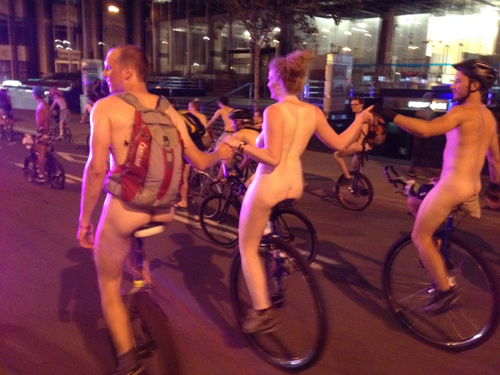
I think UNICON 17 already kicked off two days ago. But on my first night, it was apparently Naked Bike Ride day, and the unicyclist were planning on crashing it. So many unicyclists went, it was a pleasant surprise. I believe the number of unicyclists matched the bicyclists head for head. Males also outnumbered females maybe four to one. And there were definitely more naked unicyclists than there were naked bicyclists, as a lot more bicyclists kept more pieces of clothing on. Perhaps as the UNICON attenders were from another country, they didn’t have to worry about maintaining some sort of professional credibility in Montreal as many of the bikers did. Or maybe Europeans just like getting naked a lot more.

mtl4

As I was not registered to participate competitively, there was very little I could actually do at UNICON. I felt like making friends was an uphill endeavour, when many already had their circles of friends either from having attended UNICON before, got to know each other by virtue of participating in the same event, or were basically from the same country.

One morning, I sat myself down at a random table, and introduced myself to the table. It comprised Americans, a Canadian, and some Germans. I eventually got to see them over the next couple days and even got to hang out with them once or twice.

mtl6

Some of them (the Canadian and the Germans) went up to Mont Royal, and I joined them. One of them played the piano while I unicycle-danced in the background. It was all fun and games, until the experts showed up. Then they proceeded to defy gravity and jumped all over the place, and us mere mortals of lesser skill just stopped.

I got to see the UNICON events, of course. I was mostly there for the freestyle, and it met my expectations of what I thought it to be. Slightly dismaying was to see six to nine year olds completely outclassing me with freestyle, as the leapt onto their unis with a stand-up leg-up glide like physics was optional.

Freestyle expert solo was OK, and the first place winner went to USA Matt Sindelar, who did a Western cowboy themed routine using that very well-known tune from The Good, The Bad, and The Ugly, gun sounds and all.

Japan’s freestyle male expert solo entry Kaito Shoji was slightly less than what I expected, compared to last year’s winner. But he was still pretty good, and had great synchronicity with the music at the beginning.

Thomas Tiercy from Switzerland had one of the more interesting routines, though he didn’t place in top three. Perhaps it was because his routine was less about unicycling and more about object manipulation, but I felt it deserved a place on the pedestal because it was so different from the rest. It was also more show-sy than the others, which I appreciated a lot.

Shoji’s pair entry with Natsume Yamamoto was definitely much better, and the performance was more enjoyable. It featured great chemistry between the unicyclists, and felt less like a run-through of tricks, and more like a performance.

Here are some of the photos from Freestyle Solo and Pair.

This slideshow requires JavaScript.

This slideshow requires JavaScript.

While Street really isn’t my thing, here are also pictures from the competition. I have no idea who these people are, but the UNICON list says these people are: Christian Huriwai (New Zealand), Maxwell Schulze (USA), Raphael Pöham (Austria), Josef Sjönneby (Sweden), Jack Sebben (Canada), and Casper van Tielraden (Netherlands).

This slideshow requires JavaScript.

I’m breaking up this post because it’s getting too long. More to come in part 2!

Adding South-east Asian pizzazz to pizzas

SEAsianpizza2When you think about pizzas, there are really three essential components to every pizza: the crunch (the crust), the goop (the saucy base), and the bite (toppings). If one is able to recreate these three mouthfeels, one would get a decent pizza.

By distilling the essence of pizzas down to these components, I started thinking, “Does pizza always have to have cheese or tomato sauce as a base? What if I have something else that’s also goopy, would that then make for a good pizza?”

And then I started thinking, “Has anyone ever tried to make a south-east Asian pizza that isn’t simply dumping south-east Asian ingredients on top of what is still essentially an Italian pizza, with cheese et al?” I know that people have experimented with all sorts of toppings, but invariably the goopy base always boils down to tomato sauce or cheese.

So perhaps, if I could make goop from south-east Asian cuisine, I could substitute cheese and tomato sauce for the base and make a pizza that is actually truthful to the original taste of the dish!

So on my train commute to work, I sat down and went through all the Singaporean/Malaysian dishes I knew of, and started thinking about their textures. I eventually came up with a first round of dishes a few months ago that I thought could viably be transformed to recreate the three mouthfeels that go into a pizza.

SEAsian Pizzas Round 1

southeast asian pizzasThe first round of pizzas I made for my friends were: (from left to right) Mee Rebus, Char Siew, Baingan Bharta, and Daging Rendang. These pizzas had an additional tweak in that they represented all the major ethnic groups in Singapore, but also covered all the major proteins including a vegetarian option. I’m going to list each pizza and their components.

Mee Rebus Pizza

A dish which in Malay simply means “boiled noodles.” Very unassuming sounding, but is a sweet and spicy curry that’s thickened with mashed potatoes and topped with a hard-boiled egg. I discovered that by increasing the amount of mashed potatoes in the curry gravy, one could achieve the consistency of cheese. I used the gravy as a base. There are, funnily enough, no noodles of course in this pizza, so maybe it should really be called Tak Mee Rebus Pizza, but then that just means “No boiled noodles pizza.”

I don’t really speak Malay.

I topped it with hard-boiled eggs, but also fritters. A recipe I found suggested cucur udang bawang (prawn and chive fritters) but I had a friend at the pizza dinner who is allergic to shellfish so I replaced it with chicken, making it cucur ayam bawang.

Char Siew Pizza

A Chinese barbecued pork dish, glazed with honey, maltose, garlic, and spices. I learnt to make char siew from scratch, and I discovered that the sauce is already kind of thick, perfect for setting as the base for the pizza. This one was a no-brainer, and not much alteration was necessary to make char siew into pizza. Garnished with garlic and cilantro.

Baigan Bharta Pizza

A spicy Punjab dish made from eggplants. Granted, Singapore major Indian ethnic group is Tamil, but I found baingan bharta the easiest to work with. By mashing up the eggplants, they became very goopy, which I used for the base. I then topped it with mushrooms and tomatoes, because why not? This dish is vegetarian.

Rendang Daging Pizza

A Malay dish of spicy caramelised coconut beef, where the beef is original stewed in broth and left to slow cook until the broth evaporates and is absorbed by the beef. The cooking process then turns from stewing to stir-frying.

I took a portion of the stew and thickened it, and used it as the base. I topped it with rendang, and garnished it with chilli and cilantro.

The crust for the pizza, because I’m not really an accomplished Italian chef, was some simple pizza crust recipe I took from the internet using olive oil, flour, and salt.

Since a lot of south-east Asian pizzas are usually eaten with a staple, such as rice or noodles, it made sense to replace the staples with the crust, successfully blending what is traditionally a rice or noodle dish into something completely new, while preserving all of its original flavours (sans the flavours of the rice and noodles themselves).

After the success I had for the first round of pizzas, I proceeded to make more a couple months later (which was a few days ago).

SEAsian Pizzas Round 2

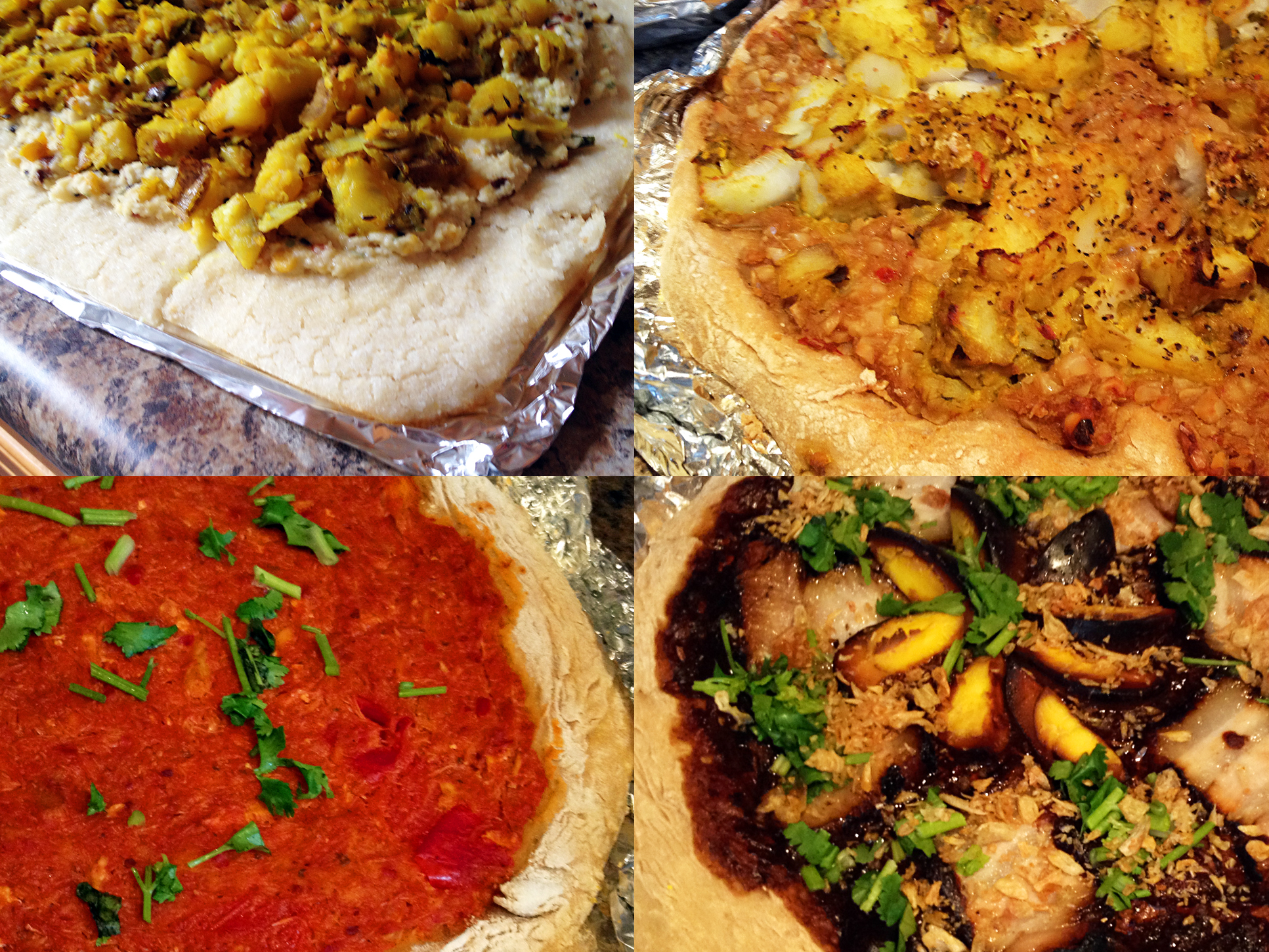
SEAsianpizza2From top left clockwise: Thosai Aloo Masala, Otak-otak, Lor Mee, Singapore Chilli Crab

I decided to go further this time, and represent Singapore’s ethnicities better, while keeping the custom of varying the proteins. I also had the sense to take pictures of the making process this time. Once again, I’ll describe the pizzas.

Thosai Aloo Masala with coconut chutney

In Singapore, the food most people think of when Indian food comes to mind is immediately roti prata or thosai. I decided to go with thosai, because I’m an abysmal prata maker (I’ve tried).

Known in New York as dosa, and thosai in Singapore, it’s a vegetarian Tamil rice-and-lentil crepe dish, topped with any variety of things, from eggs to potatoes to magic. The batter is thinly poured over a flat tawa, just as crepes are. I’m very proud to say I made my own batter, fermenting idli and dal, but there was a necessity to make my own batter.

thosai

Regular thosai/dosa is too thin to turn into pizza, and I had to thicken it somehow. Simply pouring more on the tawa isn’t sufficient, because it’s quite liquidy and wouldn’t stay in place. Thus, I had to alter the proportions of rice to lentils, to achieve the consistency I needed to make a sturdy enough crust to hold the toppings, while still retaining the taste of the thosai.

aloosabzi coconutchutney

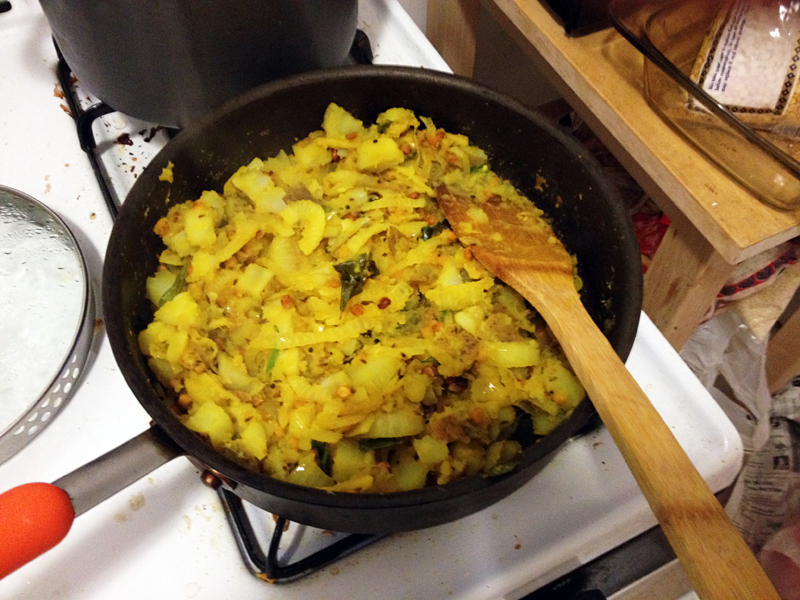
I made coconut chutney, and thickened it by reducing the water in it. That formed the base. It’s also one of my favourite chutneys to use for thosai. I topped it with aloo sabzi, a potato filling with curry leaves and turmeric. I had a baking tray that I greased, put it in the oven until it got really hot, and thickly but evenly poured the batter over it, and put it back in the oven for a couple of minutes. I then took it back out when it is lightly cooked, poured the chutney and topped it with the potato masala, and put it back in the oven. It came out as a flatbread sorta pizza, and I was pleasantly surprised how well it turned out.

Otak-otak Pizza

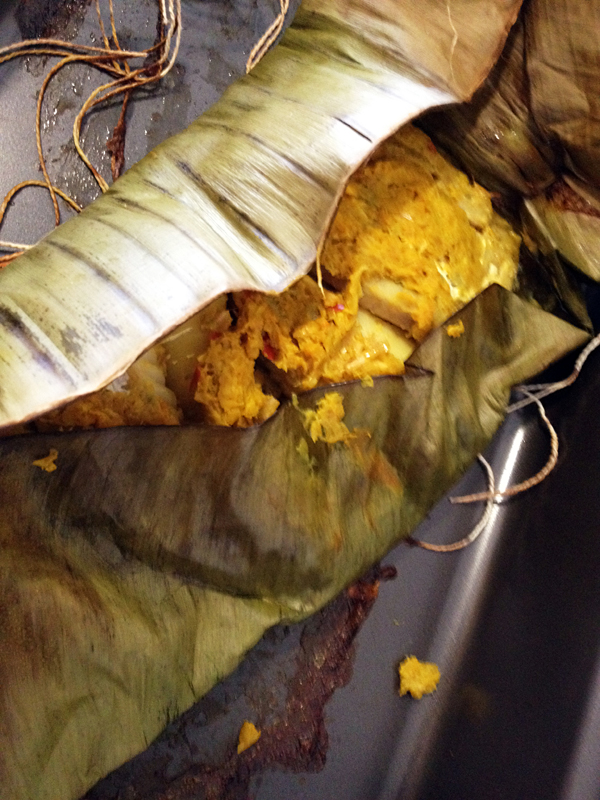
Otak-otak is a Peranakan dish, making it the first time I’m representing this ethnic group in Singapore with pizzas. It’s a spicy fish custard with coconut and eggs. Unfortunately, my otak-otak had the right smell and taste, but wrong consistency, as it failed to custardise properly. I think in my zeal, I put in too much coconut milk, causing there to be too much liquid for the custard to form. I’ll need to try again.

otak sataysauce

But anyway, I still had the fish soaked in the otak custard dip, and at least the flavours stayed. I used a satay peanut sauce as the base, and topped it with the fish

Lor Mee Pizza

A Chinese braised pork noodle dish, usually topped with a braised hard-boiled egg and a variety of other toppings, in a soy-vinegar broth thickened with starch and egg. Once again, lor mee means “braised noodles,” and the lack of noodles in this pizza (replaced instead with a pizza crust) should really name this dish “Lor Ang Mor Peng,” or braised Caucasian pastry, which doesn’t make it sound any more appetising.

lor mee sm

(I forgot to take pictures of the lor bak, lor neng (egg), and lor tsap (sauce), but I did make lor mee the night before so here it is a picture of it)

I lor’d (braised) the lor bak (braised meat) for two days, the egg for one day, and extra thickened the braising sauce with starch, flour, and egg, to form the base. The pizza was then topped with the pork and egg, and garnished with cilantro and fried shallots.

Singapore Chilli Crab

I learnt that whole live crab is cheaper to buy than fish fillets in New York. Maybe it’s because I’m paying for all that shell and whatnot.

Did you know that if you buy live crabs and put them in the fridge, they’re still alive 12 hours later? I put them in the sink to wash them, and they came back to life, like daisies!

So, I guess the Singapore Chilli Crab is a Chinese spicy crab dish, with tomato puree and egg and a bunch of other stuff that unequivocally makes it Singapore’s signature dish. Just google “Singapore signature dish,” and chilli crab usually comes up tops.

And because I wasn’t going put a whole crab onto the pizzas, I had extract all the crab meat manually. I also didn’t have a shell cracker tool. All I had were knives, chopsticks, and a pair of needle-nose pliers.
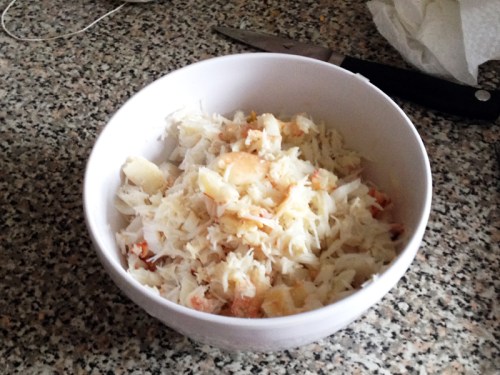
crabThis small unassuming bowl, containing over a pound of mud crab meat, took TWO HOURS and many an injured finger.

I then prepared the sauce and stirred the crab meat into the sauce, making a thick chilli crab goopy thing which was perfect as a base, no topping needed. I guess ideally I would have preferred the meat to be more in chunks and as shredded as they turned out to be, but hey try removing crab meat manually with chopsticks and needle-nose pliers and we’ll see if you can do it without destroying the meat.

But it turned out well enough and tasted great, so that’s that.

I altered some of the ingredients in the pizzas to account for allergies within my testing group. I took out the belecan (shrimp paste) from the otak, because someone was allergic to shellfish, but kept it in the chilli crab because he wouldn’t have been able to eat it anyway. The good thing about south-east Asian dishes as pizzas is that, not only is it novel, they’re all lactose-free, because we don’t use milk very often in our cooking. So my lact-arded friends get to eat what passes as pizza, I suppose.

Makes me wonder why I’m not pursuing culinary as a profession sometimes.