The Hexacoto

Listening to the sound of one hand clapping

Category: Musings

The music of the Young and Trendy

Even if one doesn’t speak or understand Japanese, listening to this song Sweet Soul Revue by Pizzicato Five, it is very easily established that it would not be what one would expect from a Japanese pop singer. In fact, it sounds closer to something put out in France in the 60’s or so.

Introducing a genre of Japanese pop known as Shibuya-kei, a branch that sounds decidedly so much more Western than its regular mainstream counterparts.

It also makes sense that this genre began and is named after the Shibuya district in Tokyo, a hyper-trendy neighbourhood famous for its scramble crossing, fashion, and shopping.

Just as French yé-yé focused on the innocent beauty of young girls as its selling point in the 60’s, Shibuya-kei is all about the young, the trendy and the beautiful. However, Shibuya-kei transcends merely its music, and its sensibilities have pervaded into a lifestyle and culture.

Design
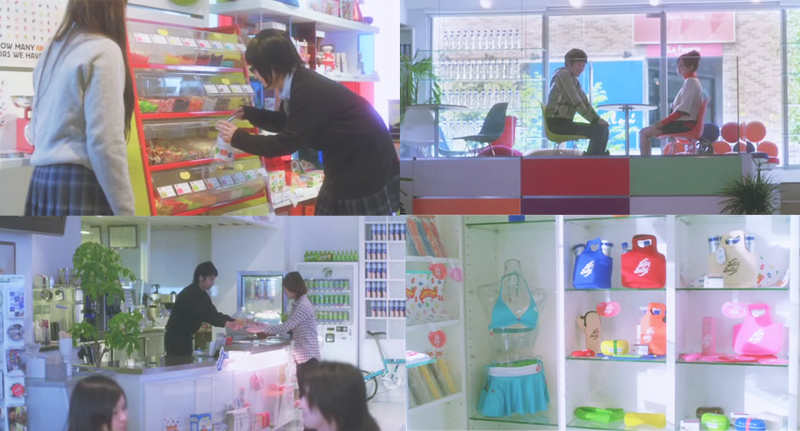
sbyk

What is the Shibuya-kei aesthetic? Think clean and simple, minimal, with bold colours that are not afraid to be seen. The images above are screen shots from the movie, Detroit Metal City, which in itself pays homage to Shibuya-kei. Minimalism, portable, retro and futuristic elements all come together to create a sleek and airy feel. Designers such as marimekko would not feel out of place in such an environment.

sbykalbLooking at the cover sleeves of four of the biggest names in Shibuya-kei, Kahimi Karie, Cornelius, Flipper’s Guitar and Pizzicato Five, all reflect the sensibilities of Shibuya-kei design; sleek, clean and very pop-art-ish.

Sound

If mainstream J-pop is about producing for a Japanese market, Shibuya-kei seems to eschew itself from that by being everything not typically Japanese. It is synthpop, bossa nova, French yé-yé, jazz, and so many other element put into one. Given the vast possibilities within Shibuya-kei, each artist tends to build a certain style and sound to establish their identity within this genre. Yukari Fresh, shown above with her mini album, Cook Some Dishes, tends toward the light and whimsical synthpop elements, while Pizzicato Five leans towards French-esque bossa pop.

Other interesting stylistic elements include Minekawa Takako with her retro-futuristic electronic sounds (above, Fantastic Cat), or Kahimi Karie (above, Good Morning World) with her whisper-like vocals as she sings in French, English, Japanese and, sometimes, Portuguese (below, Take It Easy My Brother Charlie).

Themes

If there can be one thing that can be said to be consistent in Shibuya-kei, it’s the incessant exploration, creation and expression of new ideas and old dreams.

Yoshinori Sunahara imagines the opening of an underground airport in Tokyo in his album, Take Off and Landing (track above, Hawaii 2300) and many of his works feature his obsession with aeroplanes and flight. Others, like Cornelius, a key figure in the genre, explores the relationships between harmony and dissonance, or the relationships natural musical elements can have with synthetic ones, such as in his song Drop (below).

Shibuya-kei is dead?

Shibuya-kei started in the late 80’s and took off in the early 90’s. However, its popularity waned rapidly in the 2000’s as other music, such as Korean pop, started getting a hold of the local music scene.

Interestingly, where Shibuya-kei has floundered in Japan, it has moved overseas and found its niche in Europe and the United States. Artists like Kahimi Karie and Pizzicato Five have definitely found more acclaim overseas than they do in their home countries these days.

What’s more fascinating is that the genre that began and has hit more or less a dead end in Japan is starting to see foreign artists with sounds that increasingly sound like Shibuya-kei. While not a new artist, Momus (above, I want you but I don’t need you) has been likened to Shibuya-kei, as have been other artists.

Momus writes about his thoughts on the genre,

We western pop-makers are like the Brothers Grimm. We scribbled a few fairy stories a long time ago. And now they’re there, transmuted, misunderstood and built in stone at Tokyo Disneyland, and we’re wandering around the theme park in our frock coats murmuring aloud in wonder ‘Did we really start this?’

from Momus’ webpage, imomus.com

The esoteric nature of Shibuya-kei of the 90’s has left Japan and taken residence overseas, where it is safe and carried on by foreign artists. Those left behind have transformed Shibuya-kei into something slightly different. While Cornelius and Minekawa Takako are still producing works with strong vibes of the Shibuya-kei of the yesteryear, other forefronts of the genre such as Fantastic Plastic Machine and capsule have turned their sights towards house, dance and electronic music. For example, Fantastic Plastic Machine that went from something like this (L’Aventure Fantastique, 1997):

To something like this (Daremoshiranai feat. 環ROY, 2013)

I am not lamenting the direction Shibuya-kei is headed these days; in fact they are all interesting directions. The perceptibly ‘Western’ flavour of Shibuya-kei of the past that was ironically ‘so Japanese’ has morphed into an international movement that artists around the world can participate in. Shibuya-kei is no longer only for and by the Japanese, and the scramble crossing of the district has transcended geographical borders.


The value of philosophy

I’ve heard it said before that the purpose of philosophy is to solve the problems and conditions of the human mind. Philosophy seeks to find truth, understand how we get truth and the why we get it. But when those who do philosophy get so enmeshed with finding simply finding truth and lose sight of the how and why and what for, is there purpose to their philosophy?

Consider this: Compare classical philosophy, from the times of Socrates to Descartes, and today’s modern academic philosophy. There is a stark difference in what each is trying to seek and for what purpose.

Yesterday, I had a discussion with a friend who did philosophy in college. We were comparing three things: classical philosophy, academic philosophy and commercial philosophy, which comes in the form popular books for consumer’s purpose such as Zen and the Art of Motorcycle Maintenance.

I asked him, do you think classical philosophy is superior to commercial philosophy, comparing the two? He said that both have their merits, but consumer philosophy adds nothing new to the literature; they’re simply taking what exists and people already know and packaging it in a way that people can understand. By that virtue, they are making philosophy accessible to the public, which is a good thing. Classical philosophy on the other hand sought to explore what people didn’t know and tried to explain them, even if they sometimes got them wrong. Both are still philosophy, because both still reach truths and conclusion using similar methods.

Then I asked him, what about academic philosophy these days, where they are constantly adding new things to the literature all the time, but what they do seems to be so obscure and so dense that many of them appear to have no apparent value to the society? I asked him, what good is philosophy if it serves no purpose to the society? He agreed that philosophy should have a purpose, and we both felt that many-a-times academic philosophy seeks truth and adds it to the literature simply because they’re expected to and because they can, even if the ‘truth’ discovered has little relevance to our lives.

Commercial philosophy, even if by dint of its commercial nature, has to make its material easily digestible by the reader. At least it tries to serve purpose to society. In comparison, academic philosophy doesn’t even try to make itself readable to even other academics. Bad writing and unclear direction in so many modern philosophical texts begs the question: For whom are they writing philosophy?

Some modern philosophy reveal a lot about the condition of our modern selves, but for every one good one, there exists a lot of other PhD theses that write texts akin to intellectual masturbation.

No wonder we get the sentiment of “Philosophy is a useless field of study” from the masses these days, because philosophy as made itself irrelevant.

Philosophers were well-respected in the past; no one would have dismissed the great thinkers of Nietzsche or Wittgenstein, for they were concerned about the society they live in and sought to de-construct the way society was, and hoped to allow people to understand the way they operated. Be it philosophy of religion, language, politics or science, it added an extra edge to simply practising religion, speaking language, participating in politics or conducting science. It allowed for the development of ethics, philology, and other branches of thought that make these respective fields more humane.

While I’m pretty sure a text like “Hegellian Responses to the Post-Surrealist Inclinations of Photography over Traditional Painting” (I made this up) could make for an interesting read, I’m not sure it would ever be as helpful as a book that rehashes hackneyed interpretations of Zen Buddhism as applicable to motorcycle repair.

An eternal soul or eternal ego?

I am not a religious person. I am not atheistic either — I do not vehemently believe in the non-existence of a god.

Last night, hanging out with a friend brought about an interesting discussion about religion. We were talking about how in the medieval periods, churches used stories of hell, fire and brimstone to scare people into believing in Christianity. My friend said people eventually started going to church to be intentionally frightened because it was on some level, entertaining. I said how I learnt that because most people were illiterate, religious art in that period were dramatic, flamboyant and scary, to achieve the same effect of scaring people into belief.

That reminded me of a conversation I had with another friend a week before about the eternal soul. That friend is Catholic and believes in a higher power. I asked him, “What do you think happens to us when we die? Do you believe that we have an eternal soul that endures beyond our physical bodies?” He said he believed that there must be something beyond just the finality of death, and he believed in an eternal soul. I then asked him, why must we have an eternal soul; is it that bad if whatever we know and think ends when we die? He said, wouldn’t that be depressing if all we ever are just stops there, and that he feels that we exist to achieve a higher purpose.

That, to me, sounds a little like the fear of letting oneself simply end; to die. The ego prizes itself so much that it creates an afterlife to exist in the minds of those still living, so that fears of its finality may be placated. In a way, that is the premise of the Christian hell, isn’t it? Just as good souls go to heaven, for bad souls to go to hell, the soul must be eternal first, before it can go anywhere after a person’s death.

The fear of hell isn’t a fear of hell itself, but a fear of what might happen to one’s eternal soul.

If you told a person he could be condemned into hell, but be untouched by hell’s eternal damnation, the “fear” of hell dramatically decreases. Likewise, if you told a person his or her soul would ascend to heaven, but the soul lies in a perpetual possibility of a fall to hell, heaven becomes less desirable. It is a person’s conception of their own soul that creates the existence and purpose of a heaven and hell, and not vice versa.

The key to religious faith is not in external entities; not in a god/God, not in a heaven or hell, but in that one does not simply die after one dies. That is all it takes.

We console ourselves that our dearly departed are better in the afterlife, because we believe they have continued existence after death. When we think about the ghosts and souls of others, in essence we are reminded of our own because we believe that we will one day be like them, enduring in the minds of others.

The truth value of keeping promises

What does it mean when someone promises you something?

“I promise to give you $10.”

In our everyday usage of this sentence, the person who utters this statement obliges himself to give the listener $10, is it not? However, if I utter this sentence and didn’t give you $10, is that sentence considered to be a false statement?

Most people would say “yes,” but in the study of semantics it is not that clear-cut.

What is the meaning of the sentence “I promise,”? To pare down its meaning, that sentence means “I am making a statement about agreeing to do something.” The most important and vital part about promises is that it has to be uttered. A promise is useless if the promiser doesn’t say it to the promisee. While a person can promise himself about something regarding other people (“I promise to protect her from harm.”), the promise is not valid to other people unless they hear it from the promiser (“Why’re you trying to stop me from crossing the road!?” “Oh I made a promise to protect you from harm.” “Get away from me you creep!”).

In semantics, this is known as a performative speech act, whereby a statement is true by virtue of being uttered.

Therefore, when I say, “I promise to give you $10,” did I make a promise to give you $10? Yes I did. Am I going to give you $10? I can’t afford to, I’m poor. But there is no way to look at the sentence I uttered earlier (“I promise to give you $10”) and say that that sentence is not true, because I did promise. I just did not keep my promise.

Tense matters when it comes to performative speech acts. When you change that example sentence to the past tense, “I promised to give you $!0,” that sentence can be false, because if you made no such promise prior, it is false. The future tense is slightly trickier — “I will promise to give you $10.” Is that itself a promise to exact a promise in the future, since “will” seems to have similar ‘promising’ functions, although slightly weaker than “promise” itself? Or is it a lot simpler, where its truth value is determined by whether the described action is carried out in the future?

Other fun examples to think about include:

  • “I now pronounce you man and wife.” – Are the couple not man and wife prior to the speech act, as they go through the wedding?
  • “You are under arrest.” – Was the person prior to the sentence not under arrest, even though he might be cuffed?
  • “I sentence you to death.” – Was the convict not sentenced to death prior to the utterance of the verdict, even though the jury had already decided?

My Milo is ‘kosong’ out of necessity

miloI am a huge fan of Milo, this chocolate malt drink that I have been drinking since I was a kid. Back home, the way it is usually made is to put heaping spoonfuls of the chocolate powder, add hot water and then a spoonful of sweetened condensed milk. Not with regular milk, not with creamer, just condensed milk.

These days, I’ve been having to drink my Milo ‘kosong’, or ’empty’ in Malay. What that means is simply a cup of Milo without any condensed milk; just Milo powder and hot water. This variant is preferred by those who like their Milo less sweet, since there is a measure of sugar in the Milo chocolate powder mix already.

Milo has been my regular substitute for slabs of chocolate, since it is rather chocolate-tasting and we all know chocolate makes people feel better about themselves. Heaven knows I need plenty of feel-goodness, to help the days pass by.

condm

I had a can of condensed milk at the start, and every cup of Milo made a spoonful of this sticky, sweet goodness would always go with it. Sometimes even two, if I felt like it. At times, I would even lick the spoon for the remnants after I put it into the drink. I have on occasion, simply taken a teaspoon of the stuff because it tastes really good (don’t judge).

But as the condensed milk fell from brim to bottom, and the spoon made a cloying scrape that signified the pending depletion of the condiment, I started to ration it. A full teaspoonful of condensed milk per cup of Milo became half a spoonful. Eventually the condensed milk ran out.

I then started using the milk for my cereal into my Milo, which is not as good, but a fair replacement. After all, I had run of cereal and was not planning on buying any cereal for a while, and I had been using whatever milk was left in cooking anyway. Making Milo is sort of cooking. It is a preparation of a beverage — the use of milk in Milo is certainly justified.

It would not even be a week before even the milk disappeared. And thus for the two weeks, my Milo has been unsweetened, unmilked, unembellished by anything. But I persist in imbibing this concoction, because even without the sweetness of excess, life and cups of Milo go on.

I might be unable to afford the sweetness that makes our life pleasurable, but that does not mean I should simply throw out my brew or stop drinking Milo altogether. We have become a culture so addicted to the sweet things in life that we forget what it feels like to live humbly. Maybe I grow to like the taste of ‘kosong’, maybe I will pull through and find a job and one day be able to afford condensed milk again. But in the meantime, let the hot chocolate warm my heart and relish in the joy of knowing at least you still have Milo to hold in your hands.

(If anyone is wondering why I can afford Milo but not condensed milk, when Milo in New York costs like $14 or something ridiculous for a 1kg can, I can’t. These cans of Milo are gifts. I will lament the day I run out of even Milo powder.)

To be driven to despair

Job seeker, 21, with 3 A-levels and 10 GCSEs, kills herself after she was rejected for 200 jobs

Read more: http://www.dailymail.co.uk/news/article-1267953/Job-seeker-Vicky-Harrison-commits-suicide-rejected-200-jobs.html#ixzz2bABkpoVL

After being unemployed for two years, and after over unsuccessful job application, 21-year-old Vicki Harrison kills herself. I read this today and I felt immeasurable sadness for her family, and empathy for her situation. While I have not been unemployed for two years, there are times when my mind have wandered into the similar regions of despair, self-loathing and frustration.

Every day gained is an extra day lost.

Time is ticking out for me; I’m currently on a visa that gives me a year’s grace to be employed in my field of study. A sixth of it has gone. Unlike Harrison, I don’t have two years.

Today, I bumped into the unemployed friend of mine on my way to circus. He told me that in the two years since he graduated from college, he has been unemployed for a total of 15 months when all his unemployment periods are added up. That’s more than a year, more than half of how long he has since graduated. It did not hearten me to hear that he could have been unemployed for that amount of time.

What if it happens to me? What if my year runs out and I still have yet to find a job?

The problem with being college-educated and being told that you’re good at what you do only sets you up higher for a bigger fall. Harrison has 3 A-levels and 10 GCSEs. I have 3 A-levels and 9 or 10 GCSEs, and a college degree. But these alone do not get you a job. Jobs these days want a minimum of “3-4 years work experience” for junior, associate or entry-level positions. Well, what are fresh-graduates supposed to do to get this magical work experience for entry-level jobs that are supposed to help them get experience? What’s the level below entry-level where graduates can glean experience from then? Friends have told me that internship experience counts, but I can scarcely imagine a hirer choosing a fresh-graduate with only internship experience over someone who has actual work experience from a time when entry-level was really meant for people to enter into the industry.

I wonder how long I can hold out before my font of optimism snuffs out?

Musical memories

Have you ever listened to a song, and be deluged by memories associated with it?

There are certain songs that will always remind of certain things. Amy Winehouse reminds me of my time in Prague, for I listened to a lot of it whilst there. The grey streets and grey looks of people staring across you on the tramvaj will always evoke the soulful tunes of the late musical talent.

Particular albums of Japanese electronic artist, Fantastic Plastic Machine, brings about images of my time in Munich and Vienna.

Songs from Chinese pop singer Faye Wong reminds me of this one friend whom I, of my own stupidity, did something cringe-worthy, and we’re no longer friends. We talked about how Faye Wong is one of his favourite singers. I can’t listen to her songs without being reminded of how dumb I had been.

Music is not something that is merely heard with the ears, but seen by the mind and felt by the heart. All it takes is music to remember memories, to feel emotions, to affect judgement (BrE. AmE uses ‘Judgment’). Just as diaries hold your memories for posterity, we are just as able to meaningfully code data into the tunes and lyrics of music.

It is said that Socrates used different locations of his home to memorise his oratories, by assigning a word or fact to a specific object or feature of his home. Likewise, I think tunes, rhythm and lyric can achieve the same storage effect.

Losing these memories, on the other hand, seem a lot harder. How does one consciously forget a tune? When one hears it, recollection of it is instantaneous. Plus, many memories imprinted onto music are done so subconsciously — perhaps an incident happened while you’re listening to the tune, but it is seldom a concerted effort. This makes losing that memory more difficult.

Be wary of musical memories, they have ways of nesting in your head.

Can I have some more gruel, please?

You know you’re falling on hard times when you start rationing even cabbage, and cutting out a 1/16 part of it for lunch.

Grocery shopping has become challenge as I start to cut out on things that were once deemed nice to have, but are now crossed out out of necessity. I have always been a frugal shopper, but lately I have had to extend how long groceries last in my fridge, thereby reducing the frequency with which I have to go grocery shopping. I now have to try to make two weeks’ worth of groceries last three.

I have resisted the temptation to live on a diet of processed food, even though they are probably cheaper. It’s depressing enough that I don’t have a lot of money, I shouldn’t have to suffer the idea of eating sub-par frozen dinners and the such. Besides, eating unhealthily might eventually lead to health complications that might end up costing me more. A friend who is similarly unemployed tells me that on certain sale days, frozen dinners can cost as little as $1 each, but having never grown up in a culture of microwaving meals as a norm, that idea did not sit well with me.

On average, I manage to rack up about $25 on Asian groceries and about $35 for Western groceries each trip. This $60 usually sufficiently provides me two meals every day, for about two weeks, making it a cost of $4.30 a meal a day, which isn’t bad at all. This $60 now has to last me three weeks.

The following chronicles how my diet has changed in this time of rationing.

Carbohydrates

noodles

The above are two of the cheapest noodles available in the Asian and Western supermarkets I go to.  The Chinese egg noodles on the left cost about 80 cents (the supermarket doesn’t tax!) and the capellini pasta costs about 88 cents before tax. While it seems like the pasta costs only a paltry eight cents more, too little to make a difference, the number of servings I can prepare before I finish each box is hugely different. These noodles are all the carbs that I buy.

I wonder why I always end up using finishing the box of pasta faster than the Asian noodles. I usually finish using the box of pasta after 4-5 meals, whereas the Asian noodles lasts me about 5-6 meals. This is odd because by weight, the pasta is a full pound while the Asian noodles are about 14 ounces. Maybe because the Asian noodles are in cakes and makes it easier to divvy up (one is usually enough, two if you’re really hungry) whereas I usually just eyeball how much pasta to use.

I have also stopped buying bread or pitas or tortillas.

Meats/Proteins

prot

I used to have protein from meat at least one meal a day, or once every two days if I felt like having less meat in my diet. Now, my source of protein comes primarily from eggs, and occasionally I’d be able to have some pork, perhaps twice a week. The one-pound round of pork butt which I made char siew out of in a previous post has been made to last me two to three weeks, by strategically cutting off what I need and freezing the rest.

I have also been substituting meat with tofu, because a pound of it is about a dollar.

Vegetables

veg

This is the above-mentioned 1/16 of a head of cabbage, which I have been painstakingly rationing, since they’re one of the hardiest vegetables to keep in the fridge. Even though a pound of carrots is $1 each, I also have a bag of frozen carrots and peas. However, I reserve the fresh carrots for making stew, and use the frozen ones in pasta and rice dishes. I have stopped buying bell peppers and fresh herbs such as basil, rosemary and thyme.

I love mushrooms, but they’re impossible to keep for extended periods without turning mushy.

Luxuries

snack

Chocolate has been struck off of the list. Today, my friend was kind enough to give me a slab because it was too bitter for her. Thanks goodness I love bitter chocolate.

However, I have been snacking on spoonfuls of peanut butter instead; peanut butter that I bought a long time ago but ran out of bread on which to spread.

I have also been drinking copious amounts of Milo because it tastes so chocolatey.

Flavorants

flav

I used to have flavour bouillons and stock pastes, but ever since I ran out, I’ve been relying on using shallots, onions, garlic and scallions as a replacement. These vegetables are rich in umami, and when burnt in a pot or pan, release a lot of flavour. Buying scallions from Chinatown has been a steal for me, since in Chinatown they’re usually two or three bunches for $1 (approximately 5-6 stalks per bunch!) whereas it might be as expensive as $1 a bunch in Western supermarkets. It’s also $1 for a rope of garlic and a dollar-something for a bag of shallots. Scallions last only about three weeks before they yellow, but onions, shallots and garlic stay good for a really long time, about a month or so.

Blame it on the Aracuan

Sometimes, I make myself so busy with my own projects during this period of unemployment that I wonder what it is all for.

busy (1)I’m just trying to get to the end where I hope there is no Aracuan bird to derail my efforts to delude myself that this is all worth it.

train

Keep your chin up, little bird. There will be more nests to build.

dest2

[edit] I decided to turn the above gif into a “Thanks, Obama!” gif, because it seems like the right thing to do.

tksobm

Whatever was that?

Last night, I attended the premiere of internet TV series, Whatever This is. The creators of this series previously made The Outs, which  fairly enjoyed. The event was well-attended and that floor was packed with so many plaid, skinny, mostly-white, creative-industry-looking people that I actually raised an eyebrow the moment I stepped in. I’m not calling them hipsters, because I’m sure they probably are not; I’m making a fashion and demographic observation (honest!).

The show played, and… I felt a searing sense of loneliness and distancing from everyone else in the room. In my opinion, the episode was not particularly funny to me. I don’t laugh very easily at things, and even the original outs only had me smile a couple times, but never left me adequately-humoured. However, the room erupted into laughter at what I thought were some of the most banal moments. I wondered if I have had botox done to my face at point in the screening, because my face felt stiff from not emoting in response to the show.

Don’t get me wrong, the show had good writing, and seemed to have set itself up for a good story ahead, but I just did not find it particularly funny as the audience seem to have indicated from their response.

It seems as if the American public were pre-programmed to laugh and applause at stipulated moments in television. A funny point is not funny by being funny inherently, but becomes funny because the audience participates in recognising it as funny. “This is funny because I am laughing,” so as to speak, and not “I am laughing because this is funny.”

I feel like the audience expected the show to be funny, hence the laughter and the clapping. What if the director intended the show to be sombre, but directed it exactly the same, with the same one liners that painfully reveal our dreary existence, financial woes and personal insecurities that had led the audience gleeful? Would the director feel anguished, or would he approve?

But I digress. I stood, unmoving, unsmiling, watching the show, feeling painfully removed from everyone else’s mirth. And it’s not only this show — I’ve been to stand-up comedies and felt exactly the same thing. Comic says something really ordinary, but at moments where it seems primed to harvest laughter, and the audience delivers.

I had definitely spent such shows paying attention to the audience more than I did the show. I wouldn’t know which parts of the show was funny otherwise.

Eventually the screening of the first episode of Whatever This Is ended, and everyone clapped and cheered, especially hard so at  certain lines in the credits (were half the audience cast and crew members?). I clapped because everyone else did, but I’m not sure if I’ve made the premiere a success because I clapped or that I was clapping because the premiere was a success.