The Hexacoto

Listening to the sound of one hand clapping

Category: Musings

Learning to be divided by education

I was explaining the Singapore education system to my friend from the States, and it turned out to be quite complicated:

For primary education (elementary school), we have a compulsory six years.

In secondary education (middle school), we have either a four-year program (Special/Express), or a four/five-year program (Normal Academic/Technical).

For post-secondary education (high school), we have either a two-year grammar school (Junior college), a three-year grammar school (Centralised Institute) or three-year vocational diploma program (Polytechnic). There is also a vocational institute known as the Institute of Technical Education (ITE).

I was telling my friend about how children are subject to segregation by ability from as young as third grade. In third grade, we had to take a test to see if we could be admitted into the “Gifted” stream, comprising the top 1% of the student population. These students get to be schooled in an environment full of other “gifted” kids, where they probably develop mutant powers.  I did not make it into “Gifted,” most likely because I wasn’t very gifted. I was kind of distraught to learn that I wasn’t gifted.

In fourth grade, we had our first serious, proper national-level examination that would ‘stream’ us into various ability bands. There was EM1, for kids who were ‘smart,’ EM2, for average kids (this band had the widest spectrum), and EM3, for kids who needed assistance with their studies. Needless to say everyone strove for EM1, and EM3 kids were given the snub. Elitism ran rampant amongst students and especially parents, even to the extent that some parents wouldn’t want their EM1 kids to hang out with EM3 kids. The Singapore government probably realised how divisive such a system was, and subsumed EM3 into EM2, but everyone knows EM3 still exists, and the last few classes of EM2 are the new de facto EM3. I didn’t make it into EM1, and I was kind of distraught to learn that I wasn’t smart enough for it.

At the end of primary school, at sixth grade, students take their Primary School Leaving Examination (PSLE), which is scored out of 300. The score determines which secondary school a student can enter. More prestigious schools would have cut-offs at perhaps 250 or so, while less discriminating schools took in students at lower scores. In secondary school, there are multiple tracks. In “Special,” students take a four-year program with the option to take higher Mother Tongue or a third language. “Express” students take a four-year program without the language perks, and both “Special” and “Express” culminate in taking the ‘O’ Level examinations. There is the “Normal” track, divided into two types, “Normal (Academic)” where students take a five-year program, taking the ‘N’ Level on the fourth year, with the option for the ‘O’ Level on the fifth, and “Normal (Technical)” students take a four-year program with more technical subjects such as woodworking and finish up with the ‘N’ Level. I made it into “Express,” but I was kind of distraught to learn that I wasn’t “special.”

Finally, we get to post-secondary education, where there’s a two-year and three-year grammar school (Junior College and Centralised Institute respectively), or a three-year vocational diploma at a Polytechnic or a two-year vocational course at the Institute of Technical Education (ITE). Entry into any of these post-secondary institutions require the ‘O’ or ‘N’ levels, and specifically for the JC, CI and Polytechnics, the ‘O’ levels (‘O’ levels stand for “Ordinary” levels, ‘N’ stands for “Normal”). Getting into grammar school is pretty competitive, as there are only 16 of them in the entire country of a population of 5.5 million. Many who do not go into grammar school usually go to a Polytechnic. However, the difference between grammar school and vocational institutes is that the majority of seats in university are more or less set aside for grammar school students, where perhaps 65-70% of the student body makes it into university, as opposed to perhaps 10% from a polytechnic. Thus, for those who wish to end up in college, the pressure to enter a grammar school is really high, unless one is really confident of being on top of the cohort in polytechnic. Even then, to get to enter college a year earlier is certainly a boon for those set on entering college.

But even within grammar schools and polytechnics, they are not ranked equally. We have what is informally known as ‘elite’ junior colleges and ‘neighbourhood’ junior colleges, where the junior colleges with more stringent entry requirements tend to produce more stellar students who get to go farther and further.

‘Elite’ junior colleges tend to have resources to prepare their students prepare for further education anywhere, even overseas, while most ‘neighbourhood’ junior college students are more or less expected to stay local. Not that local universities are any bad, but when you’re talking about the reaching the limits of Oxbridge and the Ivies, most ‘neighbourhood’ JC students would never even dream of such endeavours.

I only made it into a ‘neighbourhood’ JC, having come from a ‘neighbourhood’ secondary school as well, and today, there is no distress — I have come to hold it as a badge of honour.

Despite my odds of never having been ‘gifted,’ ‘special,’ or ‘elite,’ I have been able to, through dogged determination, been able to hold ranks with those who have achieved those labels.
Journalism is killing journalism

I am out of college, trying to enter the field of journalism. “Are you crazy?” my friends and peers tell me, “Journalism is dead!”

But who are the ones killing journalism?

Journalism isn’t solely dead because people are reading physical newspapers less and less — people go online for their sources of news. People still need the news, and all that is happening is that newspaper journalism is simply undergoing a transformation, not death.

It is the journalism industry itself that is killing itself by being unable to change simply because they’re not letting anyone new in.

Having spent nearly three months job-hunting for journalism jobs, all entry-level positions have a minimum requirement of three years of experience, and that they’re only looking to do experienced hires only. This locks out an entire generation of people with fresh ideas and enthusiasm who have not yet been tainted by the whole “journalism is dead” creed yet, but rather cycles around existing journalists who are even deadbeat about their own prospects.

Other industries in IT and finance constantly take in fresh hires and in its young blood, is able to reinvent itself and stay on top of changes.

Journalism tries to protect itself by holding on to its existing assets and shuns acquiring new people, landing itself slowly into attrition and becoming irrelevant.

How can we make news accessible to the future generation? The easiest way to that answer would be to ask people in that generation, wouldn’t it?

Of course, it is easy to say that as much as papers want to hire, they are unable to because of finances. Well if they keep up in this way, eventually they will go the way of the Boston Globe, Washington Post and Chicago Tribune; sold off to people who are less interested in producing journalism than in serving their own financial interests.

So for the sake of the future of journalism, start hiring already.

Smelling without your nose

Poetry and prose these days are very good with conjuring metaphors and images and the such, and they are very expressive. But I feel that modern poetry lack a sort of creativity in their use of the language. True, the images conjured are very strong and vivid, but in the reading the poems, one mostly appreciates the effect of the images and not so much the language. I would look at my own writing and think that the content is strong but were I to look at the words used alone and how they relate to each other, they are nothing special.

I think it’s because we’re too used as writers to acutely represent and display our senses and what we think and feel — we are able to show readers what we see, what we hear, and feel, through our similes, metaphors, analogies, onomatopoeia, etc. But these uses are expected and staid, after a certain point; there is nothing surprising about using a tapping dactylic meter to represent galloping action.

What if we were not allowed to see with our eyes, hear with our ears, smell with our nose, taste with our tongue, or touch with our skin? Just as a blind person sees the world differently, with his hands, surely we must be able to write about our experiences with the world through our immediate mediums?

With that, I bring to you the challenge of writing about smelling without using your nose.

I will try to write one paragraph about two topics about smelling, introducing that I am smelling something, but subsequently never using any word or phrase that is associated with the nose, or typical flavour words with which smells are associated. Let’s see if I can succeed.

The smell of fried chicken

The very first thing whenever I cycle past the Crown Fried Chicken shop in my neighbourhood is that I always smell the fried chicken on my face first. That wafting, hovering film hangs waiting in the air, waiting to arrest anyone who passes by in hopes of tempting them in for a piece of fried chicken. But that wafting, hovering film also hangs onto my face as a perceptible cling of grease that whets my appetite, even as I salivate from the thought of the crunch of batter-on-skin, the ooze of juice that washes down the side of the tongue, and the slight but oh-so-delightful burn from the steam that escapes the meat as teeth sink into yielding flesh. In but three seconds I would have already cycled past the shop, but I have left my stomach behind on the side walk, peering longingly through the filthy windows, wanting to be filled up with fried chicken and fries.

The smell of rain

I find the smell of rain after it has rained unpleasant — that scrubbing it does to the inside of my nose as it evaporates off of the side walk, that tugging feeling as it roils off of your arms and face. Had I wanted to smell mould, I’d have gone to the basement and stuck the green patches festering slowing up my nose, not to be assaulted by liquid decomposition and acidity that hangs around after the event like an unwelcome customer. Nobody ever smells the rain too much as it is happening, for they are too preoccupied by the sounds, the spectacle — the most people get is a sense of wetness in the air. But after-rain rain reminds you that it had been here, and sticks its proverbial armpit in your face, in my face, in its humidity and the awful contractions it leaves on my tongue.

Grammaticality is gangsterism

What better way to understand what is the purpose of grammar than by having to explain it to someone else?

A couple days ago, I met up with a friend to engage in workshopping each other’s writings. She was naturally stronger in Chinese, and I English, and so we both wrote a piece in each other’s weaker language.

I started by editing her poem for grammar. There was a line she used, “My feelings to him,” which I pointed out is ungrammatical. I said, “You could use ‘My feelings ‘for’ him’ or my feelings ‘towards’ him instead.” She asked why can’t she use “to” when “to” and “towards” have the same meaning; a directional preposition?

She asked me, “What is the purpose of grammar? It seems to be getting in the way of communication; people dismiss my speech because they think my grammar is not perfect, but isn’t communication about getting your point across?”

I was stumped; how often does one think about what grammar is for?

A quick search on Google about “Why is grammar important” yielded these common answers: To be able to talk about the language, and for concise, clear communication.

I asked a linguist friend, and he could only conclude why we have grammar, not why is it important. A Chomsky-esque approach would be that language and grammar are innate, then humans naturally create grammar when dealing with language; psychologist Steven Pinker notes that even deaf babies and children exposed to pidgin produce language in a grammatically-consistent manner.

What this means is that grammar is the basis in which we are able to formulate our thoughts in a particular language — a skeleton structure, if you will. Without grammar, we can still strongly feel about a topic with mere words — you only need symbols to hold meaning — but one cannot actively vocalise these thoughts without knowing that structure. From mere feelings, we graft these feelings into actuality and words around the structure that’s innate to us.

But that still does not explain why grammar is important in the way we deem it today. We say that without proper grammar, communication breaks down as meanings are lost. How true is that? Compare these:

“I am baboon.” “I are baboon.” “I am a baboon.”

They all mean the same thing, but the meaning is evidently clear when one hears any of them. The only difference between the first two grammatically-incorrect examples and the latter grammatically-correct one is that people would stop to note that the first two are grammatically-unsound, but the meaning of the sentence otherwise is gleaned regardless. Of course, egregiously grammatically-unsound sentences do impede understanding of meaning, where if one said something like, “Apples red is food favourite me,” and even then most people can still understand that sentence, with some time.

Really, it seems that for the most part, the grammaticality that we’re obsessed with contributes little to the understanding of meaning, but more so to judge people when they deviate from the correct form. We peer pressure each other to conform to a communally-agreed standard and belittle those who don’t, almost akin to gangsterism. Thus you have your pedants who would sneer at the usage of “comprises of” whereas most people don’t even know that it is technically ungrammatical. But ask these pedants why “comprises of” is ungrammatical, most would only be able to tell you that is because what was decided in the past.

But grammaticality is never dictated by what was said in the past — it is always decided by what is agreed upon in the present. It might have been inherited from what people in the past agreed on, but what they agreed on is always susceptible to change and still pending the approval of the current community using it. The pronoun-verb agreements we use today would have been ungrammatical in Middle English, where there were distinctions (“I speak,” “Thou speakest,” “He speaketh,”). Even between dialects in the same time period, what one community sees as grammatical might not be in another; an example today is between African-American Vernacular and General American English speakers. Many AmE speakers would think a speaker of AAVE as being ‘ungrammatical’ or plain wrong, when in fact AAVE has just as many rules governing it as AmE.

Linguists push for a descriptive linguistics stance; one where language is studied as it is used without value judgement, as opposed to a prescriptive one. Yet often it is the lay person that proclaims fire and brimstone should one not use the subjunctive properly, or were a person to mess up ‘who’ and ‘whom’. Funnily enough, that linguist friend tells me an anecdote that on a dating website that asks “Is proper grammar important to you?” he put the answer “No,” but only in the sense that he’s not a prescriptive linguist; you get a case where most everyone else would have indicated “Yes” on that question, linguists, who would be the ones to most academically make comments on grammar, don’t really care that much for “proper grammar.”

So to my friend who made the grammatical mistake, yes I understood what you wanted to say, but I suppose to not let other people judge you as intellectually incapable by mere virtue of your grammar, it is probably best to yield to public pressure and learn “proper grammar.”

Making the progress of the country affordable

From the New York Times:

Obama to Offer Plans to Ease Burden of Paying for College

It is about time the wildly sky-rocketing prices of a college education be addressed. While not actually depressing or stemming the increase in tuition, offering more aid is just as good a solution as any.

It must be, and I believe it is, recognised that a college education is ultimately how a country can begin progress. Oh don’t get me wrong, a college education is not necessary for an individual to be successful and happy in life — a person who has never been to college, through innovation, hard work and the right mixture of conditions can live the life he or she wants to. I’m talking about advancement and success at a national level.

A lot of the “better life” we talk about is made capable through invention — green energy, more effective farming methods, waste reduction technologies, communication, etc. — all these are the results of research and development, most if not all, made possible by researchers and scientists who have had to start in college. There are not many prodigies around who, without having to go to college, are capable of inventions at a scale enough to impact a nation as a whole; most innovations are from the toil of thousands of regular scientists who become proficient at what they do from having received the know-how and training from college and university. If a prodigy is the equivalent of a hundred scientists, rather than focus trying to find the wayward genius, it makes more sense to groom a hundred scientists instead.

If the very basic step of even attaining a bachelors remains out of reach to many because “college is too expensive”, and there might be countless untapped future inventors and pioneers waiting for the right academic environment to unleash their potential, a lot of talent and potential is wasted; all that is achieved is college heads having their pockets lined with more money.

Why is college the vital stepping stone, and not say, high school, to a country’s advancement? It is true to say that every step along of the path of education contributes to innovation’s path, but high schools being unaffordable is not quite a problem in this country, college is.

The government is investing in the country’s future when it decides to give students access to their own ingenuity by helping make the tools affordable; knowledge, and an environment to inspire.

The forgotten news

Today, we have two headlines from Asia:

North Korean Defectors Tell U.N. Panel of Prison Camp Abuses

Tank Has Leaked Tons of Contaminated Water at Japan Nuclear Site

When was the last time the news talked about either North Korea or of the Fukushima nuclear plants? After the buzz over Kim Jong Un succession and vague threats made died down, after the outcries at the displacement of citizens and the following nuclear contamination have but settled, what now? No one pays attention to these countries any more, because these stories are not shared around on the internet as much as they were when the events freshly happened.

That is the way the news work, I suppose. It is as much the news creating what the readers want to read as it is the news telling readers what to read.

It makes one wonder what is the point of being up-to-date with global news unless one was directly affected by it, or has vested in it. What is the point of me being aware that the Fukushima debacle isn’t yet resolved, and that Kim Jong Un, while no longer relevant to the current interest of the American public, represents a continuation of a long history of human rights abuses?

Other than the self-satisfaction of knowing that I know what’s happening around the world, what’s the value of that knowledge? Conversation fodder? Surely the news must be worth more than that.

I think being involved in world news is part of what being a global citizen is about — that we’re connected, and that as humans we care for each other, no matter how remote.

Followed by stars

twitstar

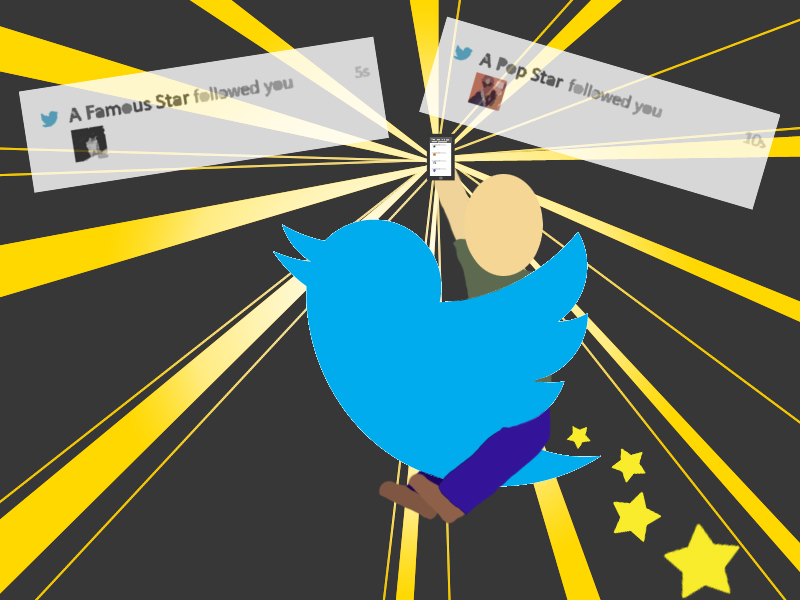
Why are people so excited to be followed by a star on Twitter?

On a reddit community that I visited, someone posted a screenshot of a famous porn star ‘following’ him back on Twitter. Responses of congratulation and envy followed soon after.

On my Facebook news feed, every now and then, some of my friends who are very into social media would post about how Rihanna or some other famous star started ‘following’ their Twitter feed, and that they “omg can’t breathe” or “am dying right now” or some equivalent.

Why does it matter that someone whom you’ve never met or will meet in person ‘follows’ you back on Twitter? We are in a culture of chasing stars, and the peripheral semblance of contact with them leaves us in a frenzy.

When these stars follow one on Twitter or any other social media, do they even really care about updates on what you post? It seems unlikely that a popular singer would want to know what you had for breakfast, what song is your groove right now or look at the heavily-edited photo of an impending storm on Instagram.

Yet the lay followers of these stars wait fervently for the just-as-seemingly mundane updates about their lives — Getting their nails done at a salon, grooming their dog, recording at the studio.

Maybe people just want to know that their stars lead normal lives too, and that Twitter gives these stars a semblance of that. And when the stars have chosen to make one privy to be voyeurs of their everyday, it makes peoples’ hearts all a-flutter.

And not to mention, a lot of these Twitter accounts are probably run by the PR staff of the stars.

How do these stars choose who to follow back? Well certainly they usually only follow back users who already have a huge following; why else would they want to befriend a no-name? And then what? Popular Tweeters are prolific Tweeters, so the stars are probably going to have to ignore the deluge of constant updates from that one new Tweeter.

So effectively including people into their social circle so that they could ignore them.

In pursuit of happiness

A gay man is marrying a woman he will never romantically love, or even have sex with.

A friend is moving in with a woman he could never see as a lover.

Initially there was shock and outrage all around from the ones around him,

“Marrying a woman?” they’d say, “Have you lost your mind?”

A (spouse) and two kids, a dog, a kitchenette. The wholesome American dream. He could pull a Madonna and adopt one of the kids from Africa, he tells me.

Apparently he has given up finding love. Apparently he has given up on disappointments and hope.

In the past, we’d call that resignation. Today, he calls it “achieving the life he’s never had.”

“Is this what the whole fight for marriage equality was for, so that you could marry a woman?” I wondered to myself, but never actually telling him that.

Then I realised that in my judgement of his decision, not only did I realise what my own views on marriage are, but that had I told him off, like some of his friends did, I would be imposing my views on his. And who was I to curtail what my friends choose to pursue? If my friends choose ‘happiness’ in whatever forms they see fit, I will be supportive, even if they aren’t the same as mine.

So I only wished him the best in his pursuit of happiness, no matter whether he eventually walks down the aisle with a bride in hand or not.

Circus death by old age?

Someone once asked me, “Is doing circus tiring?” and I replied, “Yea, sometimes after circus, I’d get so sore and tired I wouldn’t be able to pick things up from the floor.”

“Maybe I’m getting old,” I joked.

To which he asked, “What, how old are you, 23, 24?”

“25,” I replied.

“Yea, that’s like probably like circus death, isn’t it?” he said.

Which I suppose is kind of true. In Cirque du Soleil, most circus performers get their best run in their early 20’s, and by the time they’re after 25, they start to consider retiring from circus. Or so I’ve heard.

Maybe my aches are telling I’m getting old, maybe I should cool down with the exertion, but then what fun would circus be if one is going to do a geriatric version of it?

Aches and sores are external, but what about the internal aspects of circus? Some of my circus peers and friends who are dancers feel that at a certain age, they should settle into a sort of gravitas and step away from the limelight; it is time to “act one’s age.”

But that indicates that there is a certain way to behave when one is of “that age.” Should a 50-year old stop dancing in public because it is unseemly? The moment you stop working on your craft is the moment you give in to these societal pressures about what one’s age should be.

I should be able to spin my fans in public even if I’m not considered to be “in my prime” any more. I’ll stop spinning the day my arms refuse to lift the fans any longer and my legs can work my unicycle no longer.

Unrealistic expectations or unprepared for reality?

Let’s talk about expectations.

Recently, it was reported in Singapore that a majority of students from Singapore National Technological University received job offers  even before they graduated. How realistic is that, where companies are clambering to give graduates jobs even before they finish their undergraduate studies? Hardly at all.

But that is the sort of expectations I grew up with, and in a way what I expected myself to fulfil in some way. Growing up, I thought that if I put in the requisite effort in school, and graduated basically a brilliant person, the transition into adult working life would come naturally.

It’s been two months since I graduated and not only have no companies come to headhunt me, all of my applications have gone on unnoticed.

It has been a trying two months, and I fear that this is not the end of that.

I did my internships, my GPA is not abysmal. Having worked hard and knowing people in the industry have not yielded me any offers. My friends in business school have mostly gotten jobs and moved on with their lives, while I languish in unemployment and write this blog in a vain attempt to ‘increase my online profile,’ when in reality this is mostly a helpful distraction to keep me otherwise occupied. While I have cone to reject the idea of pre-graduation job-attainments as impractical, a part of me is still disappointed with myself for having not fulfilled that expectation that people back home would have of me. One of which certainly includes not being unemployed for two months and counting.

My cousin who went to Brown University here in the States went back to Singapore to work after college, and from what I’ve heard, she had to learn to readjust to the heavily-structured expectation-system that Singaporeans have and impose on one another. For example, people are expected to be at a certain level in their workplace and be earning a certain income at certain ages, or else they’d be considered to be ‘losing out’ or falling behind. A 30-year old in Singapore is most certainly expected to be earning more than $3,000 a month, and to have attained their first promotion already, regardless of the sector. By their mid-30’s, one who is not in some form of management must have some sort of ‘flaw’ in their character, or why else would they not have moved upwards already?

All these do not even permit for questions such as “What if I don’t want to move up?” or “What if I don’t want to be a field that has such structures?”

My cousin had a hard time assimilating back into such a demanding culture, after having spent a considerable amount of time in places that allowed her freedom to decide her academic path without expectations for what she should be achieving. I have no doubt that were I to go back, my self would grind itself raw at the prospect of having to live a life laid out for you by proxy of other peoples’ expectations.

And yet, as I eschew those expectations, in my current joblessness, they never fail to remind me how much of a mire I am in in comparison to those who are already drawing paychecks and have moved on.