For those who are confused why the shutdown happened, here is a New York Times graphic showing the spending bill that was bounced back and forth between the Senate and the House, and the lack of resolution on the future budget led to the shutdown.
For those who are curious as to which agencies specifically are affected and how many people will be furloughed, here’s a CNN searchable interactive list of all agencies affected, with numbers of furloughed listed as well.
P.S. When I first saw that NY Times picture (posted above), I thought I saw a picture of a guard precariously balancing on guard rails.
Approximate two hours ago, at midnight, as the U.S. congress was unable to reach a resolution in passing the budget, a shutdown of the government happened, furloughing some 800,000 government workers and shuttering some non-essential agencies and services.
That is repeated ad nauseum; what’s interesting is: how are the two polarised news sources — MSNBC on the left, and Fox News on the right — reporting this brouhaha?
For those not in the know, the Republican-held House in the Congress has been largely blamed for being unwilling to pass the budget without trying to force through language that aims to strip the Affordable Care Act, also popularly known as “Obamacare,” from the bill.
Fox News has reported that lawmakers have “missed the deadline,” emphasising that the shutdown would “limit access to national monuments, parks,” and how the shutdown might impact travellers.
MSNBC, on the other hand, of course, was all “First shutdown in 17 years!” and various iterations of how the shutdown is impending doomsday.
That basically meant: Aiya, your Chinese is really substandard!
And that was in response to me telling them my Chinese name. That someone was from Beijing, China, and I am from Singapore. We both speak Chinese, but upon hearing my pronunciation of certain words different from the way they do it, they denounced it as being substandard, for not being the “Beijing standard.”
Thus, they claim linguistic superiority of Chinese over any other regional differences.
It’s not even the way Cockney differs from RP in England, or African American Vernacular differs from General American English — in Wikipedia, the Chinese spoken in Singapore and China are both called “Standard Chinese,” but inevitably there are bound to be phonological differences, that even Wikipedia cannot capture.
A very basic example is the way my name is pronounced.
A character in my name, 俊, is transcribed in pinyin as “jùn”. As many of my friends from China would pronounce it, and the way Wikipedia transcribes it, they say:
/t͡ɕyn/
with a /voiceless alveolo-palatal affricate + high front rounded vowel + alveolar nasal/. There is a very audible “tch” sound at the onset of the word.
In Singapore, that character in my name would be pronounced:
/d͡ʒyn/
with a /voiced palato-alveolar affricate + high front rounded vowel + alveolar nasal/. That means that the initial “j” sound in Singaporean Chinese is similar to the way “judge,” “gee,” and “job” is pronounced in English. There is no “ch” sound audible at the onset of the word.
Another difference would be the character 需, xū, as in “to need.” In China, it would be pronounced:
/ɕy/
with a /voiceless alveolo-palatal sibilant + high front rounded vowel/. There is a very audible, thin “sss” sound at the onset of the word.
In Singapore, that character would be pronounced:
/ʃy/
with a /voiceless palato-alveolar sibilant + high front rounded vowel/. It is almost indistinguishable from the way “she” is pronounced in English.
Here is an example of how Standard Chinese sounds are generally pronounced by people from Mainland China:
Note the “j” “q” “x” sounds at the 41 second mark.
Compare with this Singaporean Chinese news clip:
Note at the 23 second mark, the news broadcaster even says a name that has my 俊 “jun” character in it, and the initial “j” is a lot softer than the Chinese from Mainland China. Also, the Chinese spoken by the interviewee immediately is closer to how most Singaporeans speak Chinese — with consonants closer to Taiwanese Chinese than Mainland China Chinese.
Another video clip of Singaporean Chinese, as spoken by kids, with a lot of usage of the “xue” word. Note that they all say /ʃyœ/ (sh-ü-eh).
A very simple reason why there is that difference is in the way we learn Chinese. Those in China learn Chinese via the “bopomofo” method (see video embedded above), where there is an emphasis on preserving the initial sounds (“ji-yu=ju” “xi-yu=xu”). In Singapore, Chinese is taught via the hanyu pinyin system, where its English letters are used as a springboard to understanding the sounds of Chinese. That makes sense in Singapore, given that its bilingual education system begins even in kindergarten, whereas English is only introduced in the Chinese education at a much later age in elementary school.
As such, there are some overlap between the consonants of English and Chinese in Singapore, where “xu” is pronounced “she” and “you” is pronounced “you/yew” (as in English), rather than “yo-uu” (as Mainland Chinese people would).
Furthermore, given that the influence of Chinese dialects such as Hokkien (Southern Min/Min-nan), Teochew, Cantonese, and Hakka, all of which are southern Chinese dialects, you get pronunciations of certain consonants that mimic Taiwanese or Hong Kong Chinese, such as interchanging “chi” “shi” “zhi” with “ci” “si” zi” in casual speech sometimes (that is, people who are not broadcasters or taking exams). An example would be the first video of Singapore Chinese I embedded (about the iPhone 4), where the guy said “zè” instead of “zhè” (这).
Does this make any of the Chinese spoken in Singapore, Malaysia, Taiwan, and other parts of the world less “standard” than the Beijing standard?
Were that so, then wouldn’t all variants of English but British English, not even American, be the gold standard of English in the world? Languages change and adapt to the locale, and to insist that only one type of the language is proper and the rest substandard is arrogance in its linguistic superiority.
On a whim, I took one of those online colour tests challenging one to see how well one can discriminate colour hues. This is what I got:
However, when I submitted my score, age, and gender to see how well I fared against those in my gender and age group, this is what they reported:
How does one get a score of -332? Does that mean a better-than-perfect colour acuity? Do they perhaps see more hues than human can? Maybe they’re secretly mantis shrimps.
What does it take for a language to become a language? Quite simply: grammar. Any constructed language in fiction has the potential to become functional languages, all it takes is a sound structure that is productive and consistent. It’s not the size of the lexicon but the ability to distill fundamental rules about how things such as plurals, tenses, cases, progressives, etc. can be consistently realised in the language.
Thus being able to speak Quenya or Sindarin, some of the most comprehensive constructed languages out there, shouldn’t be something of a shame. J.R.R. Tolkien has in fact said before, “The ‘stories’ were made rather to provide a world for the languages than the reverse.”
There are criticisms that constructed languages cannot be compared at the same level of languages that exist in real life, and that the ‘evolution’ that languages such as Quenya experiences in the literature isn’t the same as when real-life languages develop regional dialects and accents from contact with other people and isolation from geographical boundaries. Why should that be the case? Just simply because the change is the result of an author’s machinations doesn’t discredit any change ascribed to the constructed language from being any less real, if said constructed languages mimic real-life examples of language evolution.
There are several constructed languages in the world that experience little to no regional change, such as Esperanto or Lojban, but why should they be seen as more legit than Klingon, simply because people have had the opportunity to use them in real life?
So go forth and proudly claim your multilingualism!
When one has only 710 km² of land space (274 sq miles), as Singapore does, trying to fit 6.9 million people by 2030, one is bound to run out of space. Even the most skilled of SimCity players will struggle to find land to fit everyone in. So what is Singapore, with its current 5.4 million population, to do?
They look not to the skies, but underground.
Science fiction and fantasy have long talked of underground cities and subterranean structures, from the mines of Moria in Lord of the Rings to London Below in Neverwhere. Well Singapore is planning on “building underground to create an extensive, interconnected city, with shopping malls, transportation hubs, public spaces, pedestrian links and even cycling lanes,” as reported by the New York Times.
For all of Singapore’s flaws with trying to introduce creativity in its education system, one can’t deny that Singapore is hungry to establish itself as being at the forefront of architectural innovation, and have achieved a fair amount, usually by importing renowned architects from all over the world.
This slideshow requires JavaScript.
For more of Singapore’s impressive architecture, click here!
He who controls the past controls the future. He who controls the present controls the past.
In Orwell’s book, the world is divided into three superstates, Oceania, Eurasia, and Eastasia. Each superstate preserves itself by totalitarianism, changing the past as they see fit, ensuring their continued existence into tomorrow.
But if all life in the story were to ended the next day, would the respective governments continue to censor and repress?
If life were to end tomorrow, would we bother to write anything beautiful and lasting, if we thought posterity to be pointless?
If you were a cancer researcher, you might be less motivated to continue your work. (It would be unlikely, after all, that a cure would be found in your lifetime, and even it were, how much good would it do in the time remaining?) Likewise if you were an engineer working to improve the seismic safety of bridges, or an activist trying to reform our political or social institutions or a carpenter who cared about building things to last. What difference would these endeavors make, if the destruction of the human race was imminent?
If you were a novelist or playwright or composer, you might see little point in continuing to write or compose, since these creative activities are often undertaken with an imagined future audience or legacy in mind. And faced with the knowledge that humanity would cease to exist soon after your death, would you still be motivated to have children? Maybe not.
Time becomes meaningless when we stop living for the future — every moment we live up till the present is the result of time past, and we can control the path which the present will travel towards the future. This system pervades all aspects of our life: literature, science, relationships, etc. We are able to create and write things because we expect people in the future will at some point see it, and we are inspired by things that have come before us. But what comes before us is easily changed by those who gets to write the history books.
Why bother to control the past if the future is not worth changing? The Ingsoc government in 1984 most certainly wouldn’t if they knew that they would not exist past the next day. Our history is only as valuable as we have a tomorrow to live in.
So by that reckoning, the past and the present really isn’t that important, and what matters most is really tomorrow. Which is why those who can see no future for themselves find no point in living even in the present, and turn to suicide.
The New York Times had an opinion article about the future of 3D-printing, and how the next stage is 3D-printed food. In the article, the author had 3D-printed pizza, pasta, and some frankenfood, all served on 3D-printed cutlery and utensils.
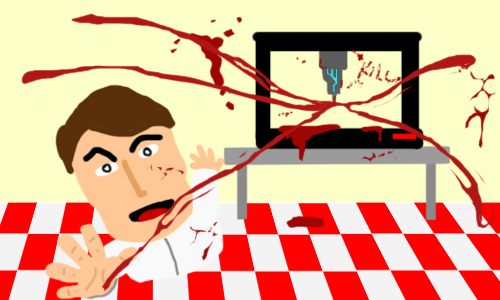
Of course, we don’t all have a meticulous scientist tinkering around with a 3D-printer, making sure that everything goes smoothly. More often than not, 3D-printing ends up in failure.
Repost from People We Remember, a site “about memorializing the poignant moments of those we’ve loved and lost along the fragile road that we call life.”
–
When I was 12 years old, I overheard my mother and sister talking about something. I couldn’t really figure exactly what they were saying but they were behaving all strange and secretive. It had to be important. It had to be significant. I had to know.
So I asked. “What are you talking about?”
To my surprise, they refused to tell me. “You don’t have to know. You don’t have to know just yet.” I persisted and persisted but they refused to tell me. I pled and whined but nothing, not a single word from either of them, and that made me incredibly suspicious.
What were they hiding from me? Why wouldn’t they tell me?
What news was so significant and yet, crucial that I didn’t know about it?
So in the middle of the night, laying on my bed and staring at my celling, I came to the conclusion that I was dying. I probably had some terminal illness, like cancer of the eyebrows or something and was going to die in a couple of months. They were just finding a way to tell me. They just wanted to shield me from the harsh truth. They just wanted me to die happy. They probably wanted me to take my PSLE (Primary School Leaving Examination) before I died.
So in the span of 2 days, I went through the 5 stages of grief.
Denial
This can’t be happening to me. I am only 12. They must have gotten it all wrong. They probably mixed me up with some other kid. It is probably Kenneth. Come on. That kid has so many moles on his face. One of them has got to be cancerous.
Anger
Why me? Why the hell me? I pay attention in class. I don’t talk and throw shit around! I don’t bully people! Why the fuck not Jun Jie? That boy calls me names all the time. I mean in what world does Perry even sound like Penis.
Bargaining
What if I study really hard? I promise I will score all As, even for Chinese. My Chinese will be better than that Indian kid who is constantly used as an example of how terrible my Chinese is.
Come on God, you can’t kill a kid with so much potential.
Depression
I might as well just stay home and watch cartoons. I might as well just not eat my fruits and vegetables. It’s not like constipation is going to affect me in a few days. Dead people don’t shit right?
Acceptance
Oh well, I mean life is full of sadness and disappointments. I might as well just go tell my mother that I know so she doesn’t have to worry about telling me anymore.
So I told my mother.
And she looked at me.
And laughed
And laughed
And laughed
Actually, she continued laughing all the way till Chinese New Year, where she told all my relatives that her son actually thought that he was going to die.
She hugged me from behind and said,
“What a silly boy.”
No one likes self-righteous people who can’t laugh at themselves.
No one likes self-righteous people who can’t laugh at their own son, especially when he is being an idiot.
~
My mother never believed in a reward system. Kids in school would get presents and money if they scored really well in their tests. I would not.
“You are supposed to do well. Why should I reward you for doing something that you are already supposed to do?”
That’s my mother’s reasoning. To a kid, that was plain bullshit. She was just being mean. She was being an asshole.
However, she did reward me for something. Whenever I did something good or righteous, she would reward me. I helped an old lady cross the road and I was allowed to choose whichever Lego set I wanted.
This led to me becoming quite an overly enthusiastic nice person. Old ladies who needed help crossing roads became like giant walking Lego sets to me.
After a while, the rewards stopped but the habit stayed with me. I guess my mother was on to something.
The world doesn’t need good intentions.
The world needs people who do nice things.
It doesn’t matter what reason or hidden agenda or Lego set you want, as long as you do nice things, that’s all that matters.
~
My mother was a liar.
Till the age of 15, I genuinely thought that my mother was an insanely picky eater.
She didn’t like:
Chicken Drumsticks
Fried Dumplings
Crab Meat
Lobsters
Oysters
Satay
Fish
Nuggets
Cheese
Basically, she didn’t like anything delicious. She would cook or buy them and later say that she didn’t like them or she wasn’t hungry.
So I ignorantly ate them all,
all of her love.
~
She constantly corrected my grammar.
Let’s face facts.
That was pretty annoying.
~
She died.
That was pretty annoying too.
~
I stared at the back of my dad’s head, trying to decipher what he felt about my little article about his dead wife; my dead mother.
After 5 minutes of silence and rapid scrolling, my dad turned and looked at me and smiled “You are the asshole.”





 The Hexacoto