Why are people so excited to be followed by a star on Twitter?
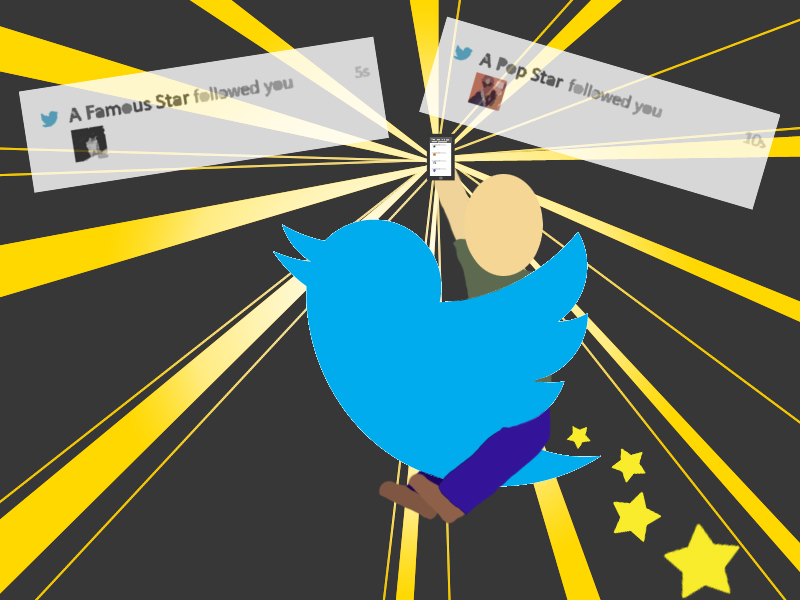
On a reddit community that I visited, someone posted a screenshot of a famous porn star ‘following’ him back on Twitter. Responses of congratulation and envy followed soon after.
On my Facebook news feed, every now and then, some of my friends who are very into social media would post about how Rihanna or some other famous star started ‘following’ their Twitter feed, and that they “omg can’t breathe” or “am dying right now” or some equivalent.
Why does it matter that someone whom you’ve never met or will meet in person ‘follows’ you back on Twitter? We are in a culture of chasing stars, and the peripheral semblance of contact with them leaves us in a frenzy.
When these stars follow one on Twitter or any other social media, do they even really care about updates on what you post? It seems unlikely that a popular singer would want to know what you had for breakfast, what song is your groove right now or look at the heavily-edited photo of an impending storm on Instagram.
Yet the lay followers of these stars wait fervently for the just-as-seemingly mundane updates about their lives — Getting their nails done at a salon, grooming their dog, recording at the studio.
Maybe people just want to know that their stars lead normal lives too, and that Twitter gives these stars a semblance of that. And when the stars have chosen to make one privy to be voyeurs of their everyday, it makes peoples’ hearts all a-flutter.
And not to mention, a lot of these Twitter accounts are probably run by the PR staff of the stars.
How do these stars choose who to follow back? Well certainly they usually only follow back users who already have a huge following; why else would they want to befriend a no-name? And then what? Popular Tweeters are prolific Tweeters, so the stars are probably going to have to ignore the deluge of constant updates from that one new Tweeter.
So effectively including people into their social circle so that they could ignore them.
“Get me out of this dream, tear it apart,” some teenager told me in my dream.
This is certainly one of the weirdest and most self-destructive dreams I’ve had, where a member of my dream tells me to rend my dream world apart so that I could wake up.
I had a cup of tea before bed, because I was thirsty. I could still fall asleep regardless; caffeine doesn’t keep me awake as it does other people, but its diuretic properties still apply. So basically when I drink coffee or tea, I don’t get particularly energised, just the urge to pee a lot.
Anyway, I dreamt that I was going deep-sea fishing with a group of people on a yacht. The yacht was going really fast, that it was hard to walk properly on the decks. Suddenly, within the dream, I felt like I needed to pee. So I went down into the cabins to use the toilets. As I proceeded to pee within the dream, I heard a voice say, “You know that peeing in the dream is not going to absolve your need to pee in real life, right?”
I finished peeing in the dream and opened the toilet door, and there was a teenager.
“I need to pee,” he said.
“You can have the toilet,” I told him.
“This one doesn’t work. You know it doesn’t mean anything.”
“So what do you want me to do then?”
“Get me out of this dream,” he said.
“What?”
“You heard what I said. Get me out of this dream, tear it apart,” the teenager said.
The yacht was still buzzing and vibrating as they do when they’re in operation, and the yacht was still rocking from speeding on water.
“Ok fine. I’ll get you out,” I said.
We backtracked through the cabin.
“You’re not doing anything!” the teenager whined.
“I am, hold on! You can’t just tear a dream apart so quickly like that. You have to do it in stages,” I said, whilst still walking. I pushed a double-door apart forcefully. It stayed opened, but the world was still intact; the yacht was still a yacht. While a part of me wanted to stay in the dream, I knew I was already dismantling the dream apart.
“Do it more forcefully. Rip it to shreds!” he said.
I said nothing, and continued striding out of the cabin. We walked up the stairs that would lead to the deck. There was one final double-door, made of glass and wood.
“Fine,” I said, and pushed the doors apart forcefully, and this time as the doors were pushed apart, there were claw marks and parts of the door were in shreds and hung as if it were made of cloth.
We were on the back of the deck and continued walking forwards. It took only a few steps before we walked over the edge of the yacht and started floating in air, but we kept walking.
“Tear it apart,” the teenager said again.
I tore the scene in front of me — the turtle-green sea stretching out in front of us and below us and cherry-blue skies above us — apart and stepped through it.
Then I woke up, felt a little sorry for all the inhabitants of the dream that I destroyed, and went to the toilet for real this time.
A gay man is marrying a woman he will never romantically love, or even have sex with.
A friend is moving in with a woman he could never see as a lover.
Initially there was shock and outrage all around from the ones around him,
“Marrying a woman?” they’d say, “Have you lost your mind?”
A (spouse) and two kids, a dog, a kitchenette. The wholesome American dream. He could pull a Madonna and adopt one of the kids from Africa, he tells me.
Apparently he has given up finding love. Apparently he has given up on disappointments and hope.
In the past, we’d call that resignation. Today, he calls it “achieving the life he’s never had.”
“Is this what the whole fight for marriage equality was for, so that you could marry a woman?” I wondered to myself, but never actually telling him that.
Then I realised that in my judgement of his decision, not only did I realise what my own views on marriage are, but that had I told him off, like some of his friends did, I would be imposing my views on his. And who was I to curtail what my friends choose to pursue? If my friends choose ‘happiness’ in whatever forms they see fit, I will be supportive, even if they aren’t the same as mine.
So I only wished him the best in his pursuit of happiness, no matter whether he eventually walks down the aisle with a bride in hand or not.
Someone once asked me, “Is doing circus tiring?” and I replied, “Yea, sometimes after circus, I’d get so sore and tired I wouldn’t be able to pick things up from the floor.”
“Maybe I’m getting old,” I joked.
To which he asked, “What, how old are you, 23, 24?”
“25,” I replied.
“Yea, that’s like probably like circus death, isn’t it?” he said.
Which I suppose is kind of true. In Cirque du Soleil, most circus performers get their best run in their early 20’s, and by the time they’re after 25, they start to consider retiring from circus. Or so I’ve heard.
Maybe my aches are telling I’m getting old, maybe I should cool down with the exertion, but then what fun would circus be if one is going to do a geriatric version of it?
Aches and sores are external, but what about the internal aspects of circus? Some of my circus peers and friends who are dancers feel that at a certain age, they should settle into a sort of gravitas and step away from the limelight; it is time to “act one’s age.”
But that indicates that there is a certain way to behave when one is of “that age.” Should a 50-year old stop dancing in public because it is unseemly? The moment you stop working on your craft is the moment you give in to these societal pressures about what one’s age should be.
I should be able to spin my fans in public even if I’m not considered to be “in my prime” any more. I’ll stop spinning the day my arms refuse to lift the fans any longer and my legs can work my unicycle no longer.
Many know that Chinese characters began by looking like the thing they describe, and even today, many of the characters still do. For example, the character for man (人) looks like a man with two legs. Other characters, by combing, form other characters, such as the character for forest (森) which is a composite of three wood (木) characters stacked together.
I can’t be the first one to do this, but since Chinese characters are pictograms, why can’t they just be used in a picture wholesale? Thus this illustration, Landscape of a rice harvest by the river and mountains.
On the top left is the rice field, where bushels of golden rice (米) wait to be harvested by the farmer wearing a hat (农) and wielding a sickle. The already-harvested rice simply turn back into fields (田). His field is irrigated by the river that flows (川), and there is a boat (船) that is floating on it. The river is lined by the mountains (山), covered by forests (森).
The path leading from the field leads to the farmer’s home, It is but a simple house, with a single door (門) flanked by two windows (窗) and topped by red tiles (瓦). The house is by a forest, build out of large trees. A tree is essentially wood (木) topped by leaves (叶), yet the difference between wood and leaves are the little circular mouths (口) that feed the tree without the roots.
Recently, it was reported in Singapore that a majority of students from Singapore National Technological University received job offers even before they graduated. How realistic is that, where companies are clambering to give graduates jobs even before they finish their undergraduate studies? Hardly at all.
But that is the sort of expectations I grew up with, and in a way what I expected myself to fulfil in some way. Growing up, I thought that if I put in the requisite effort in school, and graduated basically a brilliant person, the transition into adult working life would come naturally.
It’s been two months since I graduated and not only have no companies come to headhunt me, all of my applications have gone on unnoticed.
It has been a trying two months, and I fear that this is not the end of that.
I did my internships, my GPA is not abysmal. Having worked hard and knowing people in the industry have not yielded me any offers. My friends in business school have mostly gotten jobs and moved on with their lives, while I languish in unemployment and write this blog in a vain attempt to ‘increase my online profile,’ when in reality this is mostly a helpful distraction to keep me otherwise occupied. While I have cone to reject the idea of pre-graduation job-attainments as impractical, a part of me is still disappointed with myself for having not fulfilled that expectation that people back home would have of me. One of which certainly includes not being unemployed for two months and counting.
My cousin who went to Brown University here in the States went back to Singapore to work after college, and from what I’ve heard, she had to learn to readjust to the heavily-structured expectation-system that Singaporeans have and impose on one another. For example, people are expected to be at a certain level in their workplace and be earning a certain income at certain ages, or else they’d be considered to be ‘losing out’ or falling behind. A 30-year old in Singapore is most certainly expected to be earning more than $3,000 a month, and to have attained their first promotion already, regardless of the sector. By their mid-30’s, one who is not in some form of management must have some sort of ‘flaw’ in their character, or why else would they not have moved upwards already?
All these do not even permit for questions such as “What if I don’t want to move up?” or “What if I don’t want to be a field that has such structures?”
My cousin had a hard time assimilating back into such a demanding culture, after having spent a considerable amount of time in places that allowed her freedom to decide her academic path without expectations for what she should be achieving. I have no doubt that were I to go back, my self would grind itself raw at the prospect of having to live a life laid out for you by proxy of other peoples’ expectations.
And yet, as I eschew those expectations, in my current joblessness, they never fail to remind me how much of a mire I am in in comparison to those who are already drawing paychecks and have moved on.
Even if one doesn’t speak or understand Japanese, listening to this song Sweet Soul Revue by Pizzicato Five, it is very easily established that it would not be what one would expect from a Japanese pop singer. In fact, it sounds closer to something put out in France in the 60’s or so.
Introducing a genre of Japanese pop known as Shibuya-kei, a branch that sounds decidedly so much more Western than its regular mainstream counterparts.
It also makes sense that this genre began and is named after the Shibuya district in Tokyo, a hyper-trendy neighbourhood famous for its scramble crossing, fashion, and shopping.
Just as French yé-yé focused on the innocent beauty of young girls as its selling point in the 60’s, Shibuya-kei is all about the young, the trendy and the beautiful. However, Shibuya-kei transcends merely its music, and its sensibilities have pervaded into a lifestyle and culture.
Design
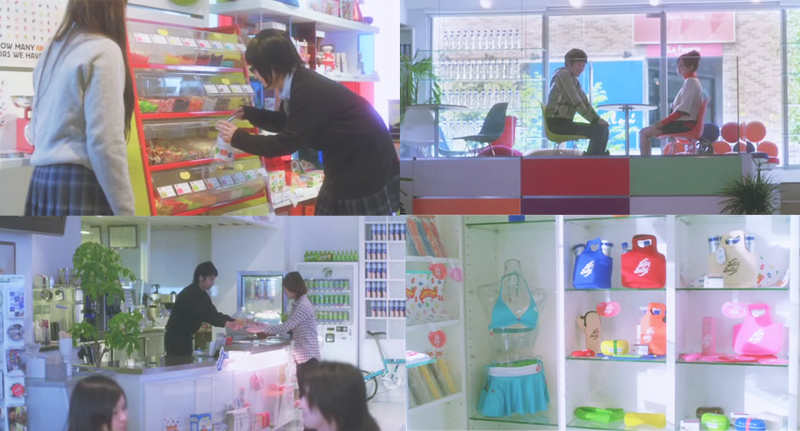
What is the Shibuya-kei aesthetic? Think clean and simple, minimal, with bold colours that are not afraid to be seen. The images above are screen shots from the movie, Detroit Metal City, which in itself pays homage to Shibuya-kei. Minimalism, portable, retro and futuristic elements all come together to create a sleek and airy feel. Designers such as marimekkowould not feel out of place in such an environment.
Looking at the cover sleeves of four of the biggest names in Shibuya-kei, Kahimi Karie, Cornelius, Flipper’s Guitar and Pizzicato Five, all reflect the sensibilities of Shibuya-kei design; sleek, clean and very pop-art-ish.
Sound
If mainstream J-pop is about producing for a Japanese market, Shibuya-kei seems to eschew itself from that by being everything not typically Japanese. It is synthpop, bossa nova, French yé-yé, jazz, and so many other element put into one. Given the vast possibilities within Shibuya-kei, each artist tends to build a certain style and sound to establish their identity within this genre. Yukari Fresh, shown above with her mini album, Cook Some Dishes, tends toward the light and whimsical synthpop elements, while Pizzicato Five leans towards French-esque bossa pop.
Other interesting stylistic elements include Minekawa Takako with her retro-futuristic electronic sounds (above, Fantastic Cat), or Kahimi Karie (above, Good Morning World) with her whisper-like vocals as she sings in French, English, Japanese and, sometimes, Portuguese (below, Take It Easy My Brother Charlie).
Themes
If there can be one thing that can be said to be consistent in Shibuya-kei, it’s the incessant exploration, creation and expression of new ideas and old dreams.
Yoshinori Sunahara imagines the opening of an underground airport in Tokyo in his album, Take Off and Landing (track above, Hawaii 2300) and many of his works feature his obsession with aeroplanes and flight. Others, like Cornelius, a key figure in the genre, explores the relationships between harmony and dissonance, or the relationships natural musical elements can have with synthetic ones, such as in his song Drop (below).
Shibuya-kei is dead?
Shibuya-kei started in the late 80’s and took off in the early 90’s. However, its popularity waned rapidly in the 2000’s as other music, such as Korean pop, started getting a hold of the local music scene.
Interestingly, where Shibuya-kei has floundered in Japan, it has moved overseas and found its niche in Europe and the United States. Artists like Kahimi Karie and Pizzicato Five have definitely found more acclaim overseas than they do in their home countries these days.
What’s more fascinating is that the genre that began and has hit more or less a dead end in Japan is starting to see foreign artists with sounds that increasingly sound like Shibuya-kei. While not a new artist, Momus (above, I want you but I don’t need you) has been likened to Shibuya-kei, as have been other artists.
Momus writes about his thoughts on the genre,
We western pop-makers are like the Brothers Grimm. We scribbled a few fairy stories a long time ago. And now they’re there, transmuted, misunderstood and built in stone at Tokyo Disneyland, and we’re wandering around the theme park in our frock coats murmuring aloud in wonder ‘Did we really start this?’
The esoteric nature of Shibuya-kei of the 90’s has left Japan and taken residence overseas, where it is safe and carried on by foreign artists. Those left behind have transformed Shibuya-kei into something slightly different. While Cornelius and Minekawa Takako are still producing works with strong vibes of the Shibuya-kei of the yesteryear, other forefronts of the genre such as Fantastic Plastic Machine and capsule have turned their sights towards house, dance and electronic music. For example, Fantastic Plastic Machine that went from something like this (L’Aventure Fantastique, 1997):
To something like this (Daremoshiranai feat. 環ROY, 2013)
I am not lamenting the direction Shibuya-kei is headed these days; in fact they are all interesting directions. The perceptibly ‘Western’ flavour of Shibuya-kei of the past that was ironically ‘so Japanese’ has morphed into an international movement that artists around the world can participate in. Shibuya-kei is no longer only for and by the Japanese, and the scramble crossing of the district has transcended geographical borders.
I’ve heard it said before that the purpose of philosophy is to solve the problems and conditions of the human mind. Philosophy seeks to find truth, understand how we get truth and the why we get it. But when those who do philosophy get so enmeshed with finding simply finding truth and lose sight of the how and why and what for, is there purpose to their philosophy?
Consider this: Compare classical philosophy, from the times of Socrates to Descartes, and today’s modern academic philosophy. There is a stark difference in what each is trying to seek and for what purpose.
Yesterday, I had a discussion with a friend who did philosophy in college. We were comparing three things: classical philosophy, academic philosophy and commercial philosophy, which comes in the form popular books for consumer’s purpose such as Zen and the Art of Motorcycle Maintenance.
I asked him, do you think classical philosophy is superior to commercial philosophy, comparing the two? He said that both have their merits, but consumer philosophy adds nothing new to the literature; they’re simply taking what exists and people already know and packaging it in a way that people can understand. By that virtue, they are making philosophy accessible to the public, which is a good thing. Classical philosophy on the other hand sought to explore what people didn’t know and tried to explain them, even if they sometimes got them wrong. Both are still philosophy, because both still reach truths and conclusion using similar methods.
Then I asked him, what about academic philosophy these days, where they are constantly adding new things to the literature all the time, but what they do seems to be so obscure and so dense that many of them appear to have no apparent value to the society? I asked him, what good is philosophy if it serves no purpose to the society? He agreed that philosophy should have a purpose, and we both felt that many-a-times academic philosophy seeks truth and adds it to the literature simply because they’re expected to and because they can, even if the ‘truth’ discovered has little relevance to our lives.
Commercial philosophy, even if by dint of its commercial nature, has to make its material easily digestible by the reader. At least it tries to serve purpose to society. In comparison, academic philosophy doesn’t even try to make itself readable to even other academics. Bad writing and unclear direction in so many modern philosophical texts begs the question: For whom are they writing philosophy?
Some modern philosophy reveal a lot about the condition of our modern selves, but for every one good one, there exists a lot of other PhD theses that write texts akin to intellectual masturbation.
No wonder we get the sentiment of “Philosophy is a useless field of study” from the masses these days, because philosophy as made itself irrelevant.
Philosophers were well-respected in the past; no one would have dismissed the great thinkers of Nietzsche or Wittgenstein, for they were concerned about the society they live in and sought to de-construct the way society was, and hoped to allow people to understand the way they operated. Be it philosophy of religion, language, politics or science, it added an extra edge to simply practising religion, speaking language, participating in politics or conducting science. It allowed for the development of ethics, philology, and other branches of thought that make these respective fields more humane.
While I’m pretty sure a text like “Hegellian Responses to the Post-Surrealist Inclinations of Photography over Traditional Painting” (I made this up) could make for an interesting read, I’m not sure it would ever be as helpful as a book that rehashes hackneyed interpretations of Zen Buddhism as applicable to motorcycle repair.
I play Russian Roulette with my mirror. I never know if I’m going to like what I see each time.
“Oh, you look alright today,” would be the sentiment on fair days. The day passes by uneventfully, mostly never remembered.
“Ugh, what is wrong with your face?” would be the judgement at other times. “Look at yourself, you look utterly and absolutely disgusting.” And then you would remember that your father used to say things like that to your acned 14-year-old self.
“Look at your face,” I’d remind myself, and remind myself I would for the rest of the day.
I grew up with a fear of having pictures of face taken, and also with the disappointment of my friends who wanted to take pictures with me.
“Let’s take a photo together,” they’d suggest, as we hang out for tea, at the park, or at a party.





 The Hexacoto